Gypsum Lath Board Guide: Veneer Plaster Base Specs & Top Brands
Master gypsum lath board specifications, top veneer plaster base brands, ASTM C588 standards, and installation costs for premium interior finishes.

Material Anatomy and the Science of Absorption
Gypsum lath board, widely referred to in the trades as veneer base or plaster base, represents the critical bridge between the speed of modern drywall installation and the monolithic durability of traditional plaster. Unlike standard gypsum board, which utilizes a sealed, moisture-resistant face paper designed to repel water and accept joint compound, gypsum lath board is engineered with a highly absorptive, multi-ply face paper. This specific permeance is not a manufacturing defect; it is a precise chemical necessity.
When wet veneer plaster is applied to the board, the absorptive face paper draws water out of the plaster matrix at a carefully calibrated rate. This controlled wicking action allows the calcium sulfate hemihydrate in the plaster to properly crystallize and cure. If a contractor attempts to apply veneer plaster over standard drywall, the sealed paper traps the moisture, resulting in a soft, chalky finish that will inevitably delaminate. Furthermore, the gypsum core of a lath board is manufactured to a higher density than standard wallboard. This increased core density provides superior nail and screw pull resistance, ensuring the board can support the added dead load of the plaster system without sagging over time.
Governing Standards: ASTM C588 and C1396
Manufacturing and performance criteria for gypsum lath board are strictly governed by the ASTM C588 / C588M Standard Specification for Gypsum Base for Veneer Plasters. This standard dictates the minimum requirements for water absorption rates, surface water retention, and core density. In recent years, ASTM has consolidated many gypsum board standards under the broader ASTM C1396 umbrella, but the specific performance metrics for veneer bases remain distinct. Compliance with these standards ensures that the board will not warp when exposed to the high moisture environment of wet plaster application and will maintain dimensional stability during the curing process.
Technical Specifications Matrix
Selecting the correct thickness and edge profile is dictated by the framing spacing and the desired fire-rating assembly. Below are the standard manufacturing specifications for premium veneer base products.
| Thickness | Weight (per sq. ft.) | Max Framing Spacing | Edge Profile | Fire Rating (Type X) |
|---|---|---|---|---|
| 1/2 in. (12.7 mm) | 1.6 - 1.8 lbs | 16 in. o.c. (wood/steel) | Square or Tapered | Standard (Non-Rated) |
| 5/8 in. (15.9 mm) | 2.2 - 2.4 lbs | 24 in. o.c. (wood/steel) | Square or Tapered | 1-Hour (Type X Core) |
| 3/4 in. (19.0 mm) | 2.6 - 2.8 lbs | 24 in. o.c. (heavy gauge) | Square | 1 to 2-Hour Assemblies |
Leading Veneer Base Product Lines
The North American market is dominated by a few key manufacturers, each offering specialized boards tailored to different plaster systems and environmental conditions.
USG Imperial Veneer Base
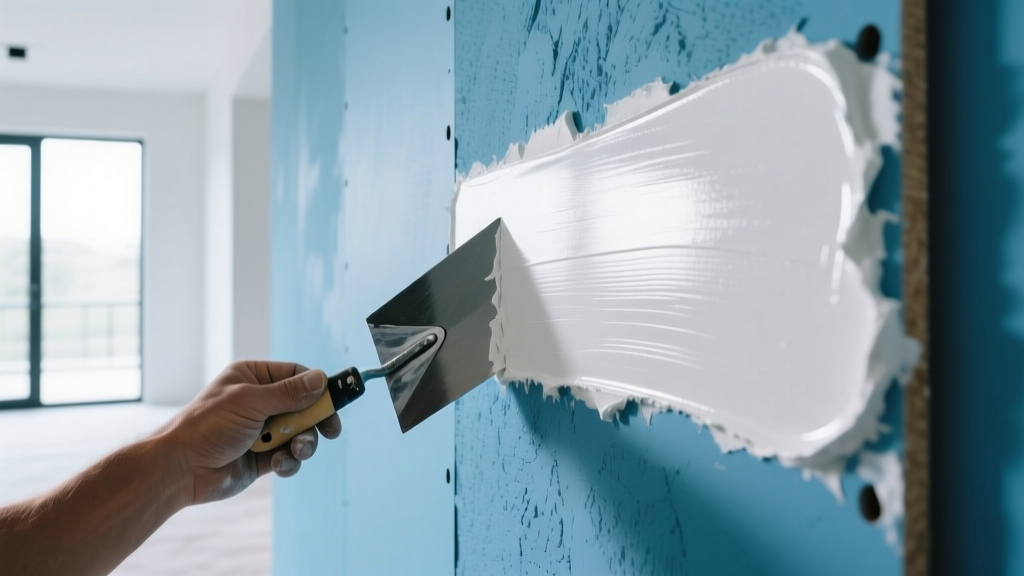
Recognizable by its distinct blue face paper, USG Imperial is the industry benchmark for single-coat veneer plaster systems. It is designed specifically to be paired with Imperial veneer plaster, providing optimal absorption for a one-day application and finish cycle. It is available in standard and Firecode (Type X) cores.
USG Diamond Veneer Base
Featuring a grey face paper, Diamond Veneer Base is engineered for two-coat plaster systems (typically a brown scratch coat followed by a white finish coat). The absorption rate of the Diamond board is calibrated to handle the prolonged moisture exposure of a two-coat system without breaking down the paper-to-core bond. It is highly recommended for high-abuse commercial environments like hospitals and schools.
National Gypsum Gold Bond Brand Kal-Kote
National Gypsum's Kal-Kote veneer base features a specialized blue face paper and is formulated to work seamlessly with their proprietary Kal-Kote plaster line. It offers excellent dimensional stability and is widely favored in commercial projects where National Gypsum's comprehensive system warranties are required.
Moisture and Mold Resistant (MR) Variants
For high-humidity environments such as commercial restrooms, locker rooms, and back-of-house kitchen areas, standard veneer base is insufficient. Manufacturers offer MR variants, such as USG Imperial MR (featuring a green face paper) and Gold Bond XP Veneer Base. These boards incorporate silicone-based water repellents in the core and fungicides in the paper facing. Critical Note: MR veneer boards must still be finished with appropriate moisture-tolerant veneer plasters; applying standard gypsum plaster in wet areas will negate the moisture resistance of the board itself.
Framing and Fastening Realities
The added weight of veneer plaster (approximately 0.5 to 1.0 lbs per square foot, depending on coat thickness) demands rigorous framing and fastening protocols. Wood framing must be a minimum of 2x4 nominal size, and steel framing should be at least 20-gauge for 16-inch o.c. spacing, stepping up to 16-gauge for 24-inch o.c. layouts.
Fastening must utilize specialized plaster-base screws, which feature a bugle head designed to seat flush without tearing the highly absorptive face paper. Tearing the paper compromises the localized absorption rate, leading to blistering in the plaster finish directly over the screw head. Screws should be spaced a maximum of 8 inches apart on ceiling edges and 12 inches in the field for walls. Nailing is generally discouraged in modern commercial applications due to the risk of nail pop as the timber framing dries and shrinks.
Plaster Chemistry and System Compatibility
A common and costly error in plastering is mismatching the veneer base with the wrong plaster chemistry. Veneer plasters are fundamentally different from traditional 3-coat gypsum plasters. They contain specialized retarders and polymers that allow them to be applied in thin layers (1/16 to 3/32 of an inch) while maintaining a workable open time.
- Single-Coat Systems: Require a highly absorptive board (like USG Imperial) to rapidly pull water from the plaster, accelerating the crystallization process so the wall can be troweled tight and finished in a single pass.
- Two-Coat Systems: Require a moderately absorptive board (like USG Diamond). The base coat needs to retain moisture longer to bond with the secondary finish coat. Using a single-coat board for a two-coat system will result in the base coat curing too rapidly, creating a cold joint and eventual delamination.
Project Cost and Labor Analysis
While gypsum lath board and veneer plaster represent a premium finish, they offer significant labor savings over traditional 3-coat plaster applied over metal or rock lath. Below is a comparative cost breakdown for a standard 10,000 sq. ft. commercial interior project.
| System Component | Gypsum Lath + Veneer Plaster | Traditional 3-Coat (Metal Lath) |
|---|---|---|
| Base Material (Board/Lath) | $0.45 - $0.65 / sq. ft. | $1.80 - $2.40 / sq. ft. |
| Plaster Material | $0.30 - $0.50 / sq. ft. | $1.10 - $1.50 / sq. ft. |
| Installation Labor | $2.50 - $3.50 / sq. ft. | $8.00 - $12.00 / sq. ft. |
| Total Installed Cost | $3.25 - $4.65 / sq. ft. | $10.90 - $15.90 / sq. ft. |
| Estimated Timeline | 3 - 5 Days | 14 - 21 Days (including curing) |
For a comprehensive overview of system assemblies and acoustic ratings, contractors should consult the USG Veneer Plaster Systems guide, which provides exact UL fire-rated designs and STC sound transmission data.
Troubleshooting Common Veneer Plaster Failures
Even with premium materials, improper site conditions or application errors can lead to system failure. Understanding the root causes of these defects is essential for quality control.
1. Plaster Delamination (Bond Failure)
Symptom: The plaster sounds hollow when tapped and separates from the gypsum lath board.
Cause: This is almost always caused by applying plaster over a dusty, dirty, or painted surface, or by using a board with the wrong absorption rate for the specific plaster. If the board is too dry or stored in a low-humidity environment prior to application, it may suck the water out of the plaster too aggressively, killing the chemical bond before crystallization occurs.
Fix: Always store veneer base indoors in climate-controlled conditions for 48 hours prior to hanging. If the environment is excessively dry, a light misting of the board with a spray pump (using a bonding agent like USG Plaster Bonder diluted in water) may be required to moderate the absorption rate.
2. Plastic Shrinkage Cracking
Symptom: A network of fine, shallow, map-like cracks appearing on the surface within hours of troweling.
Cause: Rapid surface drying due to high ambient temperatures, low humidity, or excessive air movement from HVAC systems or fans directed at the fresh plaster.
Fix: Maintain job site temperatures between 55°F and 70°F. Turn off forced-air HVAC systems and close windows during the application and initial curing phases to prevent uneven moisture extraction from the plaster surface.
3. Joint Telegraphing
Symptom: Visible ridges or lines appearing through the plaster finish at the board joints.
Cause: Improper joint treatment. Unlike standard drywall, veneer base joints must be taped with specialized fiberglass mesh plaster tape and fully embedded in a setting-type joint compound or the base coat plaster itself. Failing to properly bed the tape allows the joint to micro-flex, causing the rigid plaster above it to fracture.
Written by
Marcus ChenMarcus Chen is a licensed structural engineer (PE) and building materials analyst with over 12 years of experience across residential, commercial, and industrial construction. He holds a Master of Science in Civil Engineering from UC Berkeley and spent six years at Thornton Tomasetti before transitioning to independent consulting and technical writing. Marcus specializes in material selection for seismic-prone regions, concrete reinforcement strategies, and lifecycle cost analysis. His work has been cited by the American Concrete Institute (ACI) and the Structural Engineers Association of California (SEAOC). When he is not on a job site or at his desk, you will find him hiking the Sierra Nevada or restoring a 1920s craftsman bungalow in Oakland, CA.
More from Marcus Chen
View all
Construction Cost
How Much Did the Eiffel Tower Cost to Build?
How much did the Eiffel Tower cost to build in 1889? We adjust for inflation and compare its budget to modern skyscraper construction.
Aug 4, 2026

Fire Resistance
What Is a Fire Resistant Material? Testing & Certification Guide
Discover what is a fire resistant material through ASTM and UL testing. Learn how fire ratings, certifications, and assemblies work in construction.
Aug 4, 2026

Construction Cost
How Much Did the Burj Khalifa Cost to Build?
How much did the Burj Khalifa cost to build? We break down the $1.5B project and extract 5 money-saving strategies for your next build.
Jul 30, 2026