Plywood vs Gypsum Board: A Contractor's Selection Guide
Compare plywood vs gypsum board for interior walls and sheathing. Explore costs, fire ratings, structural limits, and installation differences.

Core Material Science and Structural Behavior
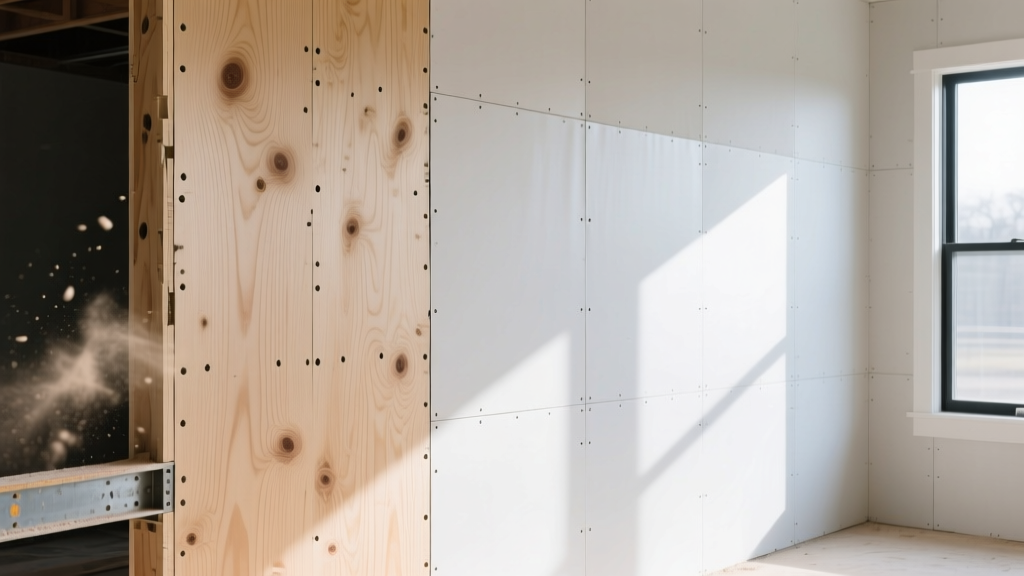
Selecting the correct wall cladding or sheathing material dictates the structural integrity, fire safety, and acoustic performance of a building envelope. When evaluating plywood vs gypsum board, contractors are essentially choosing between a structural, impact-resistant wood panel and a non-structural, fire-retardant mineral core panel. Understanding the material science behind both is critical for passing building inspections and ensuring long-term durability.
Gypsum board (commonly known as drywall) consists of a non-combustible calcium sulfate dihydrate core encased in heavy paper or fiberglass mats. Its primary function is to provide a smooth, paintable surface while acting as a passive fire barrier. Conversely, plywood is an engineered wood product made by gluing thin layers (veneers) of wood together with adjacent layers having their wood grain rotated up to 90 degrees to one another. This cross-graining grants plywood exceptional shear strength and fastener-holding capabilities, but it introduces combustible organic material into the wall assembly.
Fastener Holding Capacity
A major differentiator in the plywood vs gypsum board debate is load-bearing capability. Standard 1/2-inch gypsum board can safely support roughly 10 to 15 pounds per anchor using standard toggle bolts. In contrast, 1/2-inch CDX plywood can support upwards of 50 to 75 pounds per wood screw driven directly into the panel, making it the mandatory choice for walls slated to hold heavy cabinetry, commercial shelving, or wall-mounted medical equipment.
Fire Resistance and Building Code Mandates
Fire safety is where the divergence between these two materials becomes a strict code compliance issue. According to the International Building Code (IBC) Chapter 7, specific fire-resistance-rated assemblies are required for garage-to-living-space separations, multi-family dwelling unit partitions, and commercial elevator shafts.
The Calcination Advantage of Gypsum
Gypsum board achieves its fire rating through a process called calcination. The chemical composition of gypsum (CaSO4·2H2O) includes roughly 21% chemically combined water. When exposed to fire, the core temperature remains near 212°F (100°C) until all the water is driven off as steam. This endothermic reaction actively retards heat transfer to the structural framing behind the board. A standard 5/8-inch Type X gypsum board, reinforced with glass fibers to prevent core cracking during calcination, easily achieves a 1-hour fire rating on 2x4 wood stud assemblies. The Gypsum Association maintains extensive UL-listed assemblies detailing exactly how to achieve 1-hour, 2-hour, and 4-hour ratings using Type X and Type C boards.
Plywood and Fire Retardant Treatments (FRT)
Standard plywood is a combustible fuel source. In applications where wood sheathing is required for shear strength but a fire rating is mandated by code, contractors must specify Fire-Retardant-Treated (FRT) plywood. FRT plywood is impregnated with chemicals that reduce flame spread and smoke development. However, FRT plywood is significantly more expensive, and historical formulations have occasionally suffered from strength degradation when exposed to prolonged high heat and humidity in roof assemblies, though modern interior FRT formulations are highly stable.
Cost Analysis and Installation Labor (2026 Estimates)
Budget constraints frequently drive the selection process. The material and labor costs associated with plywood vs gypsum board vary drastically, not just in the purchase price of the sheets, but in the finishing requirements.
| Metric | 1/2" Standard Gypsum Board | 1/2" CDX Plywood | 5/8" Type X Gypsum |
|---|---|---|---|
| Material Cost (per 4x8 sheet) | $13.00 - $16.00 | $48.00 - $62.00 | $17.00 - $22.00 |
| Weight (per sq. ft.) | ~1.6 lbs | ~1.5 lbs | ~2.2 lbs |
| Finishing Labor Required | High (Taping, 3-coat mudding, sanding) | Low (Seam filling, optional clear coat or paint) | High (Taping, 3-coat mudding, sanding) |
| Acoustic STC Rating (Wood Stud) | 33 - 35 | 30 - 32 | 35 - 38 |
While plywood costs roughly three to four times more per sheet than standard gypsum, the labor savings in finishing can offset this in purely utilitarian spaces like workshops, agricultural buildings, or unfinished utility rooms where a Level 4 drywall finish is unnecessary. However, in finished residential or commercial spaces, the cost of mudding and taping gypsum is a mandatory baseline, making gypsum the undisputed economic choice for general interior partitions.
Scenario-Based Selection Framework
To eliminate guesswork, use the following decision matrix based on specific architectural and structural scenarios.
1. Garage-to-Living Space Separation
Winner: 5/8-inch Type X Gypsum Board.
Building codes universally mandate a minimum 1-hour fire-resistance rating for walls and ceilings separating an attached garage from the living quarters. Plywood cannot be used as the exposed interior layer in this assembly without highly specialized, expensive intumescent coatings or FRT treatments that still may not satisfy local fire marshals. Always default to 5/8-inch Type X gypsum on the garage side of the partition.
2. Heavy Cabinetry and Wall-Mounted Loads
Winner: Plywood (or Hybrid).
Kitchens, commercial breakrooms, and laboratories require robust backing for upper cabinets, heavy mirrors, and ADA-compliant grab bars. While you can install 2x4 blocking between studs to provide nailers for drywall, sheathing the entire wall in 1/2-inch or 3/4-inch plywood before applying the finish provides infinite flexibility for future layout changes. If a painted finish is required, the hybrid approach (plywood base layer + gypsum finish layer) is the industry standard.
3. High-Impact Commercial Corridors
Winner: Abuse-Resistant Gypsum or Plywood.
Hospitals, schools, and hotels experience heavy cart and foot traffic. Standard gypsum will dent and crack under impact. Contractors have two choices: use structural plywood with a heavy-duty wallcovering (like Type II vinyl), or specify specialized abuse-resistant and impact-resistant gypsum boards (such as USG Sheetrock Brand AbuseCode or Georgia-Pacific DensArmor Plus). Abuse-resistant gypsum features a denser core and heavier face paper, offering impact resistance that rivals wood panels while maintaining fire ratings and a seamless paintable finish.
4. High-Moisture and Basement Environments
Winner: Fiberglass-Mat Gypsum Board.
Standard plywood will delaminate and harbor mold if exposed to persistent moisture or hydrostatic pressure in basements. Standard paper-faced gypsum will also degrade. For damp environments, contractors should bypass both traditional materials and opt for fiberglass-mat gypsum panels (e.g., GP DensGlass or USG Fiberock). These panels utilize a silicone-treated, water-resistant gypsum core encased in fiberglass mats, offering zero organic food value for mold spores while maintaining dimensional stability.
Vapor Permeability Warning
When using plywood as interior sheathing or a structural layer behind drywall, be mindful of the wall assembly's drying potential. Plywood acts as a Class II vapor retarder. If you place plywood on the interior side of a wall in a cold climate, and an exterior impermeable insulation layer on the outside, you risk trapping moisture inside the stud cavity, leading to concealed rot. Always verify the dew point calculations and vapor permeability ratings with your building envelope consultant.
The Hybrid Approach: Maximizing Performance
In high-performance commercial and multi-family residential construction, the choice between plywood vs gypsum board is rarely binary. The most resilient wall assemblies utilize a double-layer hybrid system.
By applying a base layer of 1/2-inch CDX or structural plywood directly to the studs, the wall achieves exceptional shear values, impact resistance, and fastener-holding capacity. Following this, a finish layer of 5/8-inch Type X gypsum board is mechanically fastened or laminated over the plywood. This hybrid assembly satisfies the structural engineer's demand for shear rigidity, the architect's demand for a flawless Level 5 drywall finish, and the fire marshal's demand for a 1-hour or 2-hour fire-resistance rating. While material costs increase, the reduction in specialized blocking labor and the elimination of future wall-repair callbacks make this the premier choice for high-end builds.
Sourcing and Quality Standards
When procuring materials, ensure compliance with current ASTM standards. Gypsum board must meet ASTM C1396 (Standard Specification for Gypsum Board), while structural plywood must be graded and stamped according to APA - The Engineered Wood Association standards and comply with ASTM D5456 for structural composite wood products. Always verify the UL design number stamped on the edge of Type X gypsum board to ensure it matches the architectural fire-assembly schedule before signing off on municipal inspections.
Written by
Priya KapoorPriya Kapoor is a real estate market analyst and construction economics researcher with expertise in housing affordability, development feasibility, and infrastructure investment. She holds a Master of Regional Planning from Cornell University and previously worked as a senior analyst at CBRE's Investment Properties group, where she modeled returns for $4B in mixed-use development pipelines. Priya now runs an independent research practice advising developers, municipalities, and REITs on construction cost forecasting and market timing. She publishes the quarterly "BuildMat Market Pulse" report tracking material price indices across 12 commodity categories. Based in Austin, TX, Priya serves on the board of Habitat for Humanity Austin and is a marathon runner.
More from Priya Kapoor
View all
Construction Cost
Cost to Build a 1600 Sq Ft Home in 2026: Full Breakdown
Accurate 2026 cost to build a 1600 sq ft home—material, labor, and regional pricing breakdowns included. Plan your budget with real-time estimates.
Aug 11, 2026

Wood & Lumber
Name the Types of Wood for Pressure Treatment and Preservation
Learn how to name the types of wood best suited for pressure treatment. Compare species treatability, chemical retention levels, and 2026 preservation costs.
Aug 4, 2026

Stone & Masonry
Stone Veneer Suppliers Lindenhurst: 2026 Cost Analysis
Analyze 2026 stone veneer costs in Lindenhurst, NY. Compare local supplier pricing, delivery fees, and Suffolk County installation labor rates.
Aug 4, 2026