Purple Gypsum Board vs Green Board: Moisture-Resistant Guide
Compare purple gypsum board vs green drywall and cement backers. Expert guide on moisture resistance, 2026 costs, and exact installation use cases.

The Core Debate: Purple vs. Green vs. Cement
Selecting the correct wallboard for high-humidity environments requires understanding the material science of gypsum cores and face papers. While standard white board fails rapidly when exposed to ambient moisture, the market offers three primary upgrades: green board (moisture-resistant), purple gypsum board (moisture and mold-resistant), and cementitious backers. The most common error in residential and commercial construction is deploying purple gypsum board in direct-wet zones, or over-specifying cement board in damp-only zones, leading to unnecessary labor costs and potential failure modes.
Material Breakdown and Performance Matrix
To make an informed procurement decision, you must evaluate the core treatments, face materials, and standardized mold-resistance scores. The industry benchmark for mold resistance is ASTM D3273, where a score of 10 indicates no mold growth under laboratory conditions.
| Material Type | Face Material | Core Treatment | ASTM D3273 Mold Score | Best Application |
|---|---|---|---|---|
| Green Board (MR) | Green Treated Paper | Silicone/Wax Additives | 5 - 8 (Variable) | Bathroom walls (outside splash zones) |
| Purple Gypsum (XP) | Purple Treated Paper | Proprietary Antimicrobial Core | 10 (Maximum) | Basements, kitchens, bathroom ceilings/walls |
| Fiberglass-Faced | Woven Fiberglass Mat | Silicone/Water-Resistant Core | 10 (Maximum) | Tile backers in wet zones, exterior soffits |
| Cement Board | None (Cementitious) | Portland Cement & Mesh | N/A (Inorganic) | Shower pans, steam rooms, direct-wet tile bases |
Deep Dive: Purple Gypsum Board Specifications
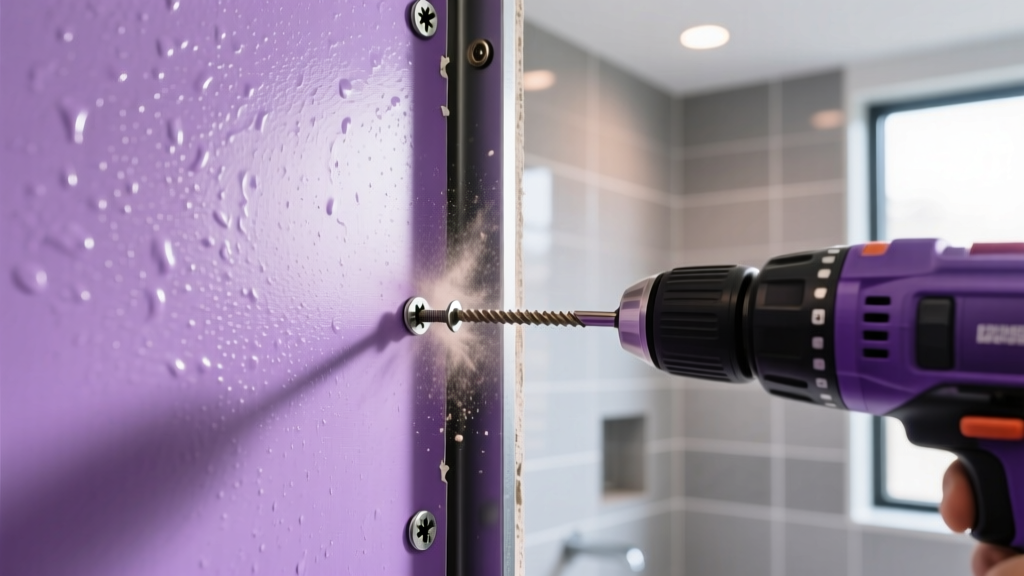
Purple gypsum board, most notably manufactured under National Gypsum's PURPLE brand (such as PURPLE XP Drywall), achieves its superior performance through a dual-action approach. The facing paper is heavily treated to repel liquid water, while the gypsum core itself is infused with antimicrobial agents that inhibit mold spore germination even if the paper facing is scored, punctured, or compromised during electrical cutouts.
Real-World Pricing and Installation Costs (2026)
Material costs have stabilized following the supply chain disruptions of the early 2020s, but premium mold-resistant boards still carry a distinct markup over standard drywall. Below is the current cost breakdown for a standard 4x8-foot, 1/2-inch thick sheet.
| Board Type | Material Cost (per 4x8 sheet) | Cost per Sq. Ft. (Installed) | Weight (per sheet) |
|---|---|---|---|
| Standard White Board | $13.00 - $15.00 | $1.80 - $2.20 | ~54 lbs |
| Green Board (MR) | $16.00 - $19.00 | $2.10 - $2.50 | ~56 lbs |
| Purple XP Board | $22.00 - $27.00 | $2.60 - $3.10 | ~58 lbs |
| Fiberglass-Faced (e.g., DensShield) | $24.00 - $29.00 | $2.80 - $3.40 | ~52 lbs |
Decision Framework: Which Board Belongs Where?
According to guidelines published by the Gypsum Association, matching the board to the specific hygroscopic load of the room is critical for long-term durability. Use this framework to specify materials for your next project:
- Shower and Tub Surrounds (Direct Wet): Use cement board (e.g., Durock, HardieBacker) or fiberglass-faced gypsum (e.g., DensShield). Apply a liquid waterproofing membrane (like RedGard) over the top. Never use purple board here.
- Bathroom Walls Outside Splash Zones: Purple XP is the optimal choice. It handles the high ambient humidity from hot showers without degrading, outperforming green board which can wick moisture through cut edges.
- Bathroom Ceilings: Purple XP (specifically 5/8-inch to prevent sagging). Steam rises and pools at the ceiling; standard paper will blister and peel paint over time.
- Kitchen Backsplashes: Purple XP. It provides a stable, mold-resistant base for tile mastic in an area prone to condensation and minor splashing.
- Basement Framing (Below Grade): Purple XP. Below-grade concrete walls transmit moisture vapor. Purple board resists the ambient dampness and prevents the organic paper facing from becoming a food source for basement mold.
Failure Modes and Edge Cases
Even when purple gypsum board is specified correctly, installation errors can compromise its moisture-management capabilities. Avoid these common field failures:
1. Fastener Rust Bleed-Through
Standard black phosphate drywall screws are highly susceptible to corrosion in high-humidity environments. As they rust, the iron oxide bleeds through the primer and paint, creating orange halos around every screw dimple. The Fix: Always use hot-dipped galvanized, ceramic-coated, or stainless-steel drywall screws (typically #6 or #8, 1-1/4" to 1-5/8" length) when hanging purple or green board in bathrooms and basements.
2. Organic Joint Compound in Wet Zones
Standard pre-mixed all-purpose joint compound contains organic binders (like starch) that serve as a primary food source for Aspergillus and Penicillium mold spores. If you use purple board but finish the seams with standard mud, the seams become the weakest link. The Fix: Use a setting-type joint compound (e.g., DuraBond 90 or Sheetrock Brand Easy Sand) for the taping and fill coats, as these are chemically inert and do not support mold growth.
3. The 'Moisture Sandwich' Vapor Barrier Error
Installing a 6-mil polyethylene vapor barrier directly behind purple gypsum board on an interior shower wall traps moisture inside the wall cavity. When water vapor penetrates the grout lines, it hits the vapor barrier, condenses, and soaks the back of the drywall. The Fix: Rely on a surface-applied liquid or sheet waterproofing membrane on the face of the tile backer board. Leave the cavity behind it breathable.
Expert Verdict and Sourcing Tips
Purple gypsum board represents the highest tier of paper-faced moisture management. While green board remains a budget-friendly option for low-risk damp areas, the marginal cost difference (roughly $6 to $8 more per sheet) makes purple board the definitive choice for any area experiencing daily humidity fluctuations. For direct-water applications, however, contractors must transition to fiberglass-mat or cementitious backers to comply with modern building codes and prevent catastrophic structural rot. When sourcing, verify that the product meets ASTM C1396 specifications for water-resistant gypsum backing board and explicitly check the mold-resistance warranty provided by the manufacturer.
Written by
Marcus ChenMarcus Chen is a licensed structural engineer (PE) and building materials analyst with over 12 years of experience across residential, commercial, and industrial construction. He holds a Master of Science in Civil Engineering from UC Berkeley and spent six years at Thornton Tomasetti before transitioning to independent consulting and technical writing. Marcus specializes in material selection for seismic-prone regions, concrete reinforcement strategies, and lifecycle cost analysis. His work has been cited by the American Concrete Institute (ACI) and the Structural Engineers Association of California (SEAOC). When he is not on a job site or at his desk, you will find him hiking the Sierra Nevada or restoring a 1920s craftsman bungalow in Oakland, CA.
More from Marcus Chen
View all
Construction Cost
How Much Did the Eiffel Tower Cost to Build?
How much did the Eiffel Tower cost to build in 1889? We adjust for inflation and compare its budget to modern skyscraper construction.
Aug 4, 2026

Fire Resistance
What Is a Fire Resistant Material? Testing & Certification Guide
Discover what is a fire resistant material through ASTM and UL testing. Learn how fire ratings, certifications, and assemblies work in construction.
Aug 4, 2026

Construction Cost
How Much Did the Burj Khalifa Cost to Build?
How much did the Burj Khalifa cost to build? We break down the $1.5B project and extract 5 money-saving strategies for your next build.
Jul 30, 2026