Galvanized Steel Framing Cost Analysis & Pricing Guide 2026
Detailed 2026 cost analysis of galvanized steel framing. Compare material, labor, and hidden costs against wood and black steel for commercial builds.

The True Cost of Galvanized Steel Framing in 2026
Galvanized steel framing—technically classified as cold-formed steel (CFS) with a zinc coating—has transitioned from a niche commercial product to a mainstream structural and non-structural necessity. Driven by stricter fire codes, termite resistance requirements, and the demand for dimensional stability, contractors are increasingly specifying galvanized studs and tracks over traditional lumber. However, evaluating the true cost requires looking beyond the per-linear-foot material price. A comprehensive financial analysis must account for zinc coating classes (G40, G60, G90), specialized fastener economics, thermal bridging mitigation, and end-of-life scrap recovery.
According to the Steel Framing Industry Association (SFIA), the market share of cold-formed steel in commercial interior partitions now exceeds 85%, with galvanized variants dominating due to their corrosion resistance during the construction phase and in high-humidity environments. This guide dissects the 2026 pricing landscape, providing exact material costs, labor differentials, and hidden expenses that general contractors and estimators must factor into their bids.
Material Pricing Breakdown by Gauge and Coating
The baseline cost of galvanized steel framing is dictated by two primary variables: the steel thickness (gauge) and the weight of the zinc coating. Under ASTM A653 standards, the coating designation refers to the total weight of zinc per square foot of sheet steel (both sides combined). A G60 coating (0.60 oz/sq ft) is the industry standard for interior, climate-controlled partitions. For exterior sheathing, high-moisture areas (like commercial bathrooms or pools), or coastal environments, a G90 coating (0.90 oz/sq ft) is mandatory to prevent white rust and subsequent red rust degradation.
Upgrading from G60 to G90 typically adds 8% to 12% to the raw material cost, while stepping up in gauge (e.g., from 20-gauge to 16-gauge) increases the steel volume and cost by 35% to 50%. Below is the current 2026 wholesale pricing matrix for standard 3-5/8" and 6" wide galvanized studs and tracks, assuming bulk commercial procurement (minimum 5,000 linear feet).
| Gauge (Thickness) | Standard Application | G60 Cost per LF (3-5/8") | G90 Cost per LF (3-5/8") | G60 Cost per LF (6") |
|---|---|---|---|---|
| 25 ga (0.0179") | Non-load-bearing partitions | $1.65 - $1.90 | $1.85 - $2.10 | $2.10 - $2.40 |
| 20 ga (0.0329") | Standard load-bearing / tall walls | $2.80 - $3.25 | $3.15 - $3.65 | $3.90 - $4.40 |
| 16 ga (0.0538") | Heavy structural / shear walls | $5.40 - $6.10 | $6.00 - $6.80 | $7.20 - $8.15 |
| 12 ga (0.0966") | Primary structural columns / trusses | $9.50 - $11.20 | $10.50 - $12.40 | $12.80 - $14.50 |
Note: Track pricing generally mirrors stud pricing per linear foot, though punch-out tracks or deflection tracks (which accommodate structural slab deflection) carry a 15% to 25% premium over standard solid tracks.
Labor, Fastener, and Tool Economics
While galvanized steel framing material costs 20% to 40% more than standard SPF (Spruce-Pine-Fir) dimensional lumber, the labor economics are more nuanced. Wood framing relies on pneumatic nail guns, allowing for rapid assembly. Steel framing requires either self-drilling screws or pneumatic metal pins, which alters the labor timeline and consumable budget.
Fastener Cost Multiplier
Connecting 20-gauge galvanized studs to tracks requires #8 x 1-5/8" wafer-head self-drilling screws. At current 2026 bulk rates, a 1,000-count box of high-quality, zinc-plated self-drillers costs between $42 and $58. A standard 10x10 foot partition wall requires approximately 120 to 150 screws just for the framing connections, adding roughly $6.50 to $8.50 in fastener costs per wall. In contrast, framing nails for wood cost a fraction of a cent per unit, making the fastener differential roughly $7.00 per 100 square feet of wall area.
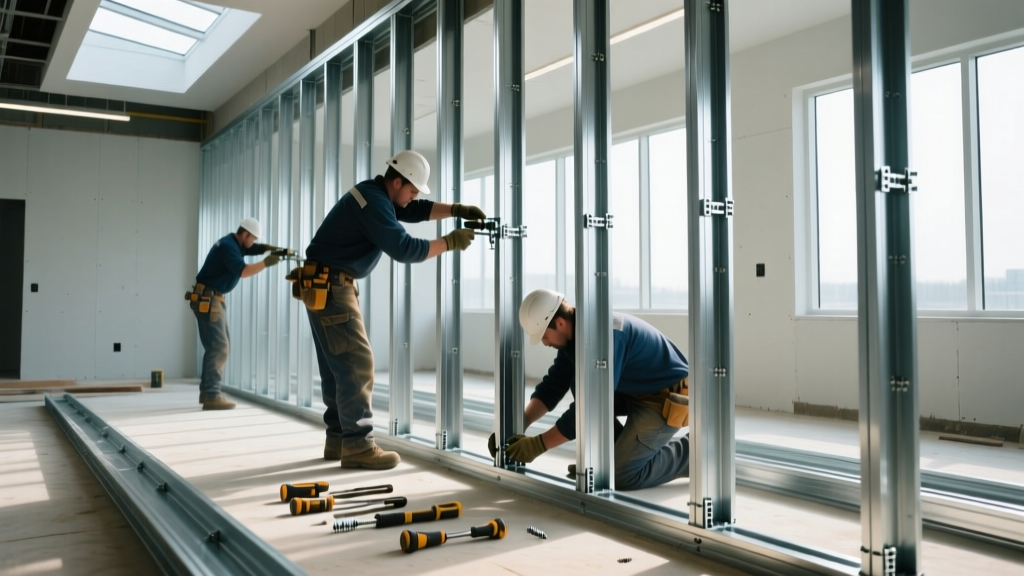
To mitigate the slower pace of screw-driving, many commercial contractors have adopted pneumatic metal pinning systems (such as Hilti or Simpson Strong-Tie powder-actuated or gas-driven pinners). These tools drive specialized knurled pins through 20-gauge and lighter steel in milliseconds. While the initial tool capital expenditure is high ($800 to $1,200 per tool), the labor time savings on large-scale commercial projects (hotels, hospitals, multi-family) typically yields a return on investment within the first 15,000 square feet of framing, reducing overall labor costs by 12% to 18% compared to screw-only assembly.
Hidden Costs: Thermal Bridging and Acoustic Upgrades
The most frequently underestimated costs in galvanized steel framing budgets are the secondary systems required to make the building envelope code-compliant and acoustically viable. Steel is a highly conductive material; a standard galvanized stud conducts heat approximately 400 times faster than a wood stud of the same depth.
Thermal Bridging Mitigation
To meet the continuous insulation (ci) requirements of modern energy codes (such as IECC 2024 and the anticipated 2027 updates), exterior galvanized steel stud walls cannot rely solely on cavity insulation. Estimators must include the cost of thermal breaks. This typically involves installing horizontal Z-girts or thermal spacer blocks (made of high-density polyurethane or fiberglass) between the steel stud flange and the exterior sheathing. Adding 1.5 inches of rigid polyisocyanurate continuous insulation over the steel framing adds roughly $2.10 to $2.80 per square foot to the wall assembly cost, a mandatory expense that does not exist in standard wood-frame residential construction.
Acoustic Decoupling
Galvanized steel framing transmits impact and airborne noise efficiently. For commercial partitions requiring high Sound Transmission Class (STC) ratings (STC 50+ for hotel corridors or medical offices), standard rigid track connections must be replaced. This requires specifying resilient channels, sound isolation clips, or specialized deflection tracks with neoprene acoustic pads. Upgrading a standard steel-framed wall to a fully decoupled acoustic assembly increases the framing and accessory labor cost by $1.80 to $3.20 per square foot.
Galvanized Steel vs. Black Steel vs. Pressure-Treated Wood
When evaluating alternatives for moisture-prone or high-load environments, estimators typically cross-shop galvanized CFS against uncoated (black) steel and pressure-treated (PT) lumber. The American Iron and Steel Institute (AISI) provides extensive design manuals that highlight the structural predictability of galvanized CFS, but the financial trade-offs remain project-specific.
| Material Metric | Galvanized Steel (G60/G90) | Black Steel (Uncoated CFS) | Pressure-Treated Wood (PT SPF) |
|---|---|---|---|
| Base Material Cost | High (Baseline) | 5% - 8% cheaper than Galv | 30% - 45% cheaper than Galv |
| Corrosion Resistance | Excellent (Zinc sacrificial layer) | Poor (Requires field painting) | Good (Chemical treatment) |
| Dimensional Stability | 100% (No warping, shrinking, or twisting) | 100% (No warping, shrinking, or twisting) | Poor (Prone to twisting, checking, and shrinkage as it dries) |
| Fire Insurance Premiums | Lowest (Non-combustible classification) | Lowest (Non-combustible classification) | Moderate to High (Combustible) |
| Scrap / Waste Recovery | High value (100% recyclable, scrap rebates apply) | High value (100% recyclable) | Negative value (Landfill tipping fees apply for PT wood) |
Black steel is rarely used in modern commercial framing because the cost savings on the front end are quickly erased by the labor required to touch up cut ends and weld points with cold galvanizing compound to prevent rust. Pressure-treated wood remains a competitor in ground-contact sill plates and exterior decks, but for vertical wall framing, the high moisture content of PT lumber (often 35% to 45% at delivery) leads to significant shrinkage and drywall screw pops, generating costly callback warranties that negate the initial material savings.
Project Decision Framework
To determine if galvanized steel framing is the most cost-effective choice for a specific project phase, apply the following decision matrix:
- Specify G60 Galvanized CFS when: The project involves interior commercial partitions, multi-family shaft walls, or load-bearing structures in climate-controlled environments where fire ratings (Type I or II construction) and acoustic predictability are paramount.
- Specify G90 Galvanized CFS when: The framing will be exposed to the elements during a prolonged construction phase, used in exterior sheathing assemblies, or installed in high-humidity zones such as commercial laundries, indoor aquatics centers, or agricultural facilities.
- Pivot to Pressure-Treated Wood when: The application involves direct ground contact (e.g., mudsills on concrete slabs without capillary breaks) or heavy timber deck substructures where the localized load-bearing capacity of thick dimensional lumber outperforms thin-gauge steel joists.
Ultimately, the ROI of galvanized steel framing is realized not on the day the materials are delivered, but over the lifecycle of the building. The elimination of framing callbacks due to lumber shrinkage, the reduction in builder's risk insurance premiums, and the zero-waste scrap recovery at the end of the project consistently position galvanized CFS as the lowest total-cost-of-ownership framing solution for commercial construction in 2026.
Written by
Marcus ChenMarcus Chen is a licensed structural engineer (PE) and building materials analyst with over 12 years of experience across residential, commercial, and industrial construction. He holds a Master of Science in Civil Engineering from UC Berkeley and spent six years at Thornton Tomasetti before transitioning to independent consulting and technical writing. Marcus specializes in material selection for seismic-prone regions, concrete reinforcement strategies, and lifecycle cost analysis. His work has been cited by the American Concrete Institute (ACI) and the Structural Engineers Association of California (SEAOC). When he is not on a job site or at his desk, you will find him hiking the Sierra Nevada or restoring a 1920s craftsman bungalow in Oakland, CA.
More from Marcus Chen
View all
Construction Cost
How Much Did the Eiffel Tower Cost to Build?
How much did the Eiffel Tower cost to build in 1889? We adjust for inflation and compare its budget to modern skyscraper construction.
Aug 4, 2026

Fire Resistance
What Is a Fire Resistant Material? Testing & Certification Guide
Discover what is a fire resistant material through ASTM and UL testing. Learn how fire ratings, certifications, and assemblies work in construction.
Aug 4, 2026

Construction Cost
How Much Did the Burj Khalifa Cost to Build?
How much did the Burj Khalifa cost to build? We break down the $1.5B project and extract 5 money-saving strategies for your next build.
Jul 30, 2026