How to Choose a Light Gauge Steel Framing Machine for Prefab Plants
A comprehensive selection framework for buying a light gauge steel framing machine, covering CNC software, tooling, production speed, and ROI metrics.

The Core Selection Matrix for Roll-Forming Equipment
Purchasing a light gauge steel framing machine is a significant capital expenditure, typically ranging from $120,000 to over $350,000 depending on automation levels and software integration. For prefab manufacturing plants and steel fabricators, the right equipment dictates production throughput, material waste, and structural compliance. Evaluating these machines requires moving beyond basic speed metrics to analyze the complete ecosystem: CAD/CAM software compatibility, mechanical precision, tooling flexibility, and total cost of ownership.
This framework isolates the critical decision variables for procurement teams evaluating CNC roll-forming systems in 2026, ensuring your investment aligns with both current project demands and future scalability.
Software and CAD/CAM Integration: The Digital Backbone
The mechanical roll-former is only as capable as the software driving it. Modern light gauge steel framing machines rely on seamless translation from 3D architectural models to CNC machine code. When selecting a machine, you must evaluate whether the hardware uses a proprietary software ecosystem or an open-architecture API.
Proprietary vs. Open-Architecture Systems
Manufacturers like FrameCAD utilize tightly integrated, proprietary design and manufacturing software. This ensures high reliability and streamlined support but can result in vendor lock-in. Conversely, open-architecture machines allow integration with industry-standard BIM and detailing software like Vertex BD or Revit, giving your engineering team the flexibility to design complex, non-standard geometries without being restricted by a single vendor's design limitations.
Mechanical Specifications and Tooling Architecture
The physical construction of the machine determines its lifespan, maintenance frequency, and the complexity of the profiles it can produce. Light gauge steel framing typically involves processing galvanized steel coils (G50 or G90 coating) with yield strengths of 345 MPa (50 ksi) to 550 MPa (80 ksi), in thicknesses ranging from 0.75mm (22 gauge) to 1.2mm (18 gauge).
Servo-Driven vs. Hydraulic Punching
For creating service holes, dimples, and swages, the punching mechanism is critical. Older or entry-level machines often use hydraulic presses, which are powerful but slower and require more maintenance due to fluid leaks and valve wear. High-end 2026 models utilize servo-driven electric punch presses. Servo systems offer superior accuracy (down to 0.1mm tolerance), faster cycle times, and significantly lower long-term maintenance costs.
Tooling Flexibility: Fixed vs. Cassette
Your choice of tooling dictates how quickly you can switch between different stud widths (e.g., transitioning from 89mm to 140mm web widths). Below is a comparison of the two primary tooling architectures:
| Feature | Fixed Tooling | Cassette Tooling |
|---|---|---|
| Changeover Time | 4 to 8 hours (manual adjustment) | 15 to 30 minutes (swap cassettes) |
| Initial Capital Cost | Lower (included in base price) | Higher ($15k-$25k per extra cassette) |
| Profile Versatility | Limited to standard C and U sections | Can accommodate custom/specialty profiles |
| Best Use Case | High-volume, single-profile production runs | Custom residential prefab and mixed-use projects |
Production Speed, Decoilers, and Material Handling
Machine speed is measured in linear meters per minute (m/min). While marketing materials often boast speeds of 60 m/min, real-world production speeds—including the time required for punching, dimpling, and cutting to length—typically average between 25 and 40 m/min for complex wall panels.
Decoiler Capacity and Tension Control
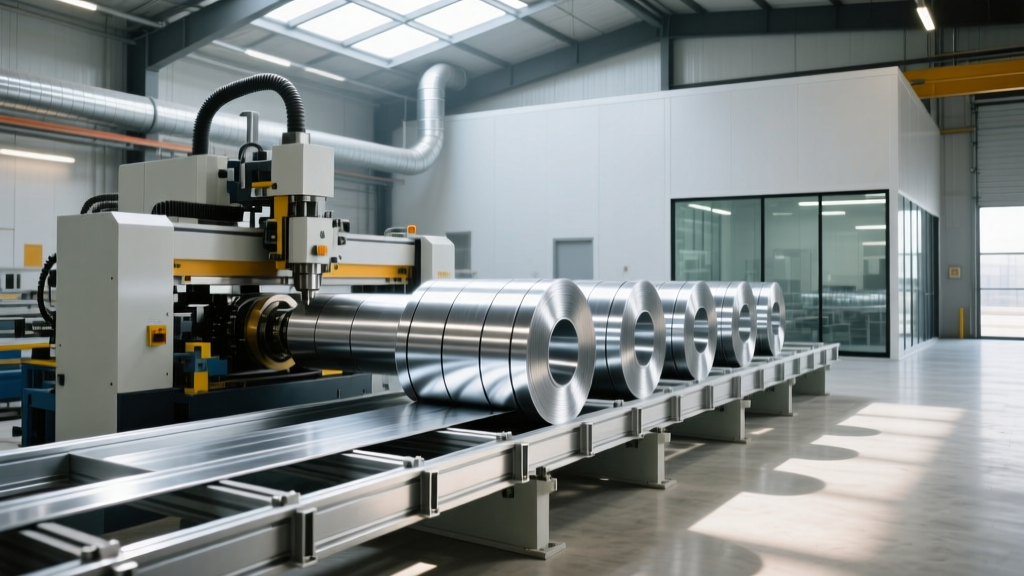
The decoiler feeds the raw steel coil into the roll-forming stations. A standard light gauge steel framing machine requires a motorized decoiler with a minimum capacity of 3 metric tons. For high-output plants, upgrading to a 5-ton or 7-ton decoiler reduces the frequency of coil changeovers. Furthermore, ensure the decoiler features an automatic loop-control system. Without proper tension control, the steel coil can slacken or over-tighten, leading to misaligned punches and material deformation before it even enters the forming stations.
2026 Capital Expenditure and ROI Framework
Calculating the return on investment requires looking past the sticker price of the roll-former. Procurement teams must model the Total Cost of Ownership (TCO) over a 5-year horizon.
Equipment Pricing Tiers
- Entry-Level / Portable Systems ($80,000 - $130,000): Typically single-profile machines with hydraulic punching and basic proprietary software. Ideal for small contractors doing on-site framing or low-volume production.
- Mid-Tier Plant Systems ($150,000 - $250,000): Feature servo-driven punching, automatic cassette tooling for multiple web widths, and integration with mid-level CAD software. The standard for regional prefab manufacturers.
- Enterprise / Automated Lines ($300,000 - $500,000+): Fully integrated lines that include automated stacking, bundling, and direct API integration with enterprise ERP systems and advanced BIM software like Vertex BD.
Hidden Costs to Budget For:
- Installation and Calibration: $5,000 to $12,000 for OEM technicians to travel to your facility, level the machine, and calibrate the CNC encoders.
- Tooling Spares: Punch and die sets wear out after approximately 500,000 to 1,000,000 cycles depending on steel hardness. Budget $3,000 annually for replacement tooling inserts.
- Electrical Upgrades: Many industrial roll-formers require 480V, 3-phase power. Upgrading a standard commercial shop's electrical panel can add $10,000 to $20,000 to the project.
Final Procurement Checklist
Before issuing a purchase order, verify the following technical and commercial parameters with the equipment manufacturer:
- Material Compliance: Confirm the machine's roll-forming stations are hardened to handle 550 MPa (80 ksi) high-tensile steel without excessive roller wear.
- Software API Access: Request documentation proving the machine's CNC controller accepts standard G-code or DXF inputs if you plan to use third-party detailing software.
- Cutting Mechanism: Ensure the cut-off system uses a flying shear or a high-speed hydraulic guillotine that does not deform the end of the stud, which would compromise structural connections on the job site.
- Local Support SLA: Demand a Service Level Agreement guaranteeing remote diagnostic support within 4 hours and on-site technician dispatch within 48 hours to prevent catastrophic production downtime.
- Test Run with Your Material: Require a Factory Acceptance Test (FAT) using the exact brand, gauge, and coating of steel coil you intend to run in your plant, ensuring the machine handles your specific material tolerances.
Selecting the correct light gauge steel framing machine requires balancing immediate production needs with long-term software and mechanical flexibility. By rigorously evaluating the CAD/CAM ecosystem, tooling architecture, and true TCO, manufacturing plants can secure equipment that delivers consistent, high-tolerance structural components while maintaining a competitive cost-per-square-foot.
Written by
Sarah WhitfieldSarah Whitfield is a chartered quantity surveyor (MRICS) and construction cost analyst with 15 years of experience in material pricing, procurement strategy, and project budgeting. She earned her degree in Construction Management from the University of Reading (UK) and has worked on projects ranging from $2M custom homes to $180M mixed-use developments across North America and Europe. Sarah currently leads cost estimating for BuildMat Insight, maintaining a proprietary database of 4,000+ material price points updated quarterly. She is a frequent contributor to RSMeans cost data panels and has presented at the International Cost Engineering Council (ICEC) congress. Based in Denver, CO, Sarah is an avid trail runner and volunteer mentor for Women in Construction.
More from Sarah Whitfield
View all
Wood & Lumber
What Are the Different Types of Wood? A Builder's Guide
Compare structural softwoods, finish hardwoods, and engineered lumber. Analyze Janka ratings, MOE values, and 2026 pricing for construction.
Aug 4, 2026

Walls & Panels
Steel Framing vs Wood Framing: Corrosion and Moisture Defense
Compare steel framing vs wood framing for moisture resistance. Learn about galvanized coatings, condensation risks, and corrosion protection strategies.
Jul 21, 2026

Stone & Masonry
How to Cut Stone Veneer: Wet Saw vs Grinder Comparison
Compare the best tools for cutting stone veneer. We review wet saws, angle grinders, and chop saws to help you achieve clean, chip-free cuts.
Jul 21, 2026