2026 Steel Deck Framing Kit Cost Breakdown & ROI Analysis
Detailed 2026 cost analysis of steel deck framing kits. Compare material, labor, and lifetime ROI against pressure-treated wood framing.

The Economics of Pre-Engineered Steel Deck Framing Kits
The transition from pressure-treated (PT) lumber to structural steel in residential outdoor living spaces has accelerated, driven by the demand for low-maintenance composite decking and the inherent vulnerabilities of wood. However, evaluating a steel deck framing kit requires looking beyond the initial material invoice. Unlike stick-built steel framing—where contractors purchase 20-foot stock lengths, cut on-site, and source hardware separately—pre-engineered kits arrive with pre-cut joists, pre-punched utility holes, and exact hardware counts. This shifts the cost burden from on-site labor and waste management to upfront manufacturing and logistics.
In 2026, the premium for a steel deck framing kit over standard #2 Southern Yellow Pine lumber ranges from 65% to 110% on a pure material basis. Yet, when factoring in the elimination of joist tape, reduced waste factors, and accelerated installation timelines, the true cost gap narrows significantly. According to industry data from the North American Deck and Railing Association (NADRA), the integration of steel substructures has become the standard specification for high-end composite and PVC deck installations, primarily due to the matching 25-year lifecycle warranties.
2026 Cost Matrix: Steel Kits vs. Pressure-Treated Lumber
The following matrix breaks down the estimated costs per square foot for a standard 400-square-foot elevated deck (8-foot joist spans, 16-inch on-center spacing) in a moderate-cost labor market. Pricing reflects Q1 2026 national averages.
| Cost Category | PT Lumber (Stick-Built) | Steel Deck Framing Kit | Variance |
|---|---|---|---|
| Framing Materials (Joists, Beams, Posts) | $6.50 - $8.00 / sq. ft. | $13.00 - $16.50 / sq. ft. | +100% |
| Hardware & Connectors | $1.20 / sq. ft. | $2.50 / sq. ft. (Included in kit) | +108% |
| Joist Tape / Moisture Barrier | $0.85 / sq. ft. | $0.00 (Not required) | -100% |
| Material Waste Factor (12% Wood vs 2% Kit) | $1.05 / sq. ft. | $0.30 / sq. ft. | -71% |
| Labor (Framing & Fastening) | $8.00 - $10.00 / sq. ft. | $9.50 - $11.50 / sq. ft. | +18% |
| Total Framing Cost (Material + Labor) | $17.60 - $21.10 / sq. ft. | $25.30 - $30.80 / sq. ft. | +43% Premium |
Component-Level Pricing: What You Are Actually Buying
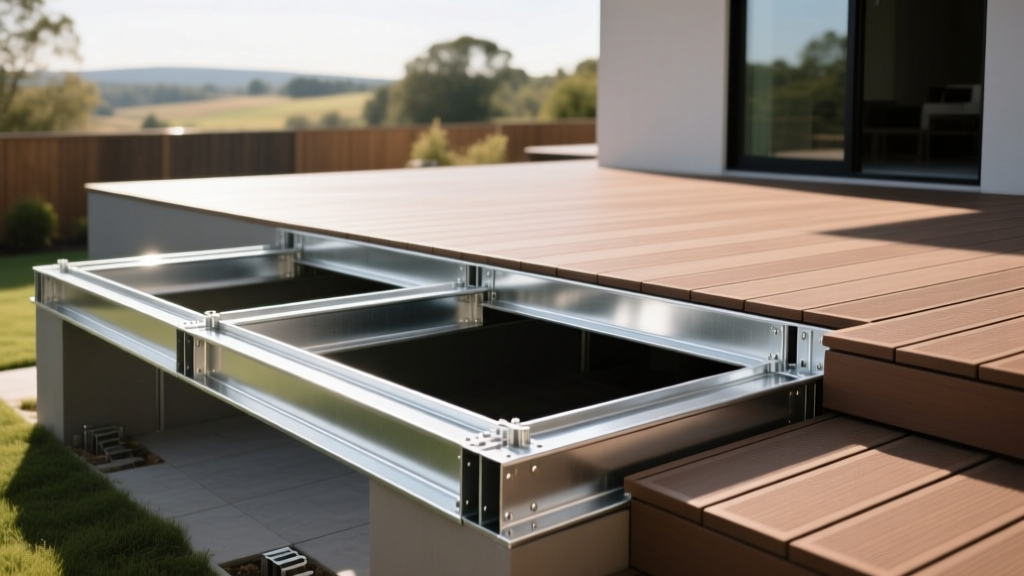
Understanding the line-item costs within a steel deck framing kit allows contractors and homeowners to identify where the premium is allocated. Leading manufacturers like Fortress Building Products engineer these kits using 16-gauge and 14-gauge galvanized steel, which dictates the load-bearing capacity and price point.
Joists and Tracks
Steel joists in a kit are typically roll-formed to mimic nominal lumber dimensions (e.g., 2x6, 2x8, 2x10). A 12-foot 16-gauge steel joist in a kit environment costs approximately $28 to $34 per piece. By contrast, a 12-foot PT 2x8 costs around $11 to $14. The steel joist includes factory-punched weep holes to prevent water pooling and pre-punched 1.5-inch knockouts for running low-voltage lighting or gas lines, eliminating the need for on-site drilling and preserving the galvanized coating.
Hardware and Connectors
A critical advantage of the kit model is the inclusion of proprietary, code-compliant connectors. Standard PT framing requires sourcing Simpson Strong-Tie or equivalent galvanized hangers, structural screws, and nails. A steel kit utilizes specialized self-drilling Tek screws (typically #10 x 1-1/2" hex washer head) and integrated track systems. The hardware alone in a steel kit adds roughly $2.50 per square foot, but it eliminates the guesswork of matching hanger sizes to warped lumber.
The "Hidden" Variables: Labor, Waste, and Tooling
Cost analyses often fail to account for the operational realities of the job site. While steel is more expensive to purchase, the installation dynamics alter the final ledger.
Tooling and Consumables
Framing with a steel kit requires specific tooling. Crews must transition from pneumatic nail guns to high-torque cordless impact drivers and metal-cutting chop saws equipped with ferrous-metal blades. While the initial tool investment is higher, the consumable cost drops. You are not buying thousands of framing nails; you are buying self-drilling screws, which are often included in the kit's hardware pack. Furthermore, the Steel Deck Institute (SDI) notes that steel's dimensional stability eliminates the time spent culling, crowning, and straightening warped lumber—a process that consumes up to 15% of a wood-framing crew's time.
The Waste Factor
Pressure-treated lumber carries an industry-standard waste factor of 10% to 15% due to end-trimming, defects, and cutting errors. Steel deck framing kits are engineered via CAD software based on your exact deck dimensions. The waste factor drops to under 2%. You are not paying for the 15% of wood that ends up in the dumpster, nor are you paying the rising municipal fees for disposing of chemically treated CCA or ACQ lumber.
Lifecycle Cost Analysis: The 25-Year Horizon
The most compelling financial argument for a steel deck framing kit emerges when calculating the Total Cost of Ownership (TCO) over a 25-year period. Composite and PVC decking manufacturers mandate specific substructure requirements to honor their 25-to-50-year fade and stain warranties. Wood framing typically begins to degrade, twist, or rot after 12 to 15 years, especially in high-moisture environments, leading to premature deck failure or costly structural reinforcements.
"When a homeowner invests $45,000 in premium PVC decking, pairing it with a wood substructure that has a 15-year functional lifespan creates a severe mismatch in asset depreciation. Steel framing aligns the substructure lifecycle with the surface material, effectively eliminating the need for a tear-off and rebuild in year 16." — Structural Engineering Assessment, Outdoor Living Trends 2026.
Over 25 years, a wood frame will require periodic inspections, hardware tightening as wood shrinks, and potential joist sistering. Steel framing requires zero maintenance. When amortized over the lifespan of the deck, the 43% initial premium of the steel kit translates to an annualized cost difference of less than $120 for a 400-square-foot structure.
Procurement Framework: When to Specify a Steel Kit
Steel deck framing kits are not a universal replacement for wood. Use the following decision matrix to determine if the ROI justifies the upfront capital for your specific project:
- Specify a Steel Kit When: The project utilizes premium composite/PVC decking; the design features complex multi-level transitions, curved fascias, or long cantilevers; the environment is coastal (salt-air exposure) or high-moisture; and local building codes require non-combustible substructures in Wildland-Urban Interface (WUI) fire zones.
- Stick with PT Lumber When: The project is a ground-level, floating deck; the budget is strictly constrained by immediate cash flow rather than long-term value; the deck will be surfaced with low-cost, temporary, or natural wood decking that will need replacement in 10 years anyway; or the terrain is so severely sloped that custom-engineered steel kits become logistically prohibitive compared to site-adapted timber.
By evaluating the structural demands, surface material compatibility, and long-term maintenance tolerance, builders and homeowners can accurately determine if a steel deck framing kit is a justified capital expenditure or an unnecessary premium for their specific 2026 construction pipeline.
Written by
James ThorntonJames Thornton is a construction industry veteran with 25 years of hands-on experience in wood framing, lumber grading, and residential building codes. He started as a framing carpenter in rural Oregon, earned his ICC Residential Building Inspector certification, and eventually became a senior plan reviewer for the City of Portland Bureau of Development Services. James holds a B.S. in Wood Science & Technology from Oregon State University and is a certified lumber grader through the West Coast Lumber Inspection Bureau (WCLIB). He has inspected over 3,000 residential construction sites and authored the city's internal guide on advanced framing techniques (2x6 at 24" O.C.). James lives in Bend, OR, where he builds custom timber-frame cabins and competes in lumberjack sports.
More from James Thornton
View all
Insulation
Best Home Insulation Materials: Complete 2026 Guide
Compare top home insulation materials for 2026. Find R-values, installed costs per square foot, and best uses for fiberglass, spray foam, and mineral wool.
Aug 4, 2026

Sustainable Building
Certify Your Green Building Material for LEED and WELL
Step-by-step guide to certifying a green building material for LEED v5 and WELL v2. Master EPDs, HPDs, and VOC limits for 2026 project specifications.
Aug 4, 2026

Stone & Masonry
Veneer Stacked Stone Panels: Interior Design & Style Showcase
Discover how veneer stacked stone panels transform interiors. Explore modern design profiles, material pairings, and technical installation specs.
Aug 4, 2026