Environmentally Friendly Insulation Materials and Steel Corrosion
Discover how environmentally friendly insulation materials affect steel framing. Learn moisture management and corrosion protection strategies for green builds.

The Hidden Corrosion Risk in Green Building
The push for net-zero and low-carbon construction has accelerated the adoption of environmentally friendly insulation materials. Builders are increasingly specifying cellulose, sheep’s wool, hempcrete, and cork to reduce embodied carbon and improve thermal performance. However, when these bio-based and recycled materials are paired with cold-formed steel (CFS) framing or structural steel, a hidden durability threat emerges: accelerated corrosion under insulation (CUI).
Unlike closed-cell spray foam or extruded polystyrene, many eco-friendly insulations are inherently hygroscopic or contain chemical fire retardants that alter the pH of trapped moisture. When steel framing acts as a thermal bridge, interstitial condensation forms on the metal surface. If the surrounding insulation wicks and holds this moisture against the steel, the protective zinc galvanization can degrade rapidly, leading to structural compromise long before the building reaches its intended lifespan.
Many budget-tier cellulose insulations rely on ammonium sulfate as a primary fire retardant. When exposed to moisture, ammonium sulfate hydrolyzes to form sulfuric acid, dropping the local pH to highly corrosive levels. This electrolytic reaction will eat through standard G60 galvanized steel studs in a matter of months. Always specify cellulose treated exclusively with borates (boric acid and sodium borate), which maintain a near-neutral pH and actually inhibit certain types of metal oxidation.
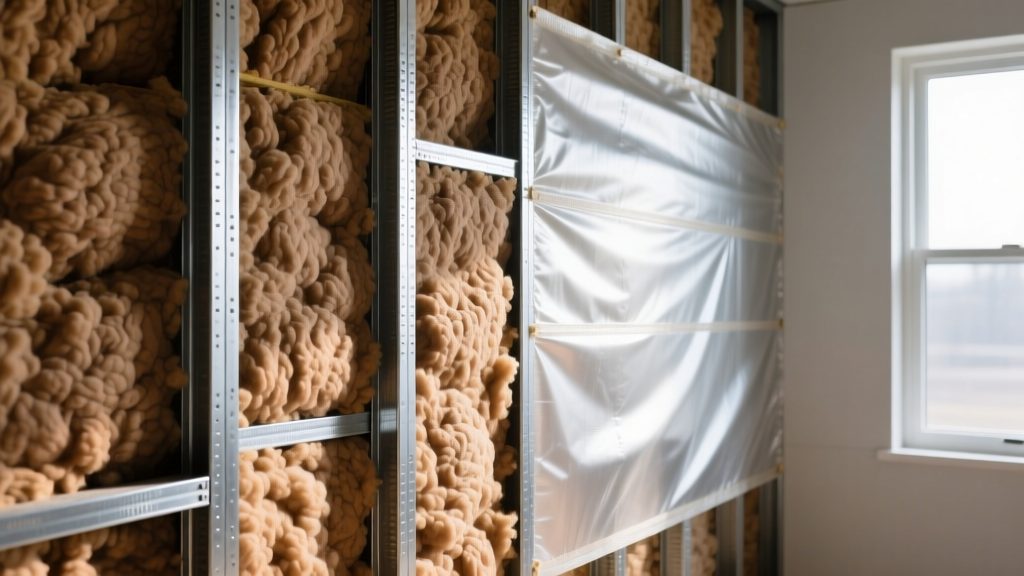
Hygroscopic Insulators: Moisture Traps Against Steel
To understand the corrosion mechanism, you must understand the moisture dynamics of bio-based materials. According to the U.S. Department of Energy, natural fibers possess a high moisture buffering capacity. Sheep’s wool, for instance, can absorb up to 30% of its own weight in water vapor without feeling damp to the touch. While this regulates indoor humidity, it means the insulation acts as a sponge against the steel stud.
When warm, moisture-laden interior air migrates through the wall assembly during winter, it hits the dew point at the interior face of the steel stud. The steel acts as a condensing surface. A hydrophobic insulation like fiberglass or mineral wool allows this water to drip down to the sill plate or evaporate back into the room. A hygroscopic eco-insulation, however, absorbs the condensate and holds it tightly against the steel flange, creating a permanent micro-climate of 100% relative humidity right at the metal surface.
Material-by-Material Corrosion Profile
Not all environmentally friendly insulation materials pose the same threat to steel. The table below breaks down the specific corrosion vectors for the most common green insulators used in steel-framed assemblies.
| Material | Hygroscopicity | Chemical Corrosion Risk | Required Steel Protection |
|---|---|---|---|
| Cellulose (Dense-Pack) | High | Severe if ammonium sulfate is used; Low if pure borate. | G90 Galvanization + Smart Vapor Retarder |
| Sheep’s Wool | Very High | Low (natural lanolin repels water, but holds vapor). | G90 Galvanization + Interior Air Barrier |
| Hempcrete (Cast-in-place) | Moderate | High during curing (highly alkaline lime binder, pH 10+). | Hot-Dip Galvanized + Epoxy Topcoat |
| Cork Board (Expanded) | Very Low | None (suberin makes it naturally hydrophobic). | Standard G60 Galvanization |
| Recycled Denim | High | Low (borate treated, but high moisture retention). | G90 Galvanization + Exterior Continuous Insulation |
Engineering Steel Protection for Eco-Insulation
When designing a steel-framed assembly with bio-based insulation, standard commercial detailing is insufficient. You must upgrade both the metallurgical protection of the steel and the hygrothermal control layers of the wall.
Upgrading Galvanization and Primers
For cold-formed steel (CFS) studs, standard commercial framing often utilizes G60 zinc coating (0.60 ounces of zinc per square foot). When pairing CFS with hygroscopic environmentally friendly insulation materials, you must specify G90 galvanization (ASTM A653) as the absolute minimum. The extra 50% zinc mass provides a thicker sacrificial anode layer that can withstand prolonged exposure to slightly acidic condensate.
For structural steel beams and columns insulated with hempcrete or dense-pack cellulose, hot-dip galvanizing per ASTM A123 is mandatory. If field welding requires grinding away the zinc, the exposed steel must be immediately treated with a cold-galvanizing compound (zinc dust primer) followed by an epoxy mastic topcoat to prevent the surrounding bio-insulation from wicking moisture into the bare metal.
Smart Membranes vs. Polyethylene Barriers
A common mistake in green building is using a Class I vapor retarder (6-mil polyethylene) on the interior warm-in-winter side of the wall. While this stops interior moisture from reaching the steel, it also traps any construction moisture or bulk water leaks inside the wall cavity, turning the eco-insulation into a permanent wet sponge against the steel.
Instead, specify a variable-permeance smart membrane, such as Pro Clima Intello or Siga Majrex. As Building Science Corporation outlines in their moisture control digests, these membranes remain vapor-closed (under 1 perm) during winter to prevent interior humidity from condensing on the cold steel studs. However, if the wall cavity gets wet, the membrane's pores open in the presence of high humidity (up to 10+ perms), allowing the hygroscopic insulation to dry to the interior, thereby rescuing the steel from prolonged wetting.
Real-World Detailing: Stopping Interstitial Condensation
The ultimate defense against corrosion under insulation is keeping the steel surface above the dew point. Because steel is highly conductive, a steel stud spanning from the interior drywall to the exterior sheathing creates a massive thermal bridge. The interior flange of the stud will be significantly colder than the surrounding insulation, guaranteeing condensation.
To neutralize this thermal bridge when using environmentally friendly insulation materials, implement the following detailing strategies:
- Exterior Continuous Insulation (ci): Install a minimum of R-5 to R-10 of rigid mineral wool or expanded cork board over the exterior sheathing. This pushes the dew point outward, away from the steel studs, ensuring the interior flange remains warm enough to prevent condensation.
- Thermal Break Pads: Where structural steel penetrates the building envelope (e.g., balcony connections or canopy brackets), use high-density fiberglass thermal break pads (like Armatherm) to sever the conductive path.
- Airtight Drywall Approach (ADA): Seal all drywall seams, top plates, and bottom plates with acoustical sealant or specialized tapes (e.g., Tescon Vana). Stopping the physical movement of moist air is 100x more effective than relying on vapor diffusion retarders to keep moisture away from the steel.
Frequently Asked Questions
Can I use cellulose insulation with standard G60 steel studs?
It is highly discouraged. While pure borate-treated cellulose is less chemically aggressive, its high density and hygroscopic nature mean it will hold condensation against the steel flange. G60 galvanization will eventually succumb to white rust and red rust in these conditions. Always upgrade to G90 for cavity insulation, or use a continuous exterior air/moisture barrier system to protect the assembly.
Does hempcrete corrode structural steel?
During the casting and curing process, hempcrete is highly alkaline (pH 9 to 11) due to the hydrated lime binder. This alkalinity actually passivates steel, similar to how concrete protects rebar. However, as hempcrete carbonates over decades, the pH drops. If the wall is exposed to driving rain and chlorides, the steel can depassivate and corrode. Structural steel in contact with hempcrete must be heavily protected with hot-dip galvanizing and an epoxy barrier coat.
What is the safest eco-friendly insulation for steel framing?
Expanded cork board is the safest bio-based option for steel. The natural suberin in cork makes it virtually impervious to water absorption, eliminating the moisture-trapping vector that plagues cellulose and wool. While more expensive, cork provides excellent thermal resistance without the CUI risks associated with other green materials. For cavity fill, borate-treated cellulose paired with a smart vapor retarder and exterior mineral wool is the most cost-effective safe assembly.
For further reading on protecting metals in insulated assemblies, the American Galvanizers Association provides extensive technical data on preventing CUI in complex architectural and structural detailing.
Written by
Elena RodriguezElena Rodriguez is a civil engineer and technical writer specializing in concrete technology, masonry systems, and ASTM/ACI compliance. She earned her B.S. in Civil Engineering from Texas A&M University and spent a decade at a materials testing laboratory, performing over 2,000 concrete compressive strength tests and masonry prism evaluations. Elena is an ACI-certified Field Testing Technician (Grade I) and a member of ASTM Committee C12 on Natural Building Stone. She currently consults on forensic engineering cases involving concrete failures and moisture intrusion. Based in San Antonio, TX, Elena is a proud member of the Society of Women Engineers (SWE) and coaches her daughter's FIRST Robotics team.
More from Elena Rodriguez
View all
Walls & Panels
Cost Analysis: Light Gauge Steel Framing Advantages and Disadvantages
Evaluate light gauge steel framing advantages and disadvantages through a strict cost analysis lens, comparing material, labor, and lifecycle expenses.
Aug 4, 2026

Walls & Panels
Gypsum Board Types: Exact Specifications, Thickness & Dimensions
Compare standard, Type X, and moisture-resistant gypsum board types. Get exact specifications, thicknesses, dimensions, and ASTM standards for your project.
Aug 4, 2026

Fire Resistance
Best Fire-Resistant Outdoor Decking Materials: 2026 Buyer Guide
Discover the best fire-resistant outdoor decking materials for 2026. Compare Class A PVC, aluminum, and hardwood options for WUI compliance and safety.
Aug 4, 2026