Matching Types of Drill Bits for Wood to Specific Lumber Species
Discover the best types of drill bits for wood based on lumber species. Match bit geometry to Janka hardness for tear-free, burn-free holes.

The Hardness Factor: Matching Bit Geometry to the Janka Scale
Drilling into Eastern White Pine requires a fundamentally different approach than boring into Ipe or MDF. When cross-referencing lumber species with the various types of drill bits for wood available on the market, the primary variable is cellular density, typically measured by the Janka hardness scale. According to the Forest Products Laboratory Wood Handbook, the specific gravity and interlocked grain patterns of hardwoods dictate how cutting edges shear fibers. Using a generic twist bit on dense, interlocked-grain species like White Oak guarantees tear-out, while using an aggressive spade bit on fragile veneer plywood destroys the face layer. Precision in woodworking and structural timber framing demands matching the bit’s cutting geometry, rake angle, and metallurgy to the specific wood species you are machining.
Core Types of Drill Bits for Wood: A Species-Specific Breakdown
Brad Point Bits (Softwoods & Mild Hardwoods)
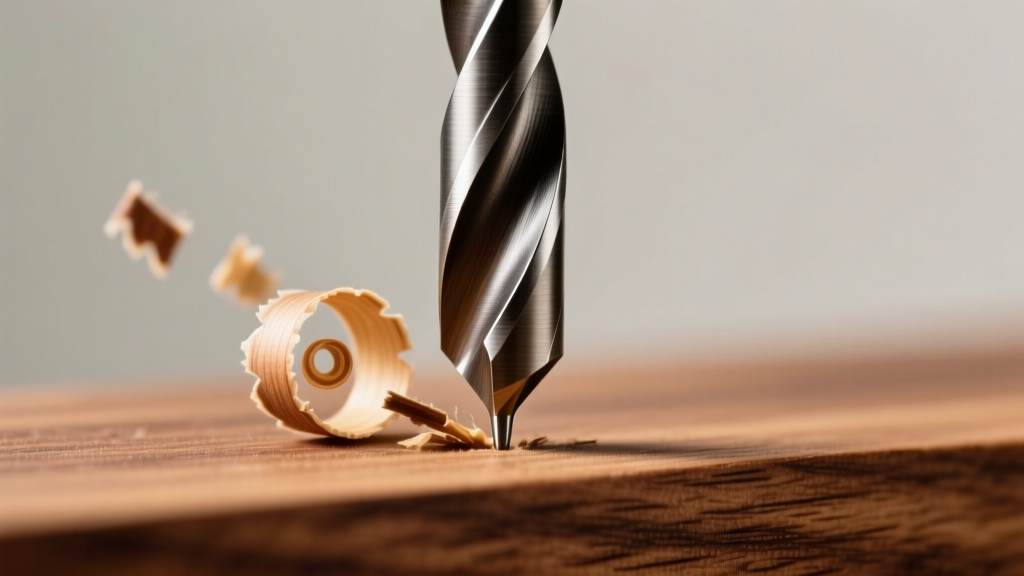
Brad point bits feature a sharp central spur that scores the exact center of the hole, preventing “walking” on curved or angled grain. The outer spurs shear the wood fibers cleanly before the main cutting lips remove the material. These are the mandatory choice for softwoods (Pine, Spruce, Cedar) and mild hardwoods (Poplar, Alder) where tear-out on the exit side is a primary concern. They excel in diameters from 1/8-inch to 1/2-inch. For production cabinet shops drilling 35mm hinge cup holes, carbide-tipped brad points maintain an edge through thousands of cycles in abrasive particleboard.
Forstner Bits (Dense Hardwoods & Exotics)
Unlike twist bits that rely on a central pilot to pull the bit forward, Forstner bits are rim-driven. The outer rim scores a perfect circle, and the shearing cutters slice the interior. This geometry is essential for dense hardwoods like Walnut, Hard Maple, and White Oak, especially when drilling overlapping holes or flat-bottomed recesses for hardware. High-speed steel (HSS) Forstner bits, such as the Freud 09-000 series, dissipate heat effectively in dense species, but they require a drill press or heavy-duty corded drill to manage the lateral torque generated by the wide cutting rim.
Auger and Self-Feed Bits (Structural Timber)
When framing with Douglas Fir, Hemlock, or LVL (Laminated Veneer Lumber) beams, chip evacuation is the limiting factor. Auger bits feature a single, deep flute and a threaded screw pilot that pulls the bit through thick structural members. Self-feed bits (often branded as Speedbor or Daredevil styles) use a replaceable threaded tip and a flat cutting head to bore rapidly through 2x10s and 2x12s. These bits are designed for high-torque, low-RPM applications. Using them on thin hardwood veneers will result in catastrophic blowout.
When drilling holes deeper than 3 inches in resinous softwoods (like Southern Yellow Pine) or dense exotics, sap and compressed chips can weld to the bit flutes due to friction heat. This causes binding, severe kickback, and shattered bits. You must “peck drill”—advancing 1 inch, withdrawing to clear chips, and repeating—to maintain safe operating temperatures.
Species-to-Bit Selection Matrix
The following matrix provides baseline parameters for achieving clean holes across common construction and cabinetry species. RPM recommendations assume a standard 1/2-inch diameter bit; larger diameters require proportionally lower speeds.
| Wood Species | Janka Hardness (lbf) | Recommended Bit Type | Target RPM (1/2" Bit) | Feed Pressure |
|---|---|---|---|---|
| Eastern White Pine | 380 | Brad Point / Spade | 1,500 - 2,000 | Light, steady |
| Red Oak | 1,290 | Brad Point / Forstner | 1,000 - 1,400 | Moderate |
| Hard Maple | 1,450 | Carbide Forstner | 800 - 1,200 | Firm, consistent |
| Ipe (Brazilian Walnut) | 3,510 | Solid Carbide / TiN Twist | 400 - 600 | Heavy, peck drilling |
| MDF (Medium Density Fiberboard) | N/A (Composite) | Carbide-Tipped V-Flute | 1,200 - 1,800 | Moderate |
Edge Cases: Silica, Scorching, and Engineered Composites
General guidelines fail when encountering specific cellular anomalies or synthetic resins. Understanding these edge cases separates amateur carpentry from professional fabrication.
The Silica Problem in Teak and Ipe
Tropical hardwoods like Teak (Tectona grandis) and Cumaru naturally accumulate silica from the soil, with concentrations sometimes exceeding 1.4% of the wood’s dry weight. According to The Wood Database, this embedded silica acts as microscopic sandpaper. A standard HSS twist bit will lose its cutting edge after drilling just 10 to 15 holes in Teak, leading to friction burns and dangerous bit binding. For these species, solid carbide drill bits or carbide-tipped Forstner bits are not optional; they are a strict requirement. Expect to pay $25 to $45 per bit for premium carbide options, but the lifespan justifies the cost in production environments.
Cherry and Maple: Preventing Scorch Marks
American Cherry and Hard Maple are highly susceptible to thermal scorching. If the drill bit RPM is too high and the feed rate (downward pressure) is too slow, the friction carbonizes the wood sugars, leaving permanent black burn marks inside the hole. This is particularly disastrous for clear-finished cabinetry. The solution is counterintuitive: lower the RPM by 30% and apply more aggressive downward pressure so the cutting lips actively shear and eject the chips rather than rubbing against the wood wall.
MDF and Particleboard: Abrasive Resins
Engineered woods do not have a Janka rating, but their urea-formaldehyde and phenol-formaldehyde binding resins are highly abrasive. Drilling 50 hinge holes in MDF with a black oxide bit will dull it rapidly. Cabinet manufacturers utilize solid carbide V-flute bits or TiN (Titanium Nitride) coated bits to slice through the glue matrix cleanly without melting the resin, which can cause the bit to seize.
Bit Metallurgy and Coatings: What to Buy
The substrate and coating of the bit determine its heat tolerance and edge retention across different species:
- High-Speed Steel (HSS): The baseline standard ($3–$8 per bit). Adequate for softwoods, framing, and occasional hardwood use. Fails rapidly in exotics and MDF.
- Black Oxide: HSS treated with a magnetite coating to reduce friction and resist rust ($5–$12 per bit). Offers slightly better chip ejection in resinous pines.
- Titanium Nitride (TiN): A ceramic coating that increases surface hardness and reduces heat buildup ($10–$20 per bit). Excellent for repetitive drilling in Oak and Maple. Note that once the TiN coating wears off the cutting edge, it performs like standard HSS.
- Carbide-Tipped / Solid Carbide: The hardest material available ($25–$60+ per bit). Mandatory for Ipe, Teak, MDF, and high-volume CNC routing. Highly brittle; will shatter if subjected to lateral bending or dropped on concrete.
Frequently Asked Questions
Can I use masonry hammer drill bits on wood?
No. Masonry bits feature a wide, blunt carbide spade tip designed to crush stone, not shear wood fibers. Using a masonry bit on wood, especially with the hammer function engaged, will violently splinter the entry and exit points, create massive amounts of smoke, and potentially ruin the workpiece. Always use bits with sharp, angled cutting lips for wood.
Why does my spade bit tear out the back of plywood?
Spade bits lack outer scoring spurs; they rely on the aggressive center point and flat cutting wings to rip through material. In plywood, the alternating cross-grain veneers catch on the wings, causing severe blowout on the exit side. To drill clean holes in plywood, switch to a brad point bit, or clamp a sacrificial piece of scrap wood tightly against the exit side to support the face veneer as the bit breaks through.
How do I maintain and sharpen wood drill bits?
Sharpening depends on the geometry. For brad point bits, use a fine diamond file to hone the inside flat of the cutting lips; never file the outer spurs, as this alters the diameter and causes binding. For Forstner bits, hone the inner bevel of the rim and the flat top of the shearing cutters. If a bit is caked with burned pitch from drilling pine, clean it with a dedicated resin remover or Simple Green before sharpening, as baked-on pitch accelerates dulling.
Written by
Marcus ChenMarcus Chen is a licensed structural engineer (PE) and building materials analyst with over 12 years of experience across residential, commercial, and industrial construction. He holds a Master of Science in Civil Engineering from UC Berkeley and spent six years at Thornton Tomasetti before transitioning to independent consulting and technical writing. Marcus specializes in material selection for seismic-prone regions, concrete reinforcement strategies, and lifecycle cost analysis. His work has been cited by the American Concrete Institute (ACI) and the Structural Engineers Association of California (SEAOC). When he is not on a job site or at his desk, you will find him hiking the Sierra Nevada or restoring a 1920s craftsman bungalow in Oakland, CA.
More from Marcus Chen
View all
Construction Cost
How Much Did the Eiffel Tower Cost to Build?
How much did the Eiffel Tower cost to build in 1889? We adjust for inflation and compare its budget to modern skyscraper construction.
Aug 4, 2026

Fire Resistance
What Is a Fire Resistant Material? Testing & Certification Guide
Discover what is a fire resistant material through ASTM and UL testing. Learn how fire ratings, certifications, and assemblies work in construction.
Aug 4, 2026

Construction Cost
How Much Did the Burj Khalifa Cost to Build?
How much did the Burj Khalifa cost to build? We break down the $1.5B project and extract 5 money-saving strategies for your next build.
Jul 30, 2026