Acme Lumber & Building Materials: Selecting Pressure-Treated Wood for Decay Resistance
Navigate Acme Lumber & Building Materials inventory for pressure-treated wood. Learn AWPA retention levels, preservative chemistries, and KDAT specs.

Understanding AWPA Retention Levels in Supplier Inventory
Specifying pressure-treated lumber requires matching the preservative retention level to the specific biodeterioration hazard of the application. When sourcing from Acme Lumber & Building Materials, contractors must verify the American Wood Protection Association (AWPA) Use Category (UC) printed on the end tag of every board. The current 2026 AWPA standards dictate minimum chemical retention measured in pounds per cubic foot (pcf). Selecting a UC3B board for a ground-contact post application will result in premature fungal decay, while over-specifying UC4C for above-ground decking wastes budget and introduces unnecessary chemical loads.
| AWPA Use Category | Application Scenario | Minimum MCA-C Retention (pcf) | Typical Acme Stock Profile |
|---|---|---|---|
| UC3B | Above Ground, Exposed (Decking, Joists) | 0.15 | 5/4x6 Decking, 2x8 Framing |
| UC4A | Ground Contact, General Use (Posts, Guardrails) | 0.28 | 4x4, 6x6 Posts, Landscape Timbers |
| UC4B | Ground Contact, Heavy Duty (Retaining Walls, Piling) | 0.40 | Timbers, Bulkhead Lumber |
| UC4C | Ground Contact, Critical Structural (Foundation, Piers) | 0.60 | Special Order / Foundation Grade |
Preservative Chemistries: What is on the Yard Rack?
Acme Lumber & Building Materials typically stocks Southern Yellow Pine treated with one of three primary waterborne preservative systems. Understanding the chemical differences is critical for fastener compatibility, paintability, and environmental compliance.
Micronized Copper Azole Type C (MCA-C)
MCA-C utilizes finely ground copper particles suspended in water, paired with tebuconazole as a co-biocide to prevent copper-resistant fungal attacks. Because the copper is micronized rather than dissolved, MCA-C treated wood exhibits a lighter, more natural brown color compared to older chemistries. It is highly paintable and stainable once the moisture content drops below 15%. According to the Southern Pine Council, MCA-C is currently the dominant chemistry for residential decking and above-ground framing due to its low corrosion profile.
Alkaline Copper Quaternary (ACQ)
ACQ relies on dissolved copper and a quaternary ammonium compound. While highly effective against decay and termites, the high alkalinity (pH 8-9) and dissolved copper make ACQ highly corrosive to standard metals. It is frequently stocked for heavy-duty agricultural and ground-contact applications where structural integrity in wet soil is paramount.
Borate Treatments (SBX)
Disodium octaborate tetrahydrate (SBX) is a non-corrosive, low-toxicity preservative used primarily for indoor or fully protected framing (UC1 and UC2). It provides excellent protection against termites and carpenter ants but is water-soluble; it will leach out if exposed to liquid water. Acme Lumber & Building Materials supplies SBX-treated lumber specifically for interior sill plates, trusses, and protected wall cavities.
Field Treatment and End-Cut Preservation Protocols
Pressure treatment penetration in Southern Yellow Pine is often limited to the outer sapwood shell. When framing crews cross-cut, notch, or drill pressure-treated lumber on-site, the untreated heartwood is exposed to fungal spores and moisture. The American Wood Protection Association (AWPA) mandates that all field cuts on UC4A and higher lumber be coated with a supplemental preservative to maintain the warranty and structural lifespan.
- Identify the Cut Zone: Any cross-cut, rip, or drill hole exceeding 1/2 inch in diameter on ground-contact lumber requires treatment.
- Select the Supplemental Preservative: Use a brush-on copper naphthenate solution (containing minimum 2% copper metal) or an MCA-based end-cut preservative. Avoid generic 'wood preservers' that lack AWPA-listed active ingredients.
- Surface Preparation: Remove sawdust and debris from the cut face using a stiff bristle brush. The wood surface must be free of standing water.
- Application Method: Apply the solution liberally using a brush or spray until the wood ceases to absorb the liquid (typically 2 to 3 coats). Ensure a 2-inch overlap onto the adjacent treated surfaces.
- Curing Time: Allow the end-cut treatment to dry for a minimum of 24 hours before backfilling soil or embedding the post in concrete.
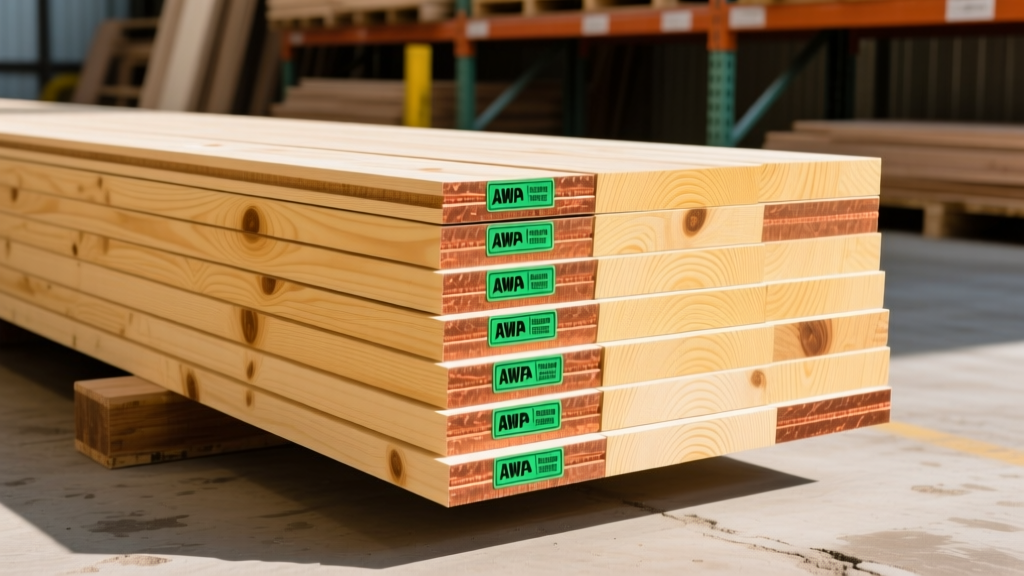
Moisture Management: KDAT vs. Green (Wet) Treated Lumber
When ordering from Acme Lumber & Building Materials, project managers must decide between standard 'green' (wet) treated lumber and Kiln-Dried After Treatment (KDAT) stock. The decision impacts project timelines, fastener holding power, and dimensional stability.
KDAT Lumber Advantages
- Dimensionally stable; minimal twisting or cupping post-installation.
- Lighter weight, reducing structural dead load and labor fatigue.
- Can be immediately painted or stained (moisture content < 15%).
- Holds fasteners tighter due to pre-shrunk wood fibers.
Standard Green Lumber Realities
- High moisture content (often 30-45%) causes significant shrinkage as it cures.
- Requires 3 to 6 months of weathering before stain or paint adhesion is viable.
- Prone to checking and warping if exposed to direct sun before drying.
- Lower upfront material cost, but higher long-term maintenance callbacks.
Expert Sourcing Strategy for High-Durability Projects
Procurement professionals leveraging Acme Lumber & Building Materials should implement a tiered sourcing matrix based on micro-climate and structural criticality. The USDA Forest Products Laboratory notes that localized moisture traps and soil drainage profiles drastically alter decay hazard zones.
"Never default to UC4A for all ground-contact applications. In poorly drained clay soils or regions with high termite pressure (Formosan subterranean termites), upgrade all sub-grade structural posts to UC4B (0.40 pcf) or UC4C (0.60 pcf) to prevent catastrophic structural failure within the first decade."
By rigorously cross-referencing the AWPA end tags with the engineered plans, contractors ensure that the lumber pulled from the Acme Lumber & Building Materials yard provides the exact chemical retention required for the specific hazard zone, eliminating both premature rot and unnecessary material expenditures.
Written by
Marcus ChenMarcus Chen is a licensed structural engineer (PE) and building materials analyst with over 12 years of experience across residential, commercial, and industrial construction. He holds a Master of Science in Civil Engineering from UC Berkeley and spent six years at Thornton Tomasetti before transitioning to independent consulting and technical writing. Marcus specializes in material selection for seismic-prone regions, concrete reinforcement strategies, and lifecycle cost analysis. His work has been cited by the American Concrete Institute (ACI) and the Structural Engineers Association of California (SEAOC). When he is not on a job site or at his desk, you will find him hiking the Sierra Nevada or restoring a 1920s craftsman bungalow in Oakland, CA.
More from Marcus Chen
View all
Construction Cost
How Much Did the Eiffel Tower Cost to Build?
How much did the Eiffel Tower cost to build in 1889? We adjust for inflation and compare its budget to modern skyscraper construction.
Aug 4, 2026

Fire Resistance
What Is a Fire Resistant Material? Testing & Certification Guide
Discover what is a fire resistant material through ASTM and UL testing. Learn how fire ratings, certifications, and assemblies work in construction.
Aug 4, 2026

Construction Cost
How Much Did the Burj Khalifa Cost to Build?
How much did the Burj Khalifa cost to build? We break down the $1.5B project and extract 5 money-saving strategies for your next build.
Jul 30, 2026