Types of Wood Fences Styles: A Lumber Grade & Quality Guide
Match types of wood fences styles with the correct lumber grades, species, and AWPA treatment categories for maximum structural durability and aesthetics.

The Intersection of Fence Style and Lumber Grading
Selecting the right wood for a fence is rarely just about picking a species; it requires aligning the physical demands of specific types of wood fences styles with the appropriate lumber grading rules. A style that looks identical on day one can fail in three years if the underlying lumber grade cannot handle the structural shear, moisture exposure, or aesthetic tolerances required. According to the U.S. Forest Products Laboratory, the degradation rate of exterior wood is directly tied to its initial moisture content, grain orientation, and the presence of structural defects like wane or loose knots. This guide decodes how to map lumber grades and treatment categories to specific fence architectures.
Decoding Lumber Grades for Fencing Applications
Lumber grading rules, established by agencies like the Western Wood Products Association (WWPA) and the National Lumber Grades Authority (NLGA), categorize boards based on structural integrity and visual defects. For fencing, you are generally balancing cost against visual tolerance and wind-load resistance.
| Lumber Grade | Visual Defects Allowed | Structural Integrity | Best Fence Application |
|---|---|---|---|
| Clear Heart / A & B Better | Virtually none; tight, small pin knots only. | High (uniform grain) | Estate picket, horizontal slat, modern architectural fences. |
| Select Structural / C Select | Small, tight knots; minor wane on edges. | Very High | Heavy-duty 2x4 rails, gate frames, high-wind privacy fences. |
| #1 Common | Moderate knots (up to 25% of face), some wane. | High | Standard privacy, board-on-board, shadowbox panels. |
| #2 Common | Large knots, occasional loose knots, significant wane. | Moderate | Stockade, rustic privacy, agricultural fencing. |
| #3 Common / Fence Grade | Severe defects, wane, split, bowing. | Low | Split rail, post-and-rail, temporary site fencing. |
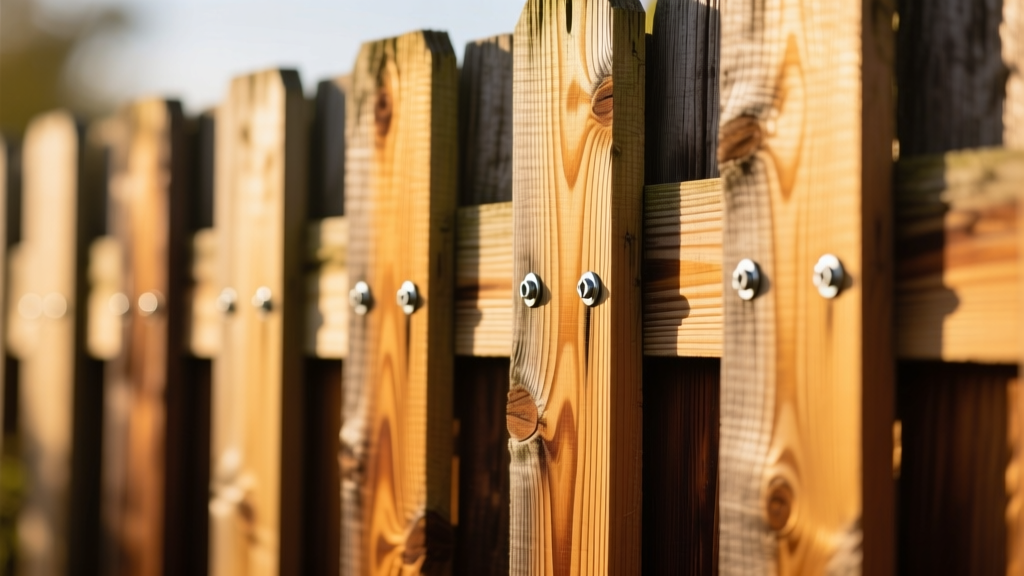
Matching Types of Wood Fences Styles to Optimal Grades
Every fence style imposes unique mechanical and environmental stresses on the lumber. Using an under-graded board for a high-stress style leads to premature failure, while over-grading a rustic style wastes budget.
1. Solid Privacy and Stockade Fences
Solid privacy fences act as massive wind sails. A 6-foot solid fence can experience over 20 pounds of lateral pressure per square foot during a 60 mph gust.
Grade Recommendation: #1 Common or #2 Common for the pickets; Select Structural for the 2x4 horizontal rails.
Quality Insight: When using #2 Common cedar or pressure-treated pine for stockade pickets, inspect for 'wane' (bark or lack of wood on the edge). If a picket has severe wane, the effective width of the board is reduced, creating unintended gaps in your privacy screen as the wood shrinks during the first summer drying cycle. Always orient the growth rings (bark side) facing outward to minimize the visual impact of cupping.
If your privacy style features flat-cut tops rather than dog-ear or gothic cuts, the exposed end-grain will absorb water like a sponge, leading to top-down rot. Either specify a sloped cap rail (using #1 Common or better to prevent warping) or factory-seal the top end-grain with a copper naphthenate-based end-sealer before installation.
2. Board-on-Board and Shadowbox Styles
These styles overlap vertical boards on alternating sides of the rail. While they allow some wind to pass through, the overlapping creates a 'trap' for moisture if the lumber is installed while too wet.
Grade Recommendation: #1 Common Western Red Cedar or #1 Pressure-Treated Southern Yellow Pine (SYP).
Quality Insight: Because the boards overlap, any twisting or bowing in the lumber is magnified, pulling fasteners loose. You must specify Kiln-Dried (KD) or Kiln-Dried After Treatment (KDAT) lumber with a moisture content (MC) below 15%. Installing 'green' pressure-treated #1 Common SYP in a shadowbox configuration guarantees severe twisting as the overlapping boards fight each other for space while drying.
3. Traditional Picket and Estate Fences
Picket fences use narrow boards (typically 1x3 or 1x4). Because the cross-sectional area is so small, a single large knot compromises the entire structural integrity of the picket.
Grade Recommendation: A & B Better or Clear Cedar.
Quality Insight: A 2-inch knot in a 1x4 picket removes nearly 40% of the board's width at that point. Under wind load or impact (e.g., a lawnmower throwing a rock), the picket will snap exactly at the knot. Do not use #1 or #2 Common for narrow pickets. For the rails, C Select or #1 Common is sufficient, provided the fastener schedule uses 304 or 316 stainless steel ring-shank nails to prevent tannin staining from the clear cedar.
4. Split Rail and Post-and-Rail
Rustic styles prioritize character and heavy mass over visual perfection or tight joinery.
Grade Recommendation: #3 Common, ungraded rough-sawn oak, or locust.
Quality Insight: For split rail, the wood is often left completely ungraded and rough-sawn. The critical quality metric here is heartwood content. Ensure your supplier provides 100% heartwood oak or locust rails. Sapwood on rustic rails will succumb to fungal decay and carpenter ants within 24 to 36 months when exposed to the elements.
Species Selection and AWPA Treatment Categories
When specifying pressure-treated lumber for types of wood fences styles, the American Wood Protection Association (AWPA) Use Categories dictate the required chemical retention levels. Misapplying these categories is the most common cause of premature post rot.
| AWPA Category | Exposure Condition | Fence Component | Required Material Spec |
|---|---|---|---|
| UC2 | Interior, dry | None (Do not use outdoors) | N/A |
| UC3B | Exterior, above ground, coated | Decorative trim, protected caps | 0.25 pcf MCA/CA-C |
| UC4A | Exterior, ground contact (general) | Rails, pickets touching soil | 0.40 pcf MCA/CA-C |
| UC4B | Heavy ground contact / fresh water | Standard 4x4 fence posts | 0.60 pcf MCA/CA-C |
| UC4C | Severe ground contact / critical | Gate hinge posts, retaining walls | 0.80 pcf MCA/CA-C |
Note: Naturally durable species like Western Red Cedar and Redwood do not require AWPA chemical treatments, but their posts must still be set in gravel-drained concrete footings or elevated on galvanized post bases to prevent ground-contact decay, as the heartwood of modern second-growth cedar lacks the decay resistance of old-growth timber. For more on natural durability, refer to the Western Red Cedar Lumber Association grading and performance guidelines.
Critical Quality Control Checks at the Lumber Yard
Do not accept delivery of fencing lumber without performing these three physical inspections:
- The Twist Test: Sight down the length of a random 2x4 rail and several 1x6 pickets. If the twist exceeds 1/2 inch over an 8-foot length, reject the bundle. Twisted rails will force pickets out of plumb and pop fasteners within the first seasonal temperature swing.
- The Bark Pocket Check: Inspect the edges of #1 and #2 Common boards for bark pockets. These inclusions trap moisture and serve as primary entry points for wood-decaying fungi. Boards with bark pockets wider than 1/4 inch should be culled.
- Fastener Compatibility Verification: If you are buying ACQ or MCA-C pressure-treated pine, verify that your hardware (post bases, brackets) is rated for the specific chemical retention. Standard galvanized hardware will corrode rapidly; you must use hot-dipped galvanized (ASTM A153 Class D) or ZMAX-coated steel.
Frequently Asked Questions
Can I use #2 Common cedar for a horizontal slat fence?
No. Horizontal slat fences require long, unsupported spans (often 6 to 8 feet between posts). #2 Common cedar lacks the modulus of elasticity (stiffness) to span these distances without sagging. You must use Select Structural or C Select grade, and ideally increase the board thickness to 5/4 (1.25 inches) or use a hidden steel stiffener rail.
Why do my clear cedar pickets have black streaks around the nails?
Clear cedar contains high levels of water-soluble tannins. If you used electro-galvanized or standard steel nails, a chemical reaction occurs between the tannins and the iron/zinc, creating black streaks. You must use 305-grade stainless steel fasteners for all clear and A & B Better cedar applications.
Is it better to buy pre-built fence panels or build stick-by-stick?
Pre-built panels (often 8x6 feet) are almost exclusively manufactured using #2 or #3 Common lumber to keep retail costs down, and they rely on pneumatic staples that lack withdrawal resistance. Building stick-by-stick allows you to hand-select #1 Common or better boards, use proper ring-shank nails or structural screws, and customize the grade to the specific types of wood fences styles you are installing.
Written by
David NakamuraDavid Nakamura is a licensed architect (AIA) and construction technology writer focused on sustainable building methods, mass timber engineering, and high-performance building envelopes. He holds a Master of Architecture from the University of Washington and is a certified Passive House Consultant (CPHC). David spent eight years at the Seattle firm Mithun, where he led the design of three LEED Platinum projects, before founding his own practice specializing in net-zero residential design. He serves on the editorial advisory board of GreenBuilder Magazine and has authored peer-reviewed papers on cross-laminated timber (CLT) connections for the Journal of Structural Engineering. In his spare time, David teaches woodworking at Pratt Fine Arts Center and kayaks the Puget Sound.
More from David Nakamura
View all
Construction Cost
Labor Cost to Build a Deck Per Sq Ft: 2026 Installation Guide
Discover the exact labor cost to build a deck per sq ft in 2026. This installation guide breaks down contractor rates, complexity factors, and hidden fees.
Aug 4, 2026

Construction Cost
How Much Does It Cost to Build a 3 Bedroom House? Financing Guide
Learn exactly how much it costs to build a 3 bedroom house and explore 2026 financing options, construction loan types, and budget frameworks for your build.
Aug 4, 2026

Construction Cost
Cost to Build a Tennis Court: 2026 Guide
How much does it cost to build a tennis court in 2026? Breakdowns for asphalt, concrete, and synthetic surfaces plus fencing and lighting.
Jul 30, 2026