Structural Types of Wood Screws Chart for Load-Bearing Framing
Reference our structural types of wood screws chart to select ICC-ES evaluated fasteners for load-bearing timber framing and shear walls.

The Critical Shift from Standard to Structural Fasteners
In modern structural framing, the distinction between standard wood screws and engineered structural screws dictates the safety and code compliance of a building. Standard wood screws (such as those conforming to ASME B18.6.1) are designed for light-duty woodworking and lack the shear strength, ductility, and evaluated load tables required by the International Building Code (IBC) and International Residential Code (IRC). For load-bearing connections, shear walls, and engineered wood products (EWP), builders must rely on proprietary structural screws that have undergone rigorous testing to earn ICC-ES Evaluation Reports.
Never substitute standard deck screws, drywall screws, or un-evaluated lag screws in structural connections. Building inspectors will reject joints that do not use fasteners listed in an ICC-ES ESR (Evaluation Service Report) or approved manufacturer load tables when specified by the structural engineer.
Comprehensive Types of Wood Screws Chart (Structural Focus)
The following chart categorizes the primary types of structural wood screws used in heavy framing, timber construction, and light-frame shear walls. Use this matrix to identify the correct fastener profile for your specific structural application.
| Screw Category | Head Style | Drive Type | Primary Structural Application | Code Equivalent / Standard |
|---|---|---|---|---|
| Structural Dowel Screws | Flat / Washer Head | T25 / T30 Torx | Sill plates, ledger boards, truss-to-wall connections | Replaces standard 10d / 16d common nails |
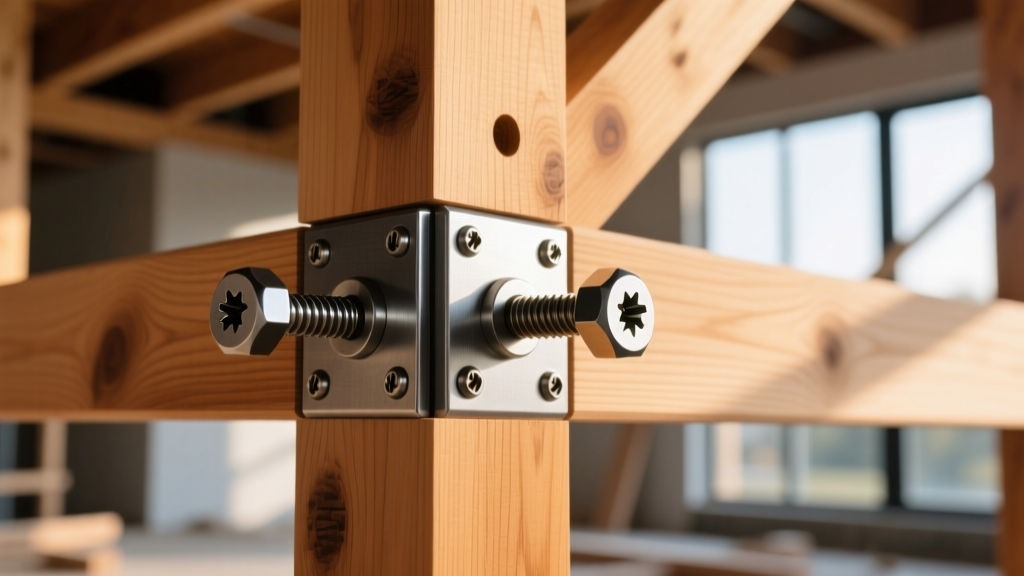
| Rugged Structural Screws (RSS) | Hex Washer / Disk | 3/8" Hex / T40 | Timber framing, beam splices, LVL/GluLam connections | Replaces 3/8" and 1/2" traditional lag screws |
| Joist Hanger Screws | Modified Truss / Pan | T20 / T25 Torx | Attaching metal connectors to wood, joist hangers | Must match connector manufacturer specs |
| Self-Drilling Ledger Screws | Hex Washer with Seal | 1/2" Hex | Deck ledgers, structural rim board attachments | Replaces 1/2" through-bolts and lag screws |
Decoding Structural Screw Specifications
Selecting the right screw from the types of wood screws chart requires understanding the metallurgical and geometric properties that grant these fasteners their structural ratings.
Shank Geometry and Thread Design
Unlike standard screws, structural screws feature highly engineered shanks. The unthreaded shoulder (shank) is precisely calibrated to match the thickness of common engineered wood products like LVL (Laminated Veneer Lumber) and PSL (Parallel Strand Lumber). This ensures the shear load is transferred through the steel shank rather than the weaker threaded portion. Furthermore, modern structural screws utilize aggressive, self-tapping threads with Type 17 auger points, which displace wood fibers rather than cutting them, preserving the withdrawal capacity of the timber.
Steel Grade and Ductility
According to the USDA Forest Products Laboratory Wood Handbook, structural connections require fasteners that yield before they fracture. Structural screws are manufactured from high-carbon or alloy steel that undergoes specialized heat treatment. This provides high tensile strength (often exceeding 100,000 psi) while maintaining the ductility required to absorb seismic and wind loads without brittle failure.
Corrosion Resistance and Coatings
For exterior structural applications or connections involving preservative-treated wood (like ACQ or Copper Azole), standard zinc coatings are insufficient and will corrode rapidly. You must specify fasteners with proprietary ceramic coatings, hot-dip galvanizing per ASTM A153, or stainless steel (Type 304 or 316). Always cross-reference the fastener coating with the wood treatment chemical to prevent galvanic corrosion.
Industry-Standard Structural Screw Models
When specifying fasteners on structural drawings, engineers typically call out specific tested models. Here are the industry benchmarks:
- Simpson Strong-Tie SDWS (Structural Dowel Screw): Designed specifically to replace nails in light-frame construction. The #9 and #10 SDWS screws feature a double-barrier coating and are evaluated for connecting cold-formed steel to wood, as well as standard wood-to-wood shear wall nailing schedules. View the Simpson SDWS technical data for specific allowable load tables.
- GRK RSS (Rugged Structural Screw): Recognizable by its integrated washer head and W-Cut thread geometry. The RSS line is heavily utilized in timber framing and heavy beam connections. The #10 and #12 RSS sizes offer shear values that directly compete with 3/8" and 1/2" lag bolts, but eliminate the need for pre-drilling. See the GRK RSS specifications for exact withdrawal capacities.
- FastenMaster LedgerLok: A heavy-duty structural screw engineered primarily for deck ledger connections. It features a built-in EPDM washer and a self-drilling point capable of penetrating dimensional lumber and rim boards without pilot holes, drastically reducing installation time while maintaining code-compliant shear values.
Installation Best Practices for Structural Integrity
Even the highest-rated structural screw will fail if installed incorrectly. Adhere to these field protocols to maintain the fastener's evaluated load capacity:
- Respect Minimum Edge Distances: The National Design Specification (NDS) for Wood Construction mandates specific edge distances to prevent timber splitting. For parallel-to-grain loading, maintain a minimum edge distance of 1.5D (where D is the screw diameter). For perpendicular-to-grain loading on the loaded edge, increase this to 3D.
- Pilot Hole Protocols: While most structural screws are self-drilling, hardwoods (like Oak or Hickory) and dense engineered lumbers may require pilot holes to prevent the screw head from snapping off under torque. If pre-drilling, the pilot hole diameter must not exceed the root diameter of the screw threads.
- Torque Limiting: Over-driving structural screws can strip the wood fibers at the bearing surface, negating the clamping force and reducing withdrawal capacity. Use impact drivers with adjustable torque clutches, and stop driving the moment the washer head seats flush and compresses the wood fibers.
- Verify Head Seating: Structural screws rely on the head bearing against the wood or steel connector. Countersinking structural screws is strictly prohibited unless explicitly tested and detailed in the manufacturer's ICC-ES report, as removing surface wood fibers drastically reduces the shear capacity of the joint.
"In structural framing, a fastener is only as strong as the wood fibers holding it. The shift toward evaluated structural screws has revolutionized timber construction, but it requires builders to abandon the 'bigger is better' lag bolt mentality in favor of precision-engineered, code-listed fasteners."
— Structural Engineering Best Practices, Wood Design Institute
Summary Decision Framework
When reviewing the types of wood screws chart for your project, apply this rapid decision matrix: Use Structural Dowel Screws for high-volume, light-frame shear walls and sill plates where nail schedules are specified. Deploy Rugged Structural Screws (RSS) for heavy timber, GluLam beams, and post-to-beam connections where traditional lag bolts are called out. Select Self-Drilling Ledger Screws exclusively for exterior rim-board and ledger attachments where moisture and withdrawal forces are the primary concerns. Always verify the specific ICC-ES ESR report for the chosen fastener to ensure compliance with your local jurisdiction's adopted building code.
Written by
Marcus ChenMarcus Chen is a licensed structural engineer (PE) and building materials analyst with over 12 years of experience across residential, commercial, and industrial construction. He holds a Master of Science in Civil Engineering from UC Berkeley and spent six years at Thornton Tomasetti before transitioning to independent consulting and technical writing. Marcus specializes in material selection for seismic-prone regions, concrete reinforcement strategies, and lifecycle cost analysis. His work has been cited by the American Concrete Institute (ACI) and the Structural Engineers Association of California (SEAOC). When he is not on a job site or at his desk, you will find him hiking the Sierra Nevada or restoring a 1920s craftsman bungalow in Oakland, CA.
More from Marcus Chen
View all
Construction Cost
How Much Did the Eiffel Tower Cost to Build?
How much did the Eiffel Tower cost to build in 1889? We adjust for inflation and compare its budget to modern skyscraper construction.
Aug 4, 2026

Fire Resistance
What Is a Fire Resistant Material? Testing & Certification Guide
Discover what is a fire resistant material through ASTM and UL testing. Learn how fire ratings, certifications, and assemblies work in construction.
Aug 4, 2026

Construction Cost
How Much Did the Burj Khalifa Cost to Build?
How much did the Burj Khalifa cost to build? We break down the $1.5B project and extract 5 money-saving strategies for your next build.
Jul 30, 2026