Types of Burl Wood: Structural Limits and Architectural Uses
Discover how different types of burl wood perform under stress. Learn the structural limits, grain mechanics, and architectural applications.

The Structural Paradox of Burl Wood
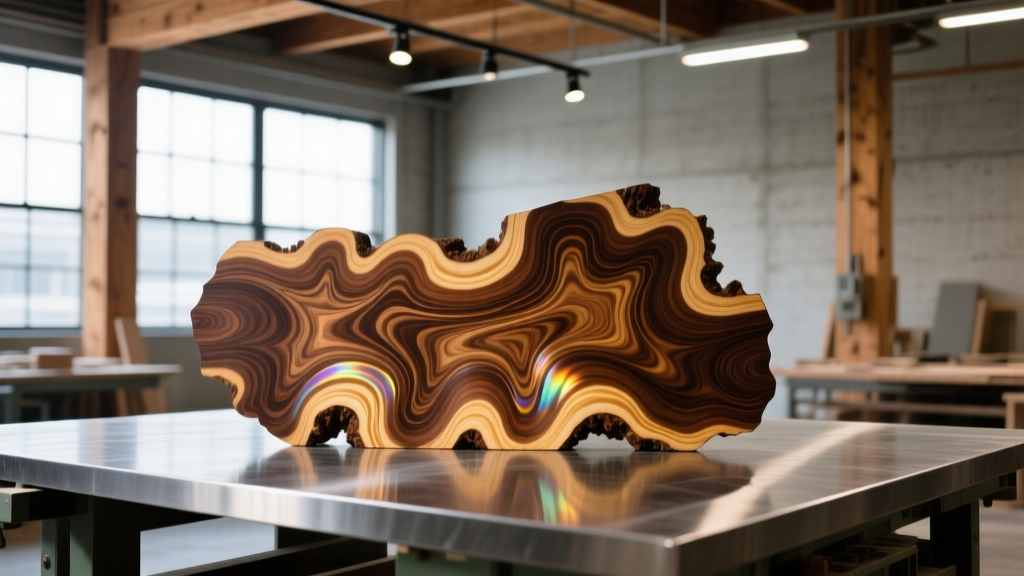
Burl wood represents one of the most profound contradictions in architectural timber. Visually, it is the pinnacle of organic luxury, prized for its dense, swirling, three-dimensional grain patterns. Mechanically, however, burl is a structural anomaly that defies the fundamental rules of wood engineering. While standard dimensional lumber relies on continuous, parallel longitudinal fibers to transfer compressive and tensile loads, burl wood consists of chaotic, interlocked, and multidirectional grain caused by dormant buds and stress responses in the tree's cambium layer.
For builders, structural engineers, and architectural millworkers, understanding the specific types of burl wood is not about finding a substitute for framing lumber. It is about recognizing the absolute limits of the material, predicting its failure modes under stress, and engineering workarounds for niche architectural applications where aesthetic demands intersect with physical load requirements.
Grain Mechanics: Why Burl Fails in Primary Load-Bearing
To understand how different burls behave, we must examine the cellular mechanics. According to the USDA Forest Products Laboratory Wood Handbook, the strength of wood is heavily dependent on the grain angle relative to the applied load. As the grain slope deviates from parallel, strength drops exponentially.
In burl wood, the grain slope is effectively randomized. The xylem and phloem tissues grow in spherical, nodular patterns rather than vertical columns. When subjected to compressive loads, these multidirectional fibers buckle against one another, leading to catastrophic shear failure rather than predictable bending. Furthermore, the high concentration of extractives and residual sugars in the burl makes it highly susceptible to differential shrinkage, resulting in severe checking (cracking) as the wood acclimates to interior HVAC environments.
Evaluating Specific Types of Burl Wood Under Stress
While no burl is suitable for primary framing, different species exhibit vastly different mechanical properties, densities, and stabilization requirements when used in heavy architectural millwork, decorative columns, or marine applications.
| Burl Species | Avg. Specific Gravity | Janka Hardness (lbf) | Checking Risk | Primary Architectural Use |
|---|---|---|---|---|
| Claro Walnut | 0.61 - 0.65 | 1,010 - 1,200 | Extreme | Epoxy-consolidated panels, luxury inlays |
| Bigleaf Maple | 0.50 - 0.55 | 850 - 950 | High | Veneers, stabilized turnery, cabinet faces |
| Coast Redwood | 0.35 - 0.42 | 420 - 480 | Moderate | Decorative non-load columns, wall cladding |
| White Oak | 0.68 - 0.75 | 1,300 - 1,450 | Extreme | Heavy architectural accents, marine trim |
Claro Walnut Burl (Juglans hindsii)
Claro walnut burl is the most sought-after domestic burl for high-end architectural millwork. Its specific gravity approaches 0.65, making it exceptionally heavy and hard. However, the intense interlocking of the grain creates massive internal tension. When milled into thick slabs for conference tables or reception desks, Claro walnut burl will almost invariably develop end-checks and honeycomb internal cracks during the kiln-drying process. Millworkers must employ slow, controlled air-drying followed by low-temperature kiln schedules, often sealing the end grain with anchor seal immediately upon cutting to prevent rapid moisture egress.
Bigleaf Maple Burl (Acer macrophyllum)
Maple burl features a tighter, more uniform 'pin' or 'eye' pattern compared to walnut. Mechanically, it is softer and more prone to spalting (fungal decay) while the tree is still alive. According to data compiled by the Wood Database, Bigleaf maple has a lower crushing strength than hard maple. In architectural applications, solid maple burl is rarely used in thicknesses exceeding 2 inches without chemical stabilization, as the porous, irregular grain absorbs ambient humidity rapidly, leading to seasonal swelling that can shatter surrounding joinery.
Coast Redwood Burl (Sequoia sempervirens)
Often referred to as 'lace burl' or 'redwood burl', this material is incredibly lightweight due to its low specific gravity. While it lacks the compressive strength for any load-bearing function, its natural rot resistance and high tannin content make it a favorite for exterior architectural accents, provided it is properly sealed. Redwood burl is highly fibrous and tears out easily under standard carbide tooling; it requires specialized shear-cutting techniques or CNC routing with compression bits to achieve a clean architectural finish.
Niche Structural and Architectural Applications
While primary framing is off the table, advanced millworkers and architects integrate burl wood into structural-adjacent applications using specific engineering protocols.
- Steel-Core Decorative Columns: For luxury lobbies requiring massive, solid-looking burl wood columns, the burl is sliced into thick book-matched veneers or staved segments and wrapped around a structural steel or aluminum tube. The metal core handles all axial and lateral loads, while the burl serves as a thick architectural cladding.
- Marine Decking and Helm Inlays: In yacht building, white oak and walnut burls are used for helm stations and decking accents. Because marine environments subject wood to extreme moisture cycling, the burl is fully encapsulated in marine-grade epoxy to prevent the interlocked grain from absorbing water and expanding.
- Heavy Timber Joinery Accents: Burl is occasionally used for decorative wedges, pegs, or accent keys in traditional timber framing. While the peg itself does not carry the primary shear load of the mortise and tenon joint, the density of the burl provides excellent holding power for drawbore pins.
Engineering Workarounds: Epoxy and Resin Consolidation
The modern architectural use of solid burl wood relies heavily on chemical consolidation. Because the chaotic grain leaves microscopic voids and punky (decayed) pockets, structural epoxies are used to bind the fibers together, effectively creating a wood-polymer composite.
"When specifying solid burl for heavy architectural panels, we mandate a two-part, low-viscosity penetrating epoxy system. The epoxy wicks into the interlocked grain voids via capillary action, cross-linking the unstable fibers and reducing the wood's coefficient of expansion by up to 60%, ensuring the panel won't tear itself apart when the building's HVAC cycles." — Senior Millwork Engineer, Custom Architectural Fabrication.
For smaller architectural hardware (e.g., custom door pulls, cabinet handles, or finials), vacuum stabilization using methyl methacrylate (MMA) resins is the industry standard. The wood is placed in a vacuum chamber to evacuate air from the cellular structure, then submerged in resin under pressure. This renders the burl completely dimensionally stable and impervious to moisture, though it limits the material to smaller dimensions.
Sourcing, Grading, and Cost Realities
Procuring burl wood for architectural projects requires navigating a highly speculative market. Unlike standard lumber graded by the National Hardwood Lumber Association (NHLA) for structural yield, burl is graded visually based on figure density, color contrast, and the presence of defects.
When specifying burl for a project, adhere to the Architectural Woodwork Institute (AWI) standards for veneer and solid panel matching. Because solid burl is prone to movement, AWI guidelines strongly recommend utilizing burl as a face veneer over a stable MDF or marine-grade plywood substrate for any panel exceeding 12 inches in width, reserving solid burl only for narrow trim, edge-banding, or fully stabilized turnery.
Frequently Asked Questions
Can burl wood be used for load-bearing beams in timber framing?
No. The randomized grain structure of burl wood eliminates the continuous longitudinal fibers required to handle bending and tensile stresses. Using burl for a load-bearing beam would result in unpredictable shear failure under minimal loads, violating all modern building codes.
How do you prevent thick burl slabs from cracking in interior environments?
Thick burl slabs must be kiln-dried using specialized, multi-stage schedules that slowly reduce moisture content over several months. Once milled, the end grain must be sealed, and the slab should be stabilized with penetrating epoxy and finished with a high-build, moisture-blocking polyurethane or conversion varnish to isolate it from ambient humidity changes.
Is burl wood harder than the standard wood from the same tree?
Generally, yes. The dense, compacted nature of the dormant buds and the high concentration of extractives make burl wood denser and harder on the Janka scale than the straight-grained wood from the same species. However, this hardness does not translate to structural strength due to the lack of grain continuity.
Written by
David NakamuraDavid Nakamura is a licensed architect (AIA) and construction technology writer focused on sustainable building methods, mass timber engineering, and high-performance building envelopes. He holds a Master of Architecture from the University of Washington and is a certified Passive House Consultant (CPHC). David spent eight years at the Seattle firm Mithun, where he led the design of three LEED Platinum projects, before founding his own practice specializing in net-zero residential design. He serves on the editorial advisory board of GreenBuilder Magazine and has authored peer-reviewed papers on cross-laminated timber (CLT) connections for the Journal of Structural Engineering. In his spare time, David teaches woodworking at Pratt Fine Arts Center and kayaks the Puget Sound.
More from David Nakamura
View all
Construction Cost
Labor Cost to Build a Deck Per Sq Ft: 2026 Installation Guide
Discover the exact labor cost to build a deck per sq ft in 2026. This installation guide breaks down contractor rates, complexity factors, and hidden fees.
Aug 4, 2026

Construction Cost
How Much Does It Cost to Build a 3 Bedroom House? Financing Guide
Learn exactly how much it costs to build a 3 bedroom house and explore 2026 financing options, construction loan types, and budget frameworks for your build.
Aug 4, 2026

Construction Cost
Cost to Build a Tennis Court: 2026 Guide
How much does it cost to build a tennis court in 2026? Breakdowns for asphalt, concrete, and synthetic surfaces plus fencing and lighting.
Jul 30, 2026