Preserving Types of Wooden Fence Designs: A Treatment Guide
Learn how different types of wooden fence designs dictate specific preservation treatments, AWPA standards, and moisture management strategies.

The Hidden Link Between Fence Architecture and Wood Decay
Most contractors select wood treatments based on local building codes while entirely ignoring the micro-climates created by specific fence architectures. The reality is that different types of wooden fence designs trap moisture, expose end-grain, and interact with soil in fundamentally different ways. A horizontal slat fence retains water on its top edges, while a vertical stockade fence acts as a capillary wick, drawing soil moisture upward. Understanding these structural vulnerabilities is the key to specifying the correct American Wood Protection Association (AWPA) Use Categories and chemical preservatives to ensure a 20-year lifespan rather than a 7-year failure.
Moisture Vulnerability Matrix: Matching Design to AWPA Standards
The AWPA classifies treated wood into Use Categories based on exposure. UC3B is for above-ground applications, while UC4A is for ground contact. However, the design of the fence often forces above-ground components into ground-contact conditions. Below is a decision matrix for matching fence designs to their actual preservation requirements.
| Fence Design | Primary Moisture Risk | AWPA Category (Posts) | AWPA Category (Pickets/Boards) | Required End-Grain Sealing |
|---|---|---|---|---|
| Stockade (Vertical) | Capillary wicking from soil contact | UC4A (Ground Contact) | UC4A (if touching soil) or UC3B (with 2" gap) | Copper naphthenate on bottom cuts |
| Shadowbox (Good Neighbor) | Debris trapping in overlapping channels | UC4A (Ground Contact) | UC3B (Above Ground) | Wax-based emulsion on top rail cuts |
| Horizontal Slat | Water pooling on flat top edges | UC4A (Ground Contact) | UC3B (Above Ground) + Water Repellent | Penetrating alkyd-oil on all end cuts |
| Split Rail | Water ingress at mortise/tenon joints | UC4A (Ground Contact) | UC3A (Protected Above Ground) | Borate-based paste inside mortises |
Design-Specific Preservation Protocols
1. Stockade and Board-on-Board: The Capillary Action Threat
In vertical picket designs, the end-grain at the bottom of the board acts like a bundle of microscopic straws. If a stockade picket rests directly on the soil, capillary action will draw moisture up to 6 inches into the wood, bypassing the treatment zone and causing internal rot.
- The 2-Inch Clearance Rule: Always maintain a strict 2-inch gap between the bottom of UC3B treated pickets and the soil. Use a temporary 2x4 spacer during installation.
- Treatment Upgrade: If local terrain or snow accumulation makes a 2-inch gap impossible, you must upgrade the pickets to UC4A (Ground Contact) treatment levels. This increases the chemical retention from 0.15 pcf (pounds per cubic foot) to 0.25 pcf for Micronized Copper Azole (MCA).
- End-Grain Sealing: Any field cuts made to level the fence on sloped terrain must be immediately coated with a copper naphthenate end-grain sealer (e.g., Copper-Green). Standard brush-on water sealers do not penetrate end-grain deeply enough to stop capillary wicking.
2. Shadowbox (Good Neighbor): Debris Traps and Fastener Corrosion
Shadowbox fences alternate pickets on both sides of the rails, creating a 1/2-inch to 1-inch overlapping channel. While excellent for wind load distribution, these channels are notorious debris traps. Wet leaves and organic matter lodge between the boards, holding moisture against the wood for days after rainfall.
To preserve shadowbox designs, specify MCA-C (Micronized Copper Azole Type C) treatment. The micronized copper particles penetrate the dense overlapping zones more effectively than dissolved copper solutions, providing superior protection in the micro-climates created by the board overlaps.
3. Horizontal Slat: The "Water Shelf" Effect
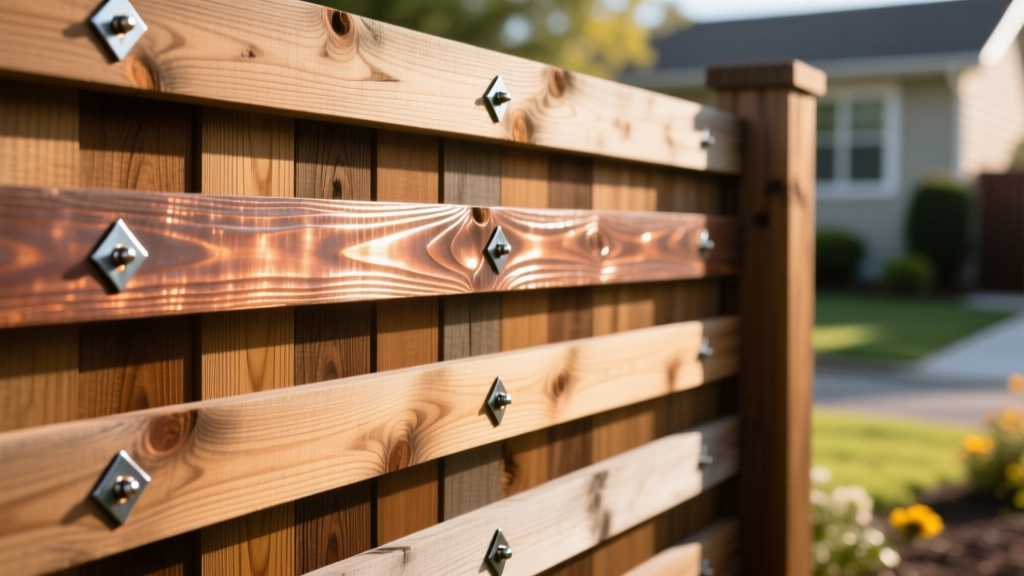
Modern horizontal slat fences look striking, but every single 1x6 or 2x6 board creates a horizontal "water shelf" where rain pools. Unlike vertical boards that shed water via gravity, horizontal boards expose their wide face and top edge to standing water.
- Top Cap Sloping: Never install flat top rails on horizontal fences. Rip the top rail at a 15-degree angle to force water runoff.
- Finish Schedule: Pressure treatment protects against rot and insects, but it does not stop water absorption and dimensional swelling. Horizontal slats require a penetrating alkyd-wood oil or high-quality water-repellent preservative (WRP) applied within 30 days of installation. Reapplication is required every 18 to 24 months, focusing heavily on the top 1/8-inch edge of every board.
The Post-to-Soil Interface: The 90% Failure Point
Regardless of the types of wooden fence designs you choose, 90% of all fence failures occur at the post-to-soil interface. The ground-line transition experiences alternating wet-dry cycles and high fungal activity.
"Setting a pressure-treated post directly in concrete creates a moisture trap. Concrete is highly alkaline (pH ~12.5) and porous, holding water against the wood while simultaneously degrading certain copper-based preservatives over time."
The Gravel Collar Method: Instead of encasing the entire post in concrete, dig an extra 6 inches below the frost line and fill it with 3/4-inch crushed gravel for drainage. Set the UC4A treated post on the gravel, then pour a concrete collar that slopes away from the post at the surface level. This prevents water from pooling at the exact point where the wood exits the soil.
Wood Species and Treatment Compatibility
Not all wood species accept chemical preservatives equally. When selecting materials for your fence design, consider the treatability of the species:
- Southern Yellow Pine (SYP): The gold standard for pressure treatment. Its sapwood is highly permeable, allowing deep penetration of MCA and CA-C preservatives. Always specify SYP for structural posts in UC4A.
- Western Red Cedar: Naturally decay-resistant due to extractives in the heartwood, but the sapwood is vulnerable. Cedar is difficult to pressure-treat deeply without incising (piercing the wood). For cedar fences, rely on the natural heartwood for above-ground components (UC3B) and use penetrating oil finishes rather than water-based film coatings, which will peel as the wood expands.
- Douglas Fir: Highly resistant to preservative penetration. If using Douglas Fir for fence posts, it must be incised and treated to UC4A standards, or it will rot at the ground line within 5 years.
Industry Standards and References
For precise chemical retention levels and structural guidelines, always consult current industry standards. The protocols outlined in this guide are based on data from the American Wood Protection Association (AWPA) Use Category system, which dictates minimum preservative retention based on exposure risk. For comprehensive data on wood moisture dynamics and species treatability, refer to the Wood Handbook published by the Forest Products Laboratory (FPL). Additionally, verify the environmental and safety compliance of specific chemical treatments via the EPA's registered wood preservatives database.
Summary Checklist for Contractors and Homeowners
- Verify the AWPA Use Category tag on the lumber (UC3B for above-ground rails/pickets, UC4A for all posts and ground-touching boards).
- Maintain a 2-inch ground clearance for vertical pickets unless UC4A lumber is used.
- Seal all field cuts and end-grains with copper naphthenate within 2 hours of cutting.
- Use ASTM A153 hot-dipped galvanized or stainless steel fasteners exclusively.
- Apply penetrating water-repellent finishes to horizontal designs within 30 days of installation.
Written by
James ThorntonJames Thornton is a construction industry veteran with 25 years of hands-on experience in wood framing, lumber grading, and residential building codes. He started as a framing carpenter in rural Oregon, earned his ICC Residential Building Inspector certification, and eventually became a senior plan reviewer for the City of Portland Bureau of Development Services. James holds a B.S. in Wood Science & Technology from Oregon State University and is a certified lumber grader through the West Coast Lumber Inspection Bureau (WCLIB). He has inspected over 3,000 residential construction sites and authored the city's internal guide on advanced framing techniques (2x6 at 24" O.C.). James lives in Bend, OR, where he builds custom timber-frame cabins and competes in lumberjack sports.
More from James Thornton
View all
Insulation
Best Home Insulation Materials: Complete 2026 Guide
Compare top home insulation materials for 2026. Find R-values, installed costs per square foot, and best uses for fiberglass, spray foam, and mineral wool.
Aug 4, 2026

Sustainable Building
Certify Your Green Building Material for LEED and WELL
Step-by-step guide to certifying a green building material for LEED v5 and WELL v2. Master EPDs, HPDs, and VOC limits for 2026 project specifications.
Aug 4, 2026

Stone & Masonry
Veneer Stacked Stone Panels: Interior Design & Style Showcase
Discover how veneer stacked stone panels transform interiors. Explore modern design profiles, material pairings, and technical installation specs.
Aug 4, 2026