What Type of Wood for Garden Bed Construction? A Complete Species Guide
Discover what type of wood for garden bed builds lasts longest. Compare cedar, redwood, black locust, and treated pine for safety, cost, and rot resistance.
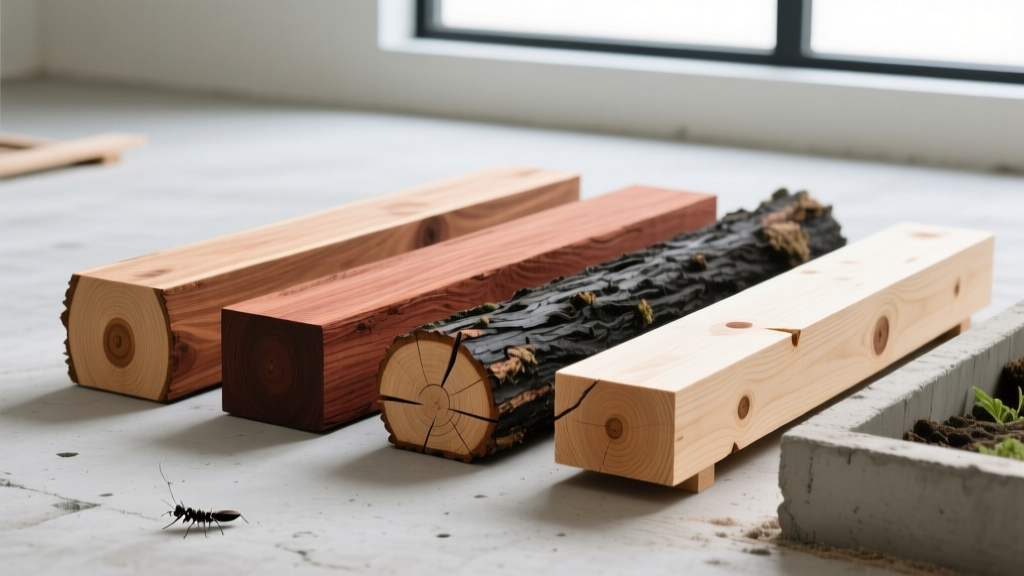
The Core Trade-Off: Rot Resistance vs. Chemical Safety
When evaluating what type of wood for garden bed construction will serve your landscape best, the decision hinges on three intersecting variables: natural decay resistance, structural longevity in constant moisture, and soil chemistry safety. Wood in a raised garden bed operates in an AWPA (American Wood Protection Association) Use Category UC4A (Ground Contact) environment. The interior soil retains moisture against the wood grain, while the exterior faces UV degradation and seasonal freeze-thaw cycles.
Species Comparison Matrix
The following matrix breaks down the primary lumber choices based on 2026 market averages and empirical decay resistance data.
| Wood Species | Est. Lifespan (Ground Contact) | Avg. Cost (per linear ft, 2x8) | Chemical Safety Profile |
|---|---|---|---|
| Black Locust | 50+ years | $8.50 - $12.00 | 100% Organic / Safe |
| Western Red Cedar (Heartwood) | 15 - 25 years | $4.00 - $6.50 | 100% Organic / Safe |
| Coast Redwood (Heartwood) | 20 - 30 years | $6.00 - $9.00 | 100% Organic / Safe |
| Bald Cypress (Old Growth) | 15 - 20 years | $3.50 - $5.50 | 100% Organic / Safe |
| ACQ / CA-C Treated Pine | 20 - 40 years | $1.80 - $2.75 | Copper-based (See Notes) |
| Untreated Douglas Fir | 5 - 8 years | $2.20 - $3.00 | 100% Organic / Safe |
Tier 1: Premium Naturally Rot-Resistant Species
Black Locust (Robinia pseudoacacia)
If budget is secondary to absolute longevity, Black Locust is the undisputed champion of garden bed lumber. With a Janka hardness rating of 1,700 lbf (nearly three times harder than cedar), it is virtually impervious to insect boring and mechanical damage from shovels or weed whackers. According to the USDA Forest Products Laboratory, Black Locust heartwood contains high levels of flavonoids and tannins that make it resistant to decay fungi even in direct soil contact. It will weather to a striking silver-gray and easily outlast the structural fasteners holding it together.
Western Red Cedar & Coast Redwood (The Heartwood Rule)
Cedar and Redwood are the industry standards for organic garden beds, but purchasing them requires strict grading vigilance. You must specify 100% Heartwood or Clear Heart grades.
- Western Red Cedar: Contains thujaplicins, natural fungicides that give the wood its distinct aroma and decay resistance. However, plantation-grown second-growth cedar often contains wide bands of sapwood. If your 2x8 cedar plank has a stark white/yellow outer edge, that edge will rot in 36 months.
- Coast Redwood: Denser and heavier than cedar, with superior structural span capabilities. Redwood is highly dimensionally stable, meaning it will not warp or twist as heavily as cedar when exposed to the wet/dry cycling of garden soil.
Tier 2: Regional & Moderate-Durability Softwoods
Bald Cypress & Douglas Fir
Bald Cypress is the premier choice for gardeners in the American South. Like cedar, only the heartwood of old-growth cypress contains cypressene, the oil responsible for its water resistance. Second-growth cypress is largely sapwood and should be avoided for ground contact.
Douglas Fir is an excellent structural framing lumber but possesses only moderate natural decay resistance. If you choose untreated Douglas Fir for a garden bed due to local availability and low cost, you must implement a physical moisture barrier (see construction specifications below) to achieve a lifespan beyond 7 years.
Tier 3: Modern Pressure-Treated Pine (ACQ & CA-C)
For large-scale commercial farms or budget-constrained residential builds, modern pressure-treated Southern Yellow Pine remains the most economical choice. The critical question is soil safety.
Never use reclaimed railroad ties, telephone poles, or wood treated with CCA (Chromated Copper Arsenate) or Creosote. These contain polycyclic aromatic hydrocarbons (PAHs), arsenic, and heavy metals that will permanently contaminate your soil and leach into root vegetables.
Understanding ACQ and Copper Azole (CA-C)
Since the phase-out of CCA for residential use, the American Wood Protection Association (AWPA) standards have shifted to Alkaline Copper Quaternary (ACQ) and Copper Azole (CA-C). These treatments rely on dissolved copper as the primary fungicide.
According to research cited by Penn State Extension, copper leaching into garden soil is minimal and generally remains confined to the first 1 to 2 inches of soil adjacent to the wood. Because copper is an essential plant micronutrient, the trace amounts leached do not pose a toxicity risk to plants or humans, provided the soil pH is maintained between 6.0 and 7.0 (highly acidic soils accelerate copper mobilization).
Structural Sizing and Fastener Specifications
Selecting the right wood is only half the equation; assembling it to withstand lateral soil pressure requires specific dimensional and metallurgical choices.
Lumber Dimensions and Span Limits
Soil exerts immense hydrostatic pressure when saturated. A 4x8 foot garden bed filled with wet loam can exert over 400 lbs of lateral outward force on the long walls.
- Height Limits: For beds 12 inches high, 2x6 lumber is sufficient. For beds 18 to 24 inches high, you must use 2x8 or 2x10 lumber, or install mid-span vertical deadmen (stakes driven into the ground and screwed to the outside of the wall) every 4 feet to prevent bowing.
- Corner Joinery: Do not rely solely on end-grain nailing. Use 4x4 corner posts cut to the height of the bed, driving 3-inch structural screws through the horizontal planks into the corner posts.
The Fastener Metallurgy Rule
The extractives in cedar and redwood, as well as the copper in ACQ-treated pine, are highly corrosive to standard metals.
Fastener Specification: You must use Hot-Dipped Galvanized (HDG) or Type 304/316 Stainless Steel structural screws. Standard zinc-plated or bright-finish screws will undergo galvanic corrosion and snap within 3 to 5 years when in contact with cedar tannins or ACQ copper. Use minimum #10 x 3.5-inch exterior structural screws for primary load-bearing joints.
Frequently Asked Questions
Do I need to line the inside of my wooden garden bed?
If you are using premium heartwood cedar, redwood, or black locust, lining is unnecessary and can actually trap moisture against the wood, accelerating decay if drainage is poor. However, if you are using untreated Douglas Fir, standard pine, or want to completely eliminate copper leaching from ACQ-treated wood, line the interior walls with heavy-duty 6-mil polyethylene sheeting or a dimpled HDPE drainage mat. Crucial detail: Never line the bottom of the bed; only line the vertical walls to allow for deep soil drainage and earthworm migration.
How do I maintain the exterior appearance of cedar or redwood?
Untreated cedar and redwood will oxidize and turn silver-gray within 12 to 18 months due to UV exposure. This is purely cosmetic and does not affect structural rot resistance. If you wish to maintain the original amber/red hue, you must apply a penetrating oil-based UV inhibitor (such as a tung oil or specialized hardwood sealer) annually. Avoid film-forming finishes like polyurethane, which will peel and flake into your garden soil within one season.
Written by
Marcus ChenMarcus Chen is a licensed structural engineer (PE) and building materials analyst with over 12 years of experience across residential, commercial, and industrial construction. He holds a Master of Science in Civil Engineering from UC Berkeley and spent six years at Thornton Tomasetti before transitioning to independent consulting and technical writing. Marcus specializes in material selection for seismic-prone regions, concrete reinforcement strategies, and lifecycle cost analysis. His work has been cited by the American Concrete Institute (ACI) and the Structural Engineers Association of California (SEAOC). When he is not on a job site or at his desk, you will find him hiking the Sierra Nevada or restoring a 1920s craftsman bungalow in Oakland, CA.
More from Marcus Chen
View all
Construction Cost
How Much Did the Eiffel Tower Cost to Build?
How much did the Eiffel Tower cost to build in 1889? We adjust for inflation and compare its budget to modern skyscraper construction.
Aug 4, 2026

Fire Resistance
What Is a Fire Resistant Material? Testing & Certification Guide
Discover what is a fire resistant material through ASTM and UL testing. Learn how fire ratings, certifications, and assemblies work in construction.
Aug 4, 2026

Construction Cost
How Much Did the Burj Khalifa Cost to Build?
How much did the Burj Khalifa cost to build? We break down the $1.5B project and extract 5 money-saving strategies for your next build.
Jul 30, 2026