Choosing the Right Types of Wood Screws for Treated Lumber
Discover which types of wood screws resist corrosion in pressure-treated lumber. Compare coatings, AWPA standards, and prevent structural failure.

The Galvanic Threat: How Preservatives Attack Fasteners
When selecting the right types of wood screws for pressure-treated lumber, the primary concern is not withdrawal strength or shear capacity—it is chemical compatibility. Modern wood preservation relies heavily on copper-based biocides to deter fungal decay and termite infestation. However, when wet, copper-rich preservatives like Alkaline Copper Quaternary (ACQ) or Copper Azole (CA-C) transform the lumber into a highly conductive, alkaline electrolyte. If you drive a standard fastener into this environment, you inadvertently complete a galvanic cell.
In this electrochemical reaction, the copper in the wood acts as the cathode, while the zinc or bare steel of the screw acts as the anode. The result is rapid galvanic corrosion, where the sacrificial anode (your screw) oxidizes and dissolves, leading to catastrophic structural failure within months. According to the USDA Forest Products Laboratory, the corrosion rate of carbon steel in contact with wet ACQ-treated wood can be up to 20 times higher than in untreated wood. Understanding this chemistry is mandatory for specifying fasteners in outdoor or ground-contact applications.
AWPA Use Categories and Minimum Fastener Requirements
The American Wood Protection Association (AWPA) U1 standard categorizes treated wood by its intended exposure environment. Matching your fastener coating to the AWPA Use Category (UC) is the baseline for code compliance and structural longevity. The AWPA standards dictate minimum corrosion resistance thresholds that fastener manufacturers must meet.
| AWPA Use Category | Exposure Environment | Minimum Fastener Requirement |
|---|---|---|
| UC3B | Exterior, above ground, exposed to weather (Decks, Fences) | Hot-Dipped Galvanized (HDG) G185, Type 304 Stainless, or approved polymer coating |
| UC4A | Ground contact, general use (Posts, Landscaping timbers) | HDG G185, Type 304 Stainless, or equivalent proprietary coating |
| UC4B | Ground contact, heavy duty (Permanent wood foundations, critical posts) | Type 304 Stainless Steel minimum |
| UC4C | Ground contact, extreme duty / Marine (Saltwater bulkheads, docks) | Type 316 Stainless Steel exclusively |
Evaluating Specific Types of Wood Screws for Treated Lumber
Not all corrosion-resistant screws are manufactured equally. The market offers several distinct types of wood screws engineered specifically for treated lumber, each utilizing different metallurgical or polymer-based defenses.
1. Hot-Dipped Galvanized (HDG) to ASTM A153
For decades, HDG has been the industry standard. However, the thickness of the zinc coating is paramount. Standard galvanized hardware often features a G90 coating (0.90 ounces of zinc per square foot). For ACQ and CA-C treated lumber, building codes require a minimum of G185 (1.85 oz/ft²) per ASTM A153 Class D. The thicker zinc layer provides a larger sacrificial anode, ensuring the zinc depletes long before the underlying steel core is compromised. HDG screws are highly reliable but can be brittle; the hot-dipping process can sometimes induce hydrogen embrittlement in high-carbon steel structural screws if not properly baked post-treatment.
2. Proprietary Ceramic and Polymer Coatings
To overcome the brittleness and aesthetic limitations of HDG, manufacturers developed multi-layer polymer and ceramic coatings (e.g., GRK's Climatek coating or FastenMaster's CORP). These coatings typically consist of an electroplated zinc base, followed by a chromate conversion layer, an epoxy primer, and a topcoat of PTFE or ceramic-infused polymer. According to Simpson Strong-Tie's corrosion guidelines, high-quality proprietary coatings often exceed the corrosion resistance of G185 HDG in salt-spray testing (ASTM B117) while maintaining the tensile strength of hardened carbon steel. They also drive smoother, as the polymer topcoat acts as a built-in lubricant.
3. Stainless Steel (Type 304 vs. Type 316)
Stainless steel relies on a passive chromium-oxide layer to resist corrosion rather than a sacrificial coating.
- Type 304: The minimum requirement for ground contact (UC4A/UC4B) and highly acidic wood species like Red Cedar or Redwood. It performs flawlessly in most freshwater and soil environments.
- Type 316: Contains molybdenum, which specifically resists chloride-induced pitting. Type 316 is mandatory for marine environments (UC4C) or structures exposed to de-icing salts.
Thread Geometry and Shrinkage Dynamics in Wet Lumber
Corrosion resistance is only half the battle. Pressure-treated lumber is typically sold at a moisture content (MC) of 35% to 50%. As the wood seasons in place and drops to an equilibrium moisture content (EMC) of 12% to 15%, it shrinks, checks, and warps. Standard single-thread wood screws often lose their withdrawal capacity as the wood fibers pull away from the shank.
"When fastening wet, pressure-treated decking or framing, rely on structural screws with dual-thread designs or serrated shanks. The upper thread grabs the joist while the lower thread bites the decking, pulling the boards tight even as the wood shrinks and attempts to cup." — Field Engineering Guidelines for Timber Construction
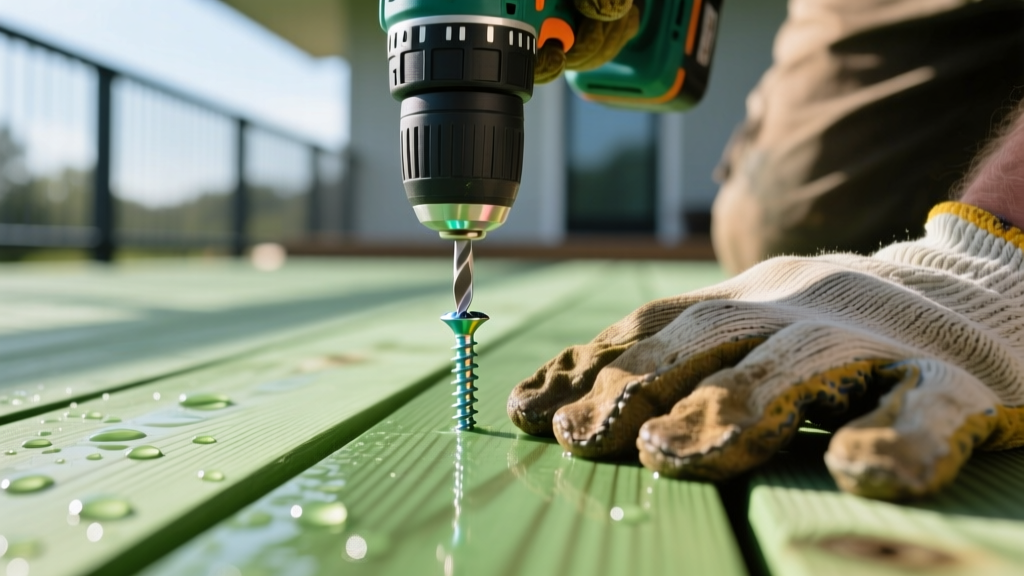
Look for screws featuring a Type 17 auger point. Wet treated wood is dense and the fibers are swollen; a Type 17 point displaces material rather than wedging it apart, drastically reducing splitting and driving torque. Additionally, a knurled shank just below the head cuts a clean countersink into the dense surface of treated pine without requiring a separate pre-drilling step.
Real-World Failure Modes in the Field
Understanding how fasteners fail in treated wood helps in specifying the correct types of wood screws for your specific project parameters:
- Hydrogen Embrittlement: Hardened carbon steel screws (common in structural ledger locks) can absorb hydrogen during the acid pickling phase of manufacturing or from the alkaline environment of the treated wood. Under high torsional load during installation, the screw head snaps off cleanly. Fix: Specify screws that have been baked post-treatment to off-gas hydrogen, or use ductile stainless steel.
- Galvanic Snap: Using a standard zinc screw in ACQ lumber. The zinc coating dissolves within 12-18 months, exposing the high-carbon steel core. The steel rusts rapidly, and the screw shears at the joist line under live loads. Fix: Strict adherence to G185 or polymer-coated specifications.
- Thread Stripping in Dry-Out: As MCQ-treated wood dries, it shrinks radially. Coarse-thread drywall or cheap deck screws strip out of the joist. Fix: Use deep, aggressive V-threads with a smaller root diameter to maximize the wood-to-metal engagement surface.
Quick-Reference Decision Matrix
Use this matrix to select the exact fastener specification based on your lumber treatment and application.
| Lumber Treatment | Application | Required Screw Type / Coating | Drive / Geometry Requirement |
|---|---|---|---|
| ACQ / CA-C | Above Ground Decking (UC3B) | G185 HDG or Multi-layer Polymer | Type 17 Point, Bugle Head, Serrated |
| ACQ / CA-C | Ground Contact Posts (UC4A) | G185 HDG or Type 304 Stainless | Hex Washer Head, Dual-Thread |
| MCQ / MCA | Framing / Ledger Boards | Approved Polymer Coating (e.g., Climatek) | Structural Shank, T-Star / Torx Drive |
| Borate (SBX) | Interior / Protected from Weather | Standard Zinc-Plated is acceptable | Standard Wood Screw Geometry |
| Any Treatment | Marine / Saltwater (UC4C) | Type 316 Stainless Steel ONLY | Pre-drilled, Blunt or Auger Point |
Specifying the correct types of wood screws for pressure-treated lumber requires looking past the packaging and verifying the coating weight, metallurgical composition, and thread geometry. By aligning your fastener selection with the specific AWPA Use Category and the chemical makeup of the preservative, you ensure the structural integrity of the assembly outlasts the wood itself.
Written by
Priya KapoorPriya Kapoor is a real estate market analyst and construction economics researcher with expertise in housing affordability, development feasibility, and infrastructure investment. She holds a Master of Regional Planning from Cornell University and previously worked as a senior analyst at CBRE's Investment Properties group, where she modeled returns for $4B in mixed-use development pipelines. Priya now runs an independent research practice advising developers, municipalities, and REITs on construction cost forecasting and market timing. She publishes the quarterly "BuildMat Market Pulse" report tracking material price indices across 12 commodity categories. Based in Austin, TX, Priya serves on the board of Habitat for Humanity Austin and is a marathon runner.
More from Priya Kapoor
View all
Construction Cost
Cost to Build a 1600 Sq Ft Home in 2026: Full Breakdown
Accurate 2026 cost to build a 1600 sq ft home—material, labor, and regional pricing breakdowns included. Plan your budget with real-time estimates.
Aug 11, 2026

Wood & Lumber
Name the Types of Wood for Pressure Treatment and Preservation
Learn how to name the types of wood best suited for pressure treatment. Compare species treatability, chemical retention levels, and 2026 preservation costs.
Aug 4, 2026

Stone & Masonry
Stone Veneer Suppliers Lindenhurst: 2026 Cost Analysis
Analyze 2026 stone veneer costs in Lindenhurst, NY. Compare local supplier pricing, delivery fees, and Suffolk County installation labor rates.
Aug 4, 2026