What Type of Wood for Cutting Board? A Lumber Grade Guide
Discover what type of wood for cutting board projects is best. Our lumber grade guide covers Janka hardness, NHLA grades, grain orientation, and toxicity.

The Intersection of Hardness, Grade, and Food Safety
When determining what type of wood for cutting board construction is optimal, the answer extends far beyond simply picking a hardwood. A functional, sanitary, and durable cutting board requires a precise balance of Janka hardness, cellular structure (porosity), and lumber grade. Selecting the wrong species or grade results in boards that harbor bacteria, dull premium kitchen knives, or warp under seasonal humidity shifts.
This guide decodes the material science and National Hardwood Lumber Association (NHLA) grading standards necessary for sourcing, milling, and fabricating professional-grade cutting boards.
Decoding the Janka Hardness Scale for Kitchen Use
The Janka hardness test measures the force required to embed a 0.444-inch steel ball halfway into a wood sample. For cutting boards, the ideal Janka range is between 900 and 1,500 lbf (pounds-force). Woods softer than 900 lbf dent easily and develop deep knife grooves that trap moisture and bacteria. Woods harder than 1,500 lbf—such as Ipe or glass-like bamboo—act as abrasives, rapidly rolling and dulling high-carbon steel knife edges.
| Wood Species | Janka Rating (lbf) | Knife Friendliness | Primary Use Case |
|---|---|---|---|
| Hard Maple (Sugar Maple) | 1,450 | Excellent | Heavy-duty commercial butcher blocks |
| Black Walnut | 1,010 | Very Good | Premium residential end-grain boards |
| American Cherry | 950 | Very Good | Accent woods and edge-grain boards |
| Teak | 1,070 | Good (High Silica) | Moisture-resistant serving boards |
| Purpleheart | 1,860 | Poor (Dulls Knives) | Decorative inlays only (max 5% surface) |
According to the Wood Database Janka Scale, Hard Maple remains the industry standard due to its optimal hardness and tight, closed-grain structure. Teak is highly resistant to moisture due to natural oils but contains high silica content, which accelerates knife wear.
NHLA Lumber Grades: Selecting the Right Board
Knowing what type of wood for cutting board use is only half the equation; you must also buy the correct lumber grade. The NHLA grading system dictates the yield of clear, defect-free cuttings you can extract from a board. Because cutting boards require pristine, knot-free, and sap-free surfaces, understanding these grades directly impacts your material costs and waste factor.
FAS (First and Seconds)
FAS is the highest grade, requiring a minimum board size of 4 inches wide by 8 feet long, yielding at least 83.3% clear cuttings. While FAS Hard Maple guarantees large, uninterrupted sections perfect for massive edge-grain commercial butcher blocks, it commands a premium price ($9.00 to $14.00 per board foot in 2026). For standard 18x24-inch residential boards, FAS is often overkill and results in paying for clear length you will ultimately cut away.
#1 Common
Often referred to as the "cabinet grade," #1 Common requires a minimum board size of 3 inches wide by 4 feet long, yielding 66.6% to 83.3% clear cuttings. This is the sweet spot for cutting board fabrication. Because cutting boards are assembled from smaller glued-up strips or blocks, you can easily mill around knots, wane, and sapwood. Purchasing #1 Common Hard Maple ($5.50 to $8.00 per board foot) reduces material costs by up to 40% compared to FAS, with virtually no compromise in the final product's structural integrity.
Pro-Tip on Sapwood: While NHLA grades allow sapwood in #1 Common, sapwood is more porous and susceptible to fungal staining than heartwood. When milling #1 Common for cutting boards, rip off the sapwood edges and reserve them for non-food-safe jigs or shop projects.
Grain Orientation and Structural Integrity
The way the log is milled and oriented during glue-up dictates the board's longevity, warping resistance, and "self-healing" properties.
- End-Grain (Premium): The growth rings face upward. Knife blades slide between the wood fibers rather than severing them, allowing the wood to close back up (self-healing). End-grain boards require 4x more lumber to produce, making them the most expensive option. They must be built at least 1.5 inches thick to prevent structural failure.
- Edge-Grain (Standard): The board is sliced vertically along the log. The tight, vertical grain lines face up. Edge-grain boards are highly stable, resist warping better than face-grain, and offer the best balance of cost, durability, and weight for daily kitchen use.
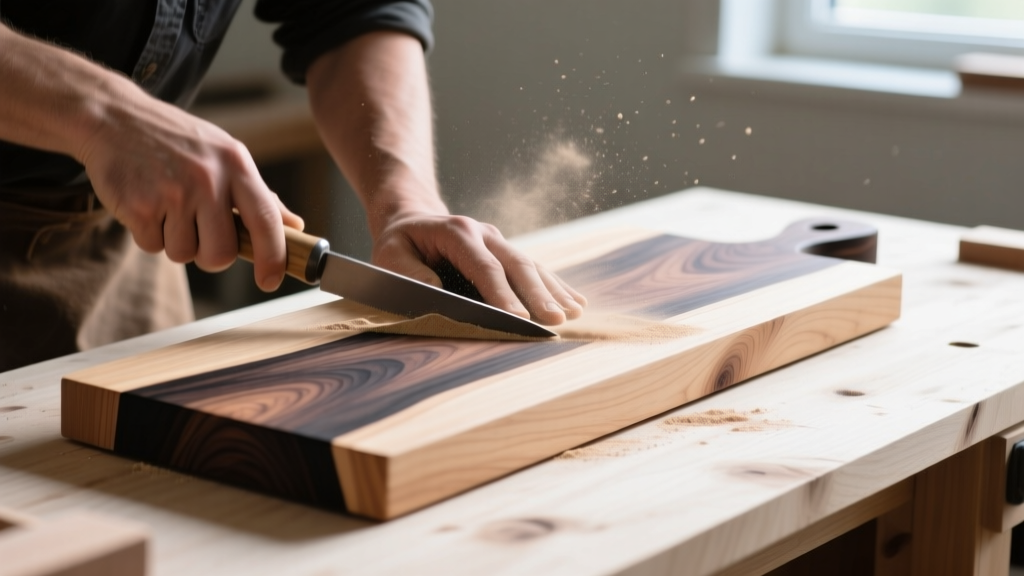
- Face-Grain (Avoid for Heavy Chopping): The flat-sawn surface faces up. While it showcases the most dramatic cathedral grain patterns, face-grain is the softest cutting surface. It shows knife scars immediately and is highly prone to cupping if exposed to uneven moisture on a kitchen counter.
The Porosity and Toxicity Trap: Woods to Avoid
Not all hardwoods are food-safe. The cellular structure of the wood and its natural chemical defenses play a massive role in kitchen safety.
Open-Grain Woods (Bacterial Hazards)
Woods like Red Oak, White Oak, Ash, and Hickory possess large, open pores (vessels) designed to transport water up the tree. When sliced open on a cutting board, these pores act as microscopic traps for meat juices, fats, and food particles. Even with rigorous washing, bacteria can thrive deep within the open pores. Always select closed-grain, diffuse-porous woods like Maple, Cherry, or Walnut.
Toxic and Sensitizing Woods
Many exotic hardwoods contain natural fungicides and insecticides that are toxic to humans. The Wood Database Toxicity Guide explicitly warns against using woods like Rosewood, Cocobolo, Yew, and Purpleheart for food contact surfaces. The oils in these woods can leach into acidic foods (like tomatoes or citrus) and cause severe allergic reactions or systemic toxicity. Stick to domestic, fruit-and-nut-bearing hardwoods for guaranteed food safety.
Moisture Content and Milling Tolerances
The most common cause of cutting board failure is not wood selection, but improper moisture management and poor glue-line tolerances.
Critical Milling Specifications
- Target Moisture Content (MC): 6% to 8%. The USDA Forest Service Wood Handbook notes that interior wood products in climate-controlled homes equilibrate around 8% MC. Kiln-dried lumber must be acclimated in your shop for 2 to 3 weeks before milling.
- Glue Joint Tolerance: When preparing edge-grain strips for glue-up, the jointed edges must be perfectly square (90 degrees). The maximum allowable gap at the glue line is 0.005 inches. Wider gaps starve the joint of adhesive, leading to catastrophic delamination when the board is washed.
- Adhesive Selection: Use a Type I waterproof cross-linking PVA adhesive (such as Titebond III). Standard yellow glues (Type II) will eventually creep and fail under repeated hot-water washing cycles.
Summary Decision Framework
Use this matrix to finalize your material order based on the end-user and budget:
| Project Requirement | Recommended Species | Recommended NHLA Grade | Grain Orientation |
|---|---|---|---|
| Heavy-Duty Commercial Butcher Block | 100% Hard Maple | FAS (for long continuous strips) | Edge-Grain |
| Premium Residential Heirloom Board | Maple & Black Walnut mix | #1 Common (cut around defects) | End-Grain (1.75" thick) |
| Budget-Friendly Charcuterie/Serving | American Cherry | #1 Common or #2 Common | Edge-Grain or Face-Grain |
By prioritizing closed-grain domestic hardwoods in the 900-1500 Janka range, leveraging #1 Common lumber to minimize waste, and strictly controlling moisture content prior to glue-up, you ensure the cutting board will remain flat, sanitary, and structurally sound for decades.
Written by
Marcus ChenMarcus Chen is a licensed structural engineer (PE) and building materials analyst with over 12 years of experience across residential, commercial, and industrial construction. He holds a Master of Science in Civil Engineering from UC Berkeley and spent six years at Thornton Tomasetti before transitioning to independent consulting and technical writing. Marcus specializes in material selection for seismic-prone regions, concrete reinforcement strategies, and lifecycle cost analysis. His work has been cited by the American Concrete Institute (ACI) and the Structural Engineers Association of California (SEAOC). When he is not on a job site or at his desk, you will find him hiking the Sierra Nevada or restoring a 1920s craftsman bungalow in Oakland, CA.
More from Marcus Chen
View all
Construction Cost
How Much Did the Eiffel Tower Cost to Build?
How much did the Eiffel Tower cost to build in 1889? We adjust for inflation and compare its budget to modern skyscraper construction.
Aug 4, 2026

Fire Resistance
What Is a Fire Resistant Material? Testing & Certification Guide
Discover what is a fire resistant material through ASTM and UL testing. Learn how fire ratings, certifications, and assemblies work in construction.
Aug 4, 2026

Construction Cost
How Much Did the Burj Khalifa Cost to Build?
How much did the Burj Khalifa cost to build? We break down the $1.5B project and extract 5 money-saving strategies for your next build.
Jul 30, 2026