Different Types of Hard Wood: A Builder's Selection Framework
Master the selection framework for different types of hard wood. Compare Janka ratings, dimensional stability, and costs for structural and finish use.
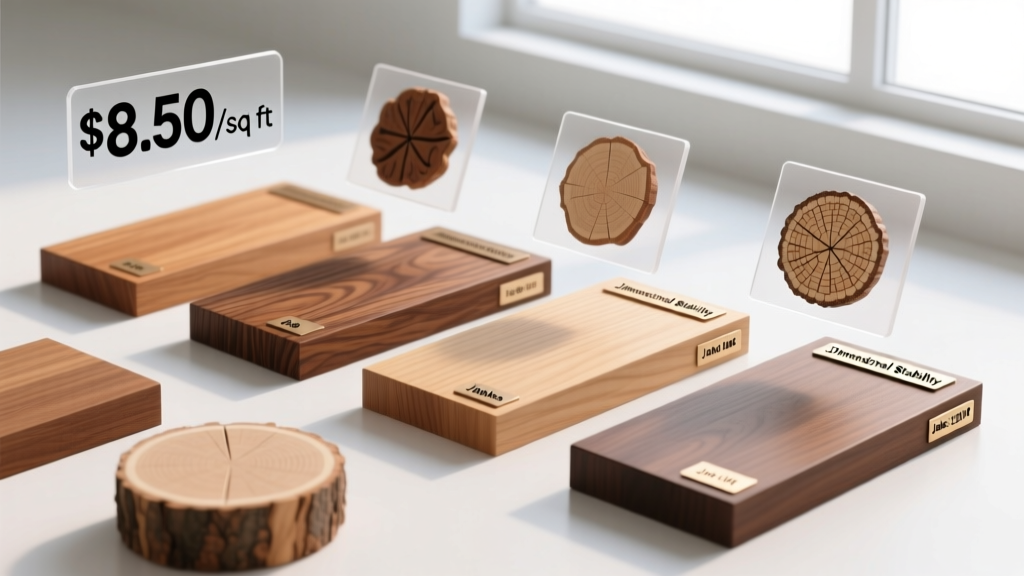
The 4-Pillar Hardwood Selection Framework
Selecting the wrong hardwood species for a specific environment is one of the most expensive mistakes in finish carpentry and flooring. A plank of hard maple installed over a humid basement crawl space will cup and crown within a single seasonal cycle, while white oak in the same environment remains dimensionally stable. Understanding the different types of hard wood requires moving beyond basic aesthetics and evaluating cellular structure, moisture dynamics, and mechanical properties.
This framework evaluates hardwood species across four critical pillars: Janka hardness and load capacity, dimensional stability, machinability, and finish compatibility. By applying these metrics, builders and architects can specify the exact species, cut, and grade required for long-term performance.
Pillar 1: Janka Hardness and Load-Bearing Capacity
The Janka hardness test measures the force required to embed a 0.444-inch steel ball halfway into the wood grain. While often marketed purely as a 'scratch resistance' metric for flooring, Janka ratings actually dictate fastener holding power, structural load limits, and tool wear rates. According to the Wood Database, species with ratings above 1,500 lbf (pounds-force) require specialized carbide tooling and pre-drilling for structural fasteners.
| Species | Janka Rating (lbf) | T/R Shrinkage Ratio | 2026 Avg. Cost (per BF) | Optimal Application |
|---|---|---|---|---|
| Hard Maple | 1,450 | 1.53 | $7.50 - $10.00 | High-traffic commercial flooring, bowling alleys |
| White Oak | 1,360 | 1.87 | $8.00 - $12.50 | Exterior siding, wet-area flooring, structural beams |
| Hickory | 1,820 | 1.43 | $9.00 - $13.00 | Heavy-duty tool handles, rustic high-impact flooring |
| White Ash | 1,320 | 1.35 | $6.50 - $9.50 | Millwork, cabinetry, bentwood applications |
| Ipe (Brazilian Walnut) | 3,510 | 1.08 | $16.00 - $23.00 | Exterior decking, boardwalks, marine docks |
Pillar 2: Dimensional Stability and Moisture Tolerance
Hardwood expands and contracts at different rates depending on the grain orientation. The Tangential/Radial (T/R) shrinkage ratio is the most vital metric for predicting dimensional stability. A T/R ratio closer to 1.0 indicates the wood shrinks evenly across and along the growth rings, minimizing warping and checking. The USDA Forest Products Laboratory's Wood Handbook details how quartersawn lumber inherently leverages the radial shrinkage plane, reducing surface cupping by up to 50% compared to plainsawn boards.
Woods high in tannic acid, particularly White Oak and Walnut, will react with galvanized or electroplated fasteners. This creates a permanent black iron-tannate stain that bleeds through finishes. Always specify 304 or 316 stainless steel, or hot-dipped galvanized fasteners with a polymer coating, when framing or face-nailing tannin-rich species.
Pillar 3: Machinability and Tool Wear Constraints
The silica content and interlocked grain patterns in certain hardwoods dictate production timelines and tooling budgets. When milling different types of hard wood, factor in the following constraints:
- High Silica / High Density (Ipe, Cumaru): Blunts standard HSS (High-Speed Steel) router bits within 50 linear feet. Requires solid carbide tooling with a reduced hook angle to prevent tear-out and burning.
- Interlocked Grain (Sapele, Hickory): Prone to severe tear-out during planing. Requires taking shallow passes (under 1/32 inch) and ensuring planer knives are honed to a mirror finish.
- Uniform / Closed Grain (Hard Maple, Cherry): Machines exceptionally well but is prone to burn marks from dull blades. Maintain feed rates above 30 feet per minute when routing to avoid friction scorching.
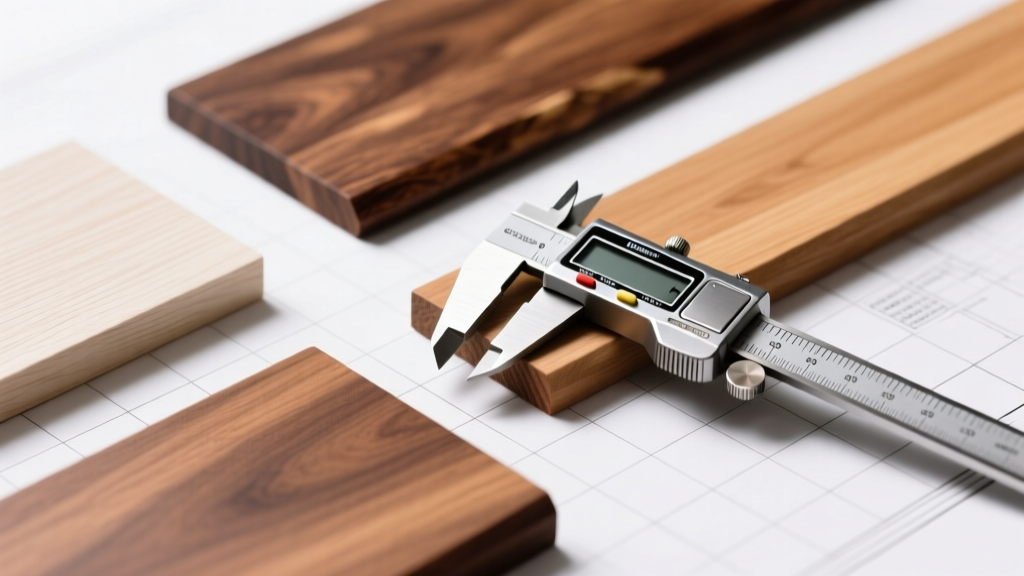
Application-Specific Decision Matrix
Use this matrix to cross-reference environmental threats with the correct species and milling technique. The National Wood Flooring Association (NWFA) strictly advises against installing solid hardwoods below grade; however, specific species and cuts can mitigate risk in borderline environments when paired with vapor retarders.
| Environment | Primary Threat | Recommended Species | Required Cut / Grade |
|---|---|---|---|
| Below-Grade Basement | High ambient humidity, concrete moisture vapor | Engineered White Oak (Not Solid) | Quarter-sawn, 4mm wear layer |
| Sunroom / Solarium | Extreme UV degradation, thermal expansion | Ipe or Teak | Kiln-dried to 12-15% MC, oiled finish |
| Commercial Lobby | High impact, rolling loads, abrasive dirt | Hickory or Hard Maple | Plainsawn, FAS grade, aluminum oxide finish |
| Bathroom (Dry Zones) | Splashing, localized humidity spikes | Teak or White Oak | Quarter-sawn, penetrating oil sealant |
Finish Compatibility and Grain Structure
The cellular pore structure of hardwood determines how it accepts stains and topcoats. Ignoring grain structure leads to blotchy finishes and premature coating failure.
Open-Grain Species (Oak, Ash, Mahogany)
These woods feature large, visible pores that trap air and require filling before applying high-gloss film finishes. If applying a water-based polyurethane (like Bona Traffic HD) over open-grain white oak without a pore filler, the finish will sink into the grain, creating a pitted, uneven surface. Use a paste wood filler tinted to match the stain before applying the topcoat.
Closed-Grain Species (Maple, Cherry, Birch)
Closed-grain woods have tight, uniform pores but are notorious for uneven stain absorption, particularly in maple. The dense latewood absorbs less stain than the earlywood, resulting in severe blotching.
Expert Finishing Protocol for Maple: Never use traditional liquid oil stains on raw maple. Instead, apply a 1 lb cut of dewaxed shellac as a pre-stain sealer, followed by an aniline dye or a gel stain. Gel stains sit on the surface rather than penetrating deeply, ensuring uniform color distribution across varying density zones.
Sourcing, Grading, and Compliance
When procuring different types of hard wood for large-scale projects, understanding NHLA (National Hardwood Lumber Association) grading rules is essential for budget accuracy. FAS (Firsts and Seconds) grade guarantees a minimum clear-face cutting yield of 83.3%, making it mandatory for long, continuous runs of baseboard, crown molding, or wide-plank flooring. #1 Common grade yields only 66.7% clear wood and is suited for cabinetry and short-run millwork where defects can be cut around.
Furthermore, ensure all imported tropical hardwoods comply with the Lacey Act and carry FSC (Forest Stewardship Council) Chain of Custody certification. In 2026, customs enforcement on undocumented tropical timber has intensified, and specifying FSC-certified Ipe or Teak protects the general contractor from severe federal fines and project delays. Always request the FSC certificate number from the lumber distributor and verify it against the public FSC database before authorizing the purchase order.
Written by
Priya KapoorPriya Kapoor is a real estate market analyst and construction economics researcher with expertise in housing affordability, development feasibility, and infrastructure investment. She holds a Master of Regional Planning from Cornell University and previously worked as a senior analyst at CBRE's Investment Properties group, where she modeled returns for $4B in mixed-use development pipelines. Priya now runs an independent research practice advising developers, municipalities, and REITs on construction cost forecasting and market timing. She publishes the quarterly "BuildMat Market Pulse" report tracking material price indices across 12 commodity categories. Based in Austin, TX, Priya serves on the board of Habitat for Humanity Austin and is a marathon runner.
More from Priya Kapoor
View all
Construction Cost
Cost to Build a 1600 Sq Ft Home in 2026: Full Breakdown
Accurate 2026 cost to build a 1600 sq ft home—material, labor, and regional pricing breakdowns included. Plan your budget with real-time estimates.
Aug 11, 2026

Wood & Lumber
Name the Types of Wood for Pressure Treatment and Preservation
Learn how to name the types of wood best suited for pressure treatment. Compare species treatability, chemical retention levels, and 2026 preservation costs.
Aug 4, 2026

Stone & Masonry
Stone Veneer Suppliers Lindenhurst: 2026 Cost Analysis
Analyze 2026 stone veneer costs in Lindenhurst, NY. Compare local supplier pricing, delivery fees, and Suffolk County installation labor rates.
Aug 4, 2026