Types of Golf Woods: Grade and Quality Guide for Persimmon Lumber
Explore the types of golf woods through a lumber grading lens. Learn how persimmon and maple blanks are graded for density, moisture, and structural quality.
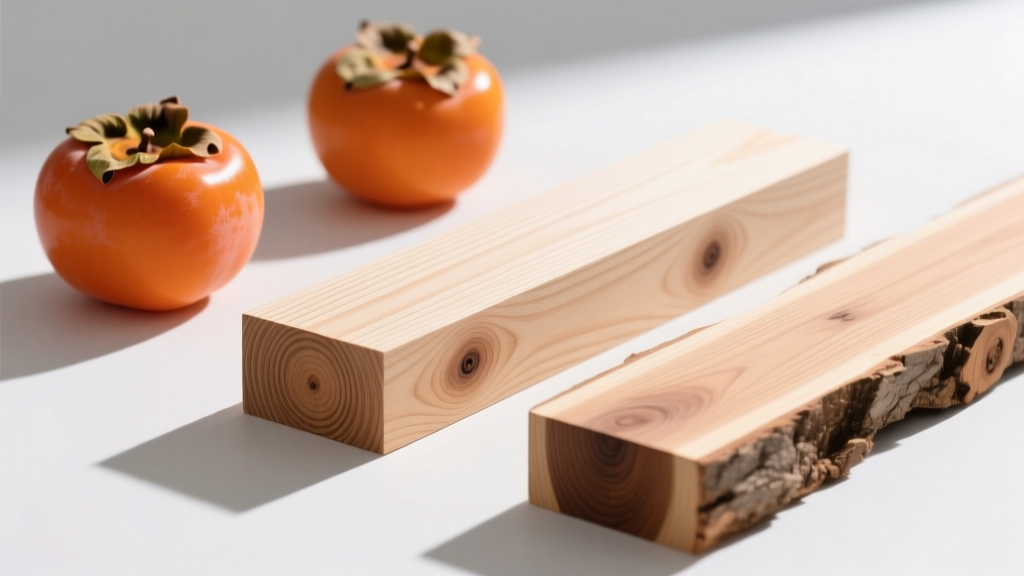
The Material Science Behind Traditional Golf Woods
When discussing the types of golf woods, most players immediately think of club classifications like drivers, 3-woods, and 5-woods. However, from a lumber grading, woodworking, and material science perspective, the term refers to the actual wood species and precision-milled blanks used to manufacture these club heads. While modern club manufacturing has largely transitioned to titanium, carbon fiber, and maraging steel, the foundational science of grading wood for high-impact sports equipment remains a masterclass in specialty lumber selection.
Manufacturing a wooden golf club head requires timber that can withstand repeated high-velocity impacts with a hardened urethane or Surlyn golf ball traveling at speeds exceeding 140 mph. The wood must possess extreme shock resistance, high specific gravity, and a tight, interlocking grain structure. This guide breaks down the exact grading parameters, species selection, and quality control metrics used to evaluate lumber for traditional golf wood blanks.
Grading American Persimmon: The Gold Standard
American Persimmon (Diospyros virginiana) is the undisputed king of traditional golf club lumber. Unlike the dark, expensive ebony used in fine furniture, American persimmon is valued for its dense, pale sapwood and incredibly tight grain. According to The Wood Database, persimmon boasts a Janka hardness of 2,300 lbf and a specific gravity of 0.75 to 0.85, making it one of the hardest and most shock-resistant domestic hardwoods in North America.
Density and Specific Gravity Requirements
Not every persimmon log qualifies for golf club manufacturing. Graders evaluate rough-sawn blanks using a combination of weight-to-volume ratios and acoustic testing.
- Target Specific Gravity: Premium grade blanks must fall between 0.78 and 0.83 (oven-dry basis). Blanks below 0.75 lack the necessary mass for optimal energy transfer, while those above 0.85 are prone to brittle fracture upon impact.
- Grain Orientation: The highest quality blanks are quarter-sawn or rift-sawn. Edge-grain (vertical grain) orientation provides superior structural integrity across the striking face, minimizing the risk of face collapse.
- Growth Ring Density: Graders look for a minimum of 20 to 30 growth rings per inch. Slow-growth persimmon from rocky, nutrient-poor soils yields the tightest, most resilient grain structure.
Moisture Content and Kiln Drying Tolerances
Moisture management is the most critical failure point in golf wood manufacturing. If a blank is milled into a club head before reaching Equilibrium Moisture Content (EMC), the face will warp, and the sole will crack. The USDA Forest Products Laboratory Wood Handbook outlines strict drying schedules for dense hardwoods. For persimmon golf blanks, the lumber is first air-dried for 12 to 18 months, followed by a carefully monitored kiln-drying phase.
Expert Insight: Premium persimmon blanks must be dried to a strict 6% to 8% moisture content. Graders use pinless electromagnetic moisture meters to scan the entire 4.5" x 3" x 2.5" blank. Any blank showing a moisture gradient greater than 1.5% between the core and the shell is rejected for golf use and downgraded to tool handle stock.
Laminated Maple and Alternative Wood Blanks
While persimmon was the standard for drivers (1-woods), its extreme density made it difficult to shape into the larger, more sweeping sole profiles required for fairway woods (3-woods and 5-woods). For these clubs, manufacturers turned to laminated sugar maple (Acer saccharum) and yellow birch.
Laminated blocks are created by gluing together thin veneers (typically 1/16" thick) under high pressure using resorcinol-formaldehyde or modern aerospace-grade epoxy adhesives. This cross-lamination process artificially eliminates the risk of end-grain splitting and allows for complex CNC milling of the sole plate. When grading laminated blanks, inspectors look for:
- Glue Line Integrity: Zero evidence of delamination or starved joints when viewed under 10x magnification.
- Veneer Consistency: All veneers must be rotary-peeled sugar maple with a minimum Janka hardness of 1,450 lbf.
- Void Detection: Blanks are tapped with a steel mallet; a dull thud indicates internal voids or glue failure, resulting in immediate rejection.
Wood Species Comparison for Golf Club Heads
The table below compares the physical properties of the primary wood species used in traditional golf club manufacturing against modern composite alternatives.
| Material / Species | Janka Hardness (lbf) | Specific Gravity | Primary Application | Impact Shock Resistance |
|---|---|---|---|---|
| American Persimmon | 2,300 | 0.78 - 0.85 | Drivers (1-Wood) | Exceptional |
| Sugar Maple (Solid) | 1,450 | 0.68 - 0.72 | Fairway Woods | Good |
| Laminated Birch/Maple | 1,260 - 1,450 | 0.65 - 0.75 | Fairway Woods / Utility | Very Good (Engineered) |
| White Ash | 1,320 | 0.60 - 0.67 | Historical / Vintage Clubs | Moderate |
| Titanium Alloy (Ti-6Al-4V) | N/A (Metal) | 4.43 | Modern Drivers | N/A (Elastic Rebound) |
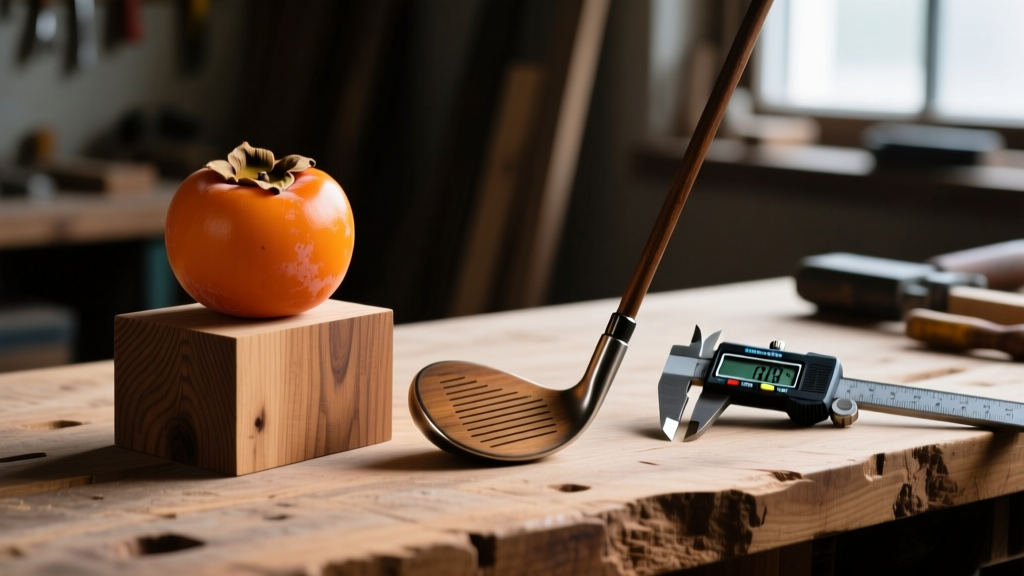
Visual and Structural Defects in Golf Wood Blanks
Grading lumber for golf clubs is unforgiving. A defect that might be acceptable in flooring or furniture will cause catastrophic failure in a golf club head. Graders categorize defects into three tiers:
1. Critical Defects (Automatic Rejection)
- End Checks and Heart Checks: Any micro-fissure radiating from the pith or the end grain. High-velocity impacts will cause these checks to propagate instantly, splitting the club head in half.
- Pin Knots on the Striking Face: While small knots are acceptable on the sole or crown of the club, the striking face must be 100% clear. A pin knot creates a localized hard spot that will dent the golf ball and alter its flight trajectory.
- Wane or Bark Pockets: Any inclusion of bark or missing wood on the edges of the rough blank that compromises the final milled dimensions.
2. Cosmetic Defects (Downgraded to Secondary Markets)
- Mineral Staining: Dark streaks caused by mineral deposits in the soil. Structurally sound, but visually unappealing for premium clear-finished clubs.
- Color Variation: Persimmon heartwood is dark brown/black, while sapwood is pale. Blanks that feature a harsh transition line between heartwood and sapwood are often rejected for aesthetic reasons, despite having excellent structural properties.
Because persimmon is so dense, internal stresses from improper kiln drying can create micro-fissures invisible to the naked eye. Professional graders use a technique called "proof-loading," where the blank is subjected to 500 lbs of static pressure in a hydraulic press. If the blank emits a high-pitched pinging sound or shows permanent deflection, it is discarded.
Sourcing and Specifying Grade-A Blanks
For custom club makers, woodturners, and specialty lumber buyers, sourcing true "golf grade" persimmon requires strict specifications. When ordering from specialty sawmills in the Appalachian region (where the best slow-growth persimmon is harvested), your purchase order must explicitly state the following parameters:
- Dimensions: Oversized rough blanks, minimum 4.5" x 3.0" x 2.5" (allowing for CNC facing and sanding).
- Moisture Content: Certified 6-8% MC, verified with pinless meter readings documented on the batch invoice.
- Grain Slope: Maximum grain slope of 1:12 (8.3%) to ensure maximum shear strength across the face.
- Compliance: While modern USGA rules heavily restrict the use of wood in conforming tournament drivers due to the USGA Equipment Rules regarding clubhead volume and spring-like effect, the wood must still be free of any injected chemical hardeners or foreign inserts if intended for vintage restoration or hickory golf society play.
Frequently Asked Questions (FAQ)
Can I use standard hardware store hardwood for a golf club head?
No. Standard dimensional hardwoods like oak, hickory, or standard maple lack the specific gravity and interlocking grain structure required to survive repeated impacts with a golf ball. They will compress, dent, or split within a few dozen swings. Only specialty-grade persimmon or cross-laminated maple blocks are viable.
Why did manufacturers stop using wood for golf "woods"?
The transition away from wood occurred in the late 1980s and 1990s. While persimmon offered excellent feel, its high density limited the size of the club head. Metal and composite materials allowed engineers to create much larger club heads with perimeter weighting and a lower center of gravity, vastly increasing the "sweet spot" and forgiveness for amateur players.
How do I store raw persimmon blanks to prevent checking?
Raw blanks must be stored in a climate-controlled environment maintaining 45-55% relative humidity and a temperature of 65-70°F. Always coat the end grain with a commercial sealer (like Anchorseal) immediately upon receiving the lumber, even if it has been kiln-dried, to prevent rapid moisture exchange with the ambient air.
Written by
Sarah WhitfieldSarah Whitfield is a chartered quantity surveyor (MRICS) and construction cost analyst with 15 years of experience in material pricing, procurement strategy, and project budgeting. She earned her degree in Construction Management from the University of Reading (UK) and has worked on projects ranging from $2M custom homes to $180M mixed-use developments across North America and Europe. Sarah currently leads cost estimating for BuildMat Insight, maintaining a proprietary database of 4,000+ material price points updated quarterly. She is a frequent contributor to RSMeans cost data panels and has presented at the International Cost Engineering Council (ICEC) congress. Based in Denver, CO, Sarah is an avid trail runner and volunteer mentor for Women in Construction.
More from Sarah Whitfield
View all
Wood & Lumber
What Are the Different Types of Wood? A Builder's Guide
Compare structural softwoods, finish hardwoods, and engineered lumber. Analyze Janka ratings, MOE values, and 2026 pricing for construction.
Aug 4, 2026

Walls & Panels
Steel Framing vs Wood Framing: Corrosion and Moisture Defense
Compare steel framing vs wood framing for moisture resistance. Learn about galvanized coatings, condensation risks, and corrosion protection strategies.
Jul 21, 2026

Stone & Masonry
How to Cut Stone Veneer: Wet Saw vs Grinder Comparison
Compare the best tools for cutting stone veneer. We review wet saws, angle grinders, and chop saws to help you achieve clean, chip-free cuts.
Jul 21, 2026