Different Types of Wood Flooring Compared: Solid vs. Engineered vs. Composite
Compare different types of wood flooring including solid hardwood, engineered wood, and composites. Expert insights on cost, durability, and installation.

The Core Contenders: Solid vs. Engineered vs. Wood-Look Composite
Selecting the right wood flooring requires moving beyond aesthetic preferences to evaluate dimensional stability, subfloor compatibility, and long-term maintenance. The market is dominated by three distinct categories: solid hardwood, engineered hardwood, and wood-polymer composites (WPC/SPC). Each interacts differently with moisture, temperature fluctuations, and structural loads. According to the National Wood Flooring Association (NWFA), improper material selection for specific climate zones and subfloors accounts for over 60% of post-installation flooring failures.
Head-to-Head Comparison Matrix
| Feature | Solid Hardwood | Engineered Hardwood | Rigid Core Composite (WPC/SPC) |
|---|---|---|---|
| Thickness | 3/4-inch standard | 3/8-inch to 3/4-inch | 5mm to 8mm |
| Dimensional Stability | Low (expands/contracts significantly) | High (cross-ply core resists movement) | Exceptional (waterproof core) |
| Subfloor Compatibility | Plywood/OSF above grade only | Plywood, OSF, or concrete (all grades) | Any subfloor, including below-grade |
| Refinishing Potential | 4 to 6 times (3/4-inch stock) | 0 to 3 times (depends on wear layer) | None (photographic wear layer) |
| Installation Methods | Nail or staple down | Glue, nail, or floating click-lock | Floating click-lock only |
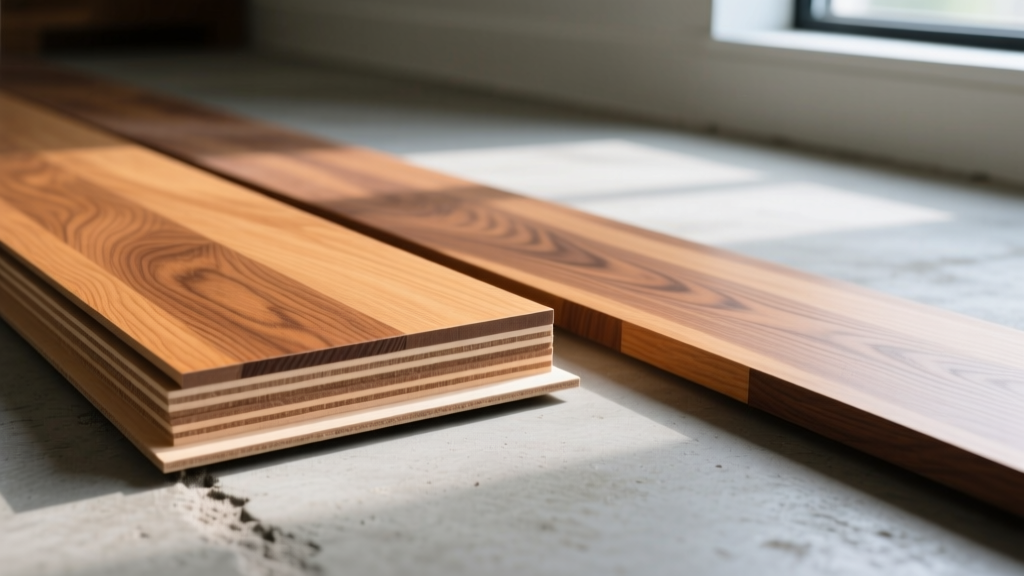
Solid Hardwood: The Traditional Benchmark
Solid hardwood is milled from a single piece of timber, typically 3/4-inch thick. Its primary advantage is longevity; a 3/4-inch plank can be sanded and refinished multiple times, often lasting over a century. However, its cellular structure makes it highly reactive to ambient moisture.
Species Hardness and Janka Ratings
Durability in solid wood is measured by the Janka hardness test, which calculates the force required to embed a 0.444-inch steel ball halfway into the wood. The USDA Forest Products Laboratory provides standardized testing for these metrics. For high-traffic residential or light commercial applications, specify species with a Janka rating above 1300.
- Brazilian Walnut (Ipe): 3,684 lbf (Exceptional durability, difficult to machine)
- Hickory: 1,820 lbf (Hardest domestic North American species, pronounced grain variation)
- Hard Maple: 1,450 lbf (Tight grain, uniform color, standard for gymnasiums)
- White Oak: 1,360 lbf (High tannin content resists rot, currently the most specified domestic species)
- Black Walnut: 1,010 lbf (Softer, prized for deep color, dents easily under point loads)
Mill Cuts and Dimensional Movement
How the log is cut dictates how the plank reacts to moisture. Plainsawn boards (cathedral grain pattern) are the most common and least expensive but are highly prone to cupping across the width. Quartersawn boards (linear grain) shrink and swell primarily in thickness rather than width, making them up to 50% more dimensionally stable. For wide-plank installations (5 inches or wider), quartersawn or riftsawn white oak is mandatory to prevent severe gapping and cupping.
Engineered Wood: The Modern Problem Solver
Engineered wood features a real hardwood veneer bonded to a structural core, usually composed of cross-laminated plywood or high-density fiberboard (HDF). The perpendicular layering of the core neutralizes the natural expansion and contraction of wood, allowing it to be installed over concrete slabs and radiant heating systems where solid wood would fail.
Veneer Thickness and Refinishing Limits
The critical specification for engineered wood is the thickness of the top hardwood wear layer. This dictates the product's lifespan and refinishing capability.
- 0.6mm to 1.2mm (Sliced/Rotary Peel): Cannot be sanded. Lifespan is limited to the durability of the factory UV finish (typically 10-15 years).
- 2mm to 3mm (Sawn Cut): Can be lightly screened and recoated, or carefully sanded once by a professional using a planetary sander.
- 4mm to 6mm (Thick Sawn Cut): Functions identically to solid wood regarding refinishing. Can be fully sanded 2 to 3 times.
"When specifying engineered wood for a 20-year lifecycle, always mandate a minimum 3mm sawn-cut wear layer. Rotary-peeled veneers at 1mm will telegraph subfloor imperfections and cannot be refinished once the aluminum oxide coating wears through."
Adhesive Chemistry for Glue-Down Installations
When gluing engineered wood to concrete, adhesive selection is critical. As of 2026, silane-modified polymer (SMP) adhesives have largely replaced traditional urethane adhesives for premium installations. SMP adhesives remain permanently flexible, accommodating the minor dimensional shifts of the wood without breaking the bond, and they do not require a separate moisture vapor barrier if the concrete's relative humidity (RH) is below 75%.
Rigid Core Composites: The Waterproof Alternative
While not true hardwood, Wood-Plastic Composite (WPC) and Stone-Plastic Composite (SPC) flooring dominate the market for moisture-prone areas. These products feature a high-resolution photographic wood layer protected by a clear urethane wear layer, bonded to a rigid, waterproof core.
WPC vs. SPC Core Construction
WPC (Wood-Plastic Composite): Incorporates a foaming agent into the PVC core, creating a thicker, softer plank (typically 7mm-8mm). It offers superior acoustic dampening and underfoot comfort but is more susceptible to indentation from heavy, concentrated loads (e.g., piano legs or heavy appliance casters).
SPC (Stone-Plastic Composite): Uses a limestone-dust and PVC core. It is thinner (5mm-6mm), denser, and highly resistant to indentation. SPC is the required choice for commercial applications or residential areas with heavy point loads, though it transmits more impact noise without an attached acoustic underlayment.
Cost Breakdown: Material vs. Installed Pricing
Pricing varies significantly based on species, origin, and finish quality. The following ranges reflect 2026 market averages for materials and professional installation.
| Flooring Type | Material Cost (per sq. ft.) | Installation Labor (per sq. ft.) | Total Installed Cost (per sq. ft.) |
|---|---|---|---|
| Solid Hardwood (Domestic) | $5.00 - $9.00 | $4.50 - $7.00 | $9.50 - $16.00 |
| Solid Hardwood (Exotic) | $9.00 - $15.00+ | $5.50 - $8.50 | $14.50 - $23.50+ |
| Engineered (Standard 2mm wear) | $4.50 - $8.00 | $3.50 - $6.00 | $8.00 - $14.00 |
| Engineered (Premium 4mm+ wear) | $8.00 - $13.00 | $4.00 - $7.00 | $12.00 - $20.00 |
| Rigid Core (WPC/SPC) | $3.00 - $6.50 | $2.00 - $4.50 | $5.00 - $11.00 |
Note: Installation costs for solid and engineered wood do not include subfloor leveling, moisture mitigation primers, or removal of existing flooring, which can add $1.50 to $3.50 per square foot.
Decision Framework: Which Type Fits Your Project?
Use this diagnostic flow to select the correct flooring type based on your specific structural and environmental parameters.
Scenario A: Below-Grade Basement or Concrete Slab-on-Grade
Verdict: Engineered Wood or Rigid Core (SPC). Solid wood will absorb moisture vapor migrating through concrete, leading to catastrophic cupping and black mold growth. If the homeowner demands real wood, specify a 5/8-inch engineered plank with a 4mm wear layer, installed using a moisture-cured SMP adhesive over a tested concrete slab (calcium chloride test must read below 3 lbs/1000 sq ft/24 hours).
Scenario B: Over Radiant Floor Heating
Verdict: Engineered Wood (Quartersawn or Riftsawn). Solid wood will gap severely when the heating system dries out the ambient air in winter. Engineered wood's cross-ply core resists this movement. Limit the plank width to 5 inches, ensure the surface temperature of the floor never exceeds 80°F (26°C), and specify a species with high dimensional stability like white oak or American walnut. Avoid maple and hickory over radiant heat, as their dense cellular structure makes them prone to checking (micro-splitting) under thermal stress.
Scenario C: High-Traffic Family Home with Large Dogs
Verdict: Solid Hickory, Solid White Oak, or SPC Composite. If real wood is required, avoid soft species like pine or walnut. Specify hickory (1820 Janka) or white oak (1360 Janka) with a wire-brushed or hand-scraped texture. These textures mask scratches and dents far better than smooth, high-gloss factory finishes. Alternatively, a 20-mil wear layer SPC composite will provide the visual of wood with complete immunity to pet claws and urine spills.
Final Specifications and Procurement Advice
When procuring materials, always verify the finish chemistry. UV-cured aluminum oxide finishes offer the highest scratch resistance (often rated for 25-year residential wear warranties) but are nearly impossible to spot-repair if deeply gouged. Penetrating hardwax oils (like Rubio Monocoat or Osmo) offer lower initial scratch resistance but allow for seamless, localized spot-repairs without sanding the entire floor, making them highly practical for active households. For comprehensive consumer testing and performance ratings on specific brands, refer to the Consumer Reports Flooring Buying Guide.
By aligning the physical properties of the wood product with the specific moisture, thermal, and structural realities of your subfloor, you ensure a flooring installation that performs flawlessly for decades.
Written by
James ThorntonJames Thornton is a construction industry veteran with 25 years of hands-on experience in wood framing, lumber grading, and residential building codes. He started as a framing carpenter in rural Oregon, earned his ICC Residential Building Inspector certification, and eventually became a senior plan reviewer for the City of Portland Bureau of Development Services. James holds a B.S. in Wood Science & Technology from Oregon State University and is a certified lumber grader through the West Coast Lumber Inspection Bureau (WCLIB). He has inspected over 3,000 residential construction sites and authored the city's internal guide on advanced framing techniques (2x6 at 24" O.C.). James lives in Bend, OR, where he builds custom timber-frame cabins and competes in lumberjack sports.
More from James Thornton
View all
Insulation
Best Home Insulation Materials: Complete 2026 Guide
Compare top home insulation materials for 2026. Find R-values, installed costs per square foot, and best uses for fiberglass, spray foam, and mineral wool.
Aug 4, 2026

Sustainable Building
Certify Your Green Building Material for LEED and WELL
Step-by-step guide to certifying a green building material for LEED v5 and WELL v2. Master EPDs, HPDs, and VOC limits for 2026 project specifications.
Aug 4, 2026

Stone & Masonry
Veneer Stacked Stone Panels: Interior Design & Style Showcase
Discover how veneer stacked stone panels transform interiors. Explore modern design profiles, material pairings, and technical installation specs.
Aug 4, 2026