Best Types of Wood Fences: 2026 Durability & Cost Review
Compare the best types of wood fences in 2026. Expert review of pressure-treated pine, cedar, redwood, and ipe costs, durability, and AWPA standards.
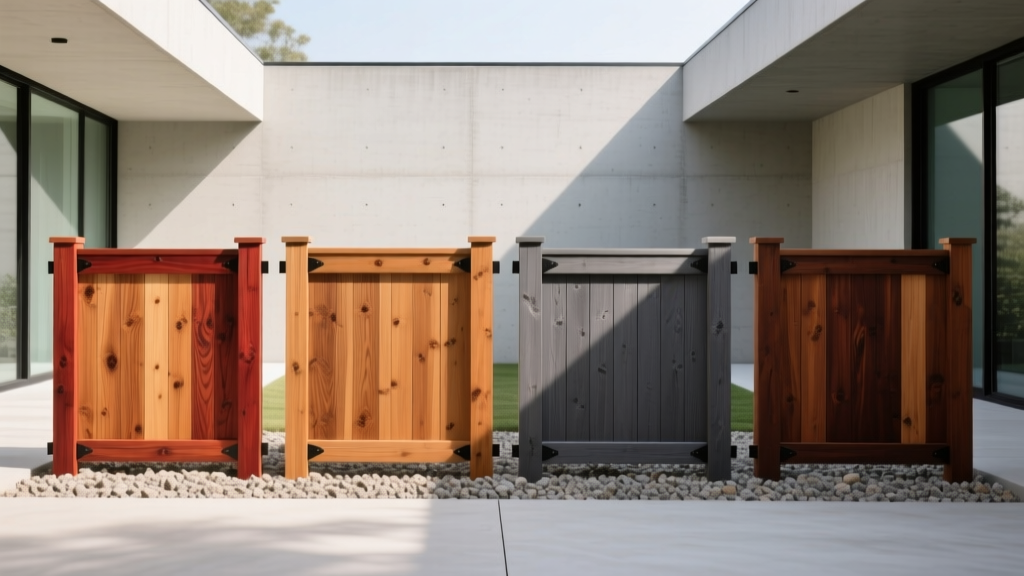
The 2026 Wood Fence Material Matrix: Quick Comparison
Selecting from the various types of wood fences requires balancing upfront capital, long-term decay resistance, and structural hardness. The table below synthesizes 2026 market pricing and material performance data to provide a baseline for your project.
| Wood Species | Janka Hardness (lbf) | Natural Decay Resistance | 2026 Installed Cost (per linear ft) | Best Use Case |
|---|---|---|---|---|
| Pressure-Treated Southern Yellow Pine | 690 | High (Chemically Enhanced) | $28 – $45 | Budget privacy, agricultural, high-wind zones |
| Western Red Cedar (WRC) | 350 | Moderate to High (Natural Oils) | $42 – $68 | Decorative privacy, trellises, modern horizontal slat |
| California Redwood | 420 | Very High (Heartwood only) | $58 – $85 | Premium estate fencing, coastal environments |
| Tropical Hardwood (Ipe) | 3,684 | Extreme (Class A Fire Rating) | $95 – $145 | Luxury estates, commercial properties, 50-year lifespan |
Deep Dive: Pressure-Treated Southern Yellow Pine (The Budget Workhorse)
Pressure-treated (PT) Southern Yellow Pine remains the most common choice among the types of wood fences due to its structural rigidity and cost-efficiency. However, the critical failure point for PT fences in 2026 is not the picket material, but the improper selection of post treatments.
AWPA Retention Standards You Must Check
The American Wood Protection Association (AWPA) categorizes treated wood by Use Category (UC). Homeowners and contractors frequently make the expensive mistake of using UC4A lumber for in-ground posts, leading to subterranean rot within 5 to 7 years.
- UC4A (Above Ground): Use ONLY for rails, pickets, and caps. Never embed in soil or concrete.
- UC4B (Ground Contact): Minimum requirement for fence posts set in concrete or soil. Retention level of 0.28 pcf (for MCA treatment).
- UC4C (Heavy Duty Ground Contact): Required for posts in severe decay zones (e.g., deep southern US, constant moisture, critical structural support).
Modern treatments like Micronized Copper Azole (MCA) or Alkaline Copper Quaternary (ACQ) are highly effective but corrosive to standard fasteners. You must use hot-dipped galvanized (HDG) or stainless steel (304 or 316 grade) nails and screws. Electroplated zinc hardware will corrode and streak the wood within months.
Western Red Cedar vs. Redwood: The Premium Softwood Showdown
When evaluating natural, untreated types of wood fences, Western Red Cedar and California Redwood dominate the premium market. Both rely on naturally occurring extractives (thujaplicins in cedar, polyphenols in redwood) to resist fungal decay and insect infestation. According to the USDA Forest Products Laboratory Wood Handbook, the heartwood of both species exhibits high decay resistance, but the sapwood is highly susceptible.
Grading and Material Selection
The performance of your cedar or redwood fence is entirely dependent on the grade you purchase:
- Clear Heart / Clear All Heart: 100% heartwood. Maximum decay resistance. Expensive, but will last 20-30 years without chemical treatment.
- Select Tight Knot (STK): Contains tight knots and some sapwood. Visually appealing but requires penetrating oil sealers to protect the sapwood margins from rot.
- Construction Common / #2 Grade: High sapwood content, large knots. Avoid for fencing unless you plan an aggressive, bi-annual sealing schedule.
Cedar vs. Redwood: Tannin Bleed & Finishing
Cedar: Prone to severe tannin bleed when exposed to rain. If painting or using a solid stain, you must apply an alkyd-based tannin-blocking primer (e.g., Zinsser Cover Stain) first. For natural looks, use penetrating oil-based sealers like TWP or Penofin.
Redwood: Less tannin bleed than cedar, but highly susceptible to UV graying. Requires UV-inhibiting penetrating oils to maintain its deep reddish hue. Water-based film-forming finishes will peel and blister on redwood due to its dimensional movement.
Tropical Hardwoods (Ipe & Cumaru): The 50-Year Fortress
Tropical hardwoods represent the absolute pinnacle of wood fence durability. Ipe (Handroanthus spp.) boasts a Janka hardness of 3,684 lbf—roughly five times harder than cedar and comparable to concrete in density. This extreme density renders it virtually impervious to termites, wood-boring bees, and fungal decay.
Installation Gotchas and Hidden Costs
Working with Ipe and Cumaru requires specialized labor and tooling, which drastically alters the project budget:
- Tool Wear: Standard HSS (High-Speed Steel) saw blades will dull after a few cuts. Contractors must use carbide-tipped blades designed for composite or metal.
- Fastening Systems: You cannot face-nail Ipe. The wood will split, and standard screws will snap under torque. Installation requires pre-drilling every hole with a specialized bit or using hidden stainless steel fastener systems (e.g., Tiger Claw or Eb-Ty) routed into the board edges.
- Weight and Framing: Ipe weighs up to 70 lbs per cubic foot. The fence framework (posts and rails) must be engineered to handle the sheer dead load, often requiring 6x6 PT posts instead of standard 4x4s, and closer post spacing (6 feet on-center maximum instead of 8 feet).
Decision Framework: Matching Wood Species to Your Soil & Climate
Use this diagnostic flow to select the correct material for your specific site conditions:
- Scenario A: Heavy Clay Soil + High Frost Line (Midwest/Northeast)
Recommendation: UC4C Pressure-Treated Pine posts with Cedar pickets. Clay holds moisture against the post base, demanding maximum chemical retention, while the frost heave requires deep bell-footed concrete piers. - Scenario B: Coastal / Salt Air Environment (Florida, California, PNW)
Recommendation: Tropical Hardwood or Redwood. Salt air rapidly corrodes the hardware used in PT pine and degrades the copper treatments. Stainless steel hardware paired with Ipe or Redwood is mandatory here. - Scenario C: Arid / High UV Exposure (Southwest)
Recommendation: Western Red Cedar. The low humidity minimizes rot risk, allowing cedar to perform exceptionally well. However, a UV-blocking penetrating oil must be applied immediately upon installation to prevent severe checking and silvering.
Hidden Costs & 2026 Installation Realities
When budgeting for types of wood fences, material costs are only half the equation. In 2026, specialized labor and site preparation dictate the final invoice.
- Footing Requirements: A standard 4x4 wood post requires approximately 1.5 to 2 bags (80 lbs each) of high-strength concrete per hole. For a 150-linear-foot fence (approx. 25 posts), expect to add $400–$600 just for concrete materials.
- Slope Stepping vs. Racking: If your yard slopes more than 10%, a "stepped" fence design (where panels remain level and drop down the hill) increases labor time by 20% and leaves triangular gaps at the bottom that require custom-cut kickboards.
- Permitting and Utility Locates: Always call 811 before digging. Hitting a fiber-optic or gas line will result in fines that dwarf the cost of the fence itself. Many municipalities in 2026 also require engineered wind-load calculations for privacy fences over 6 feet tall.
Expert FAQ: Wood Fence Longevity
Can I set wood posts directly in gravel instead of concrete?
Yes, but only in specific soil conditions. In sandy, fast-draining soils, setting UC4B or UC4C treated posts in 6 inches of crushed gravel and backfilling with native soil can actually outperform concrete. Concrete creates a "cup" that traps water around the wood base, accelerating rot if the post isn't properly elevated above the concrete collar. In heavy clay, however, concrete footings extending below the frost line are mandatory to prevent heaving.
How do I prevent the bottom of my cedar pickets from rotting?
Capillary action is the enemy of cedar fences. If pickets touch the soil or mulch, they will wick moisture upward, bypassing the natural decay resistance of the heartwood. Always maintain a strict 2-inch clearance between the bottom of the pickets and the ground. Install a pressure-treated 2x8 or 2x10 "kickboard" (rot board) along the bottom rail to take the moisture abuse; this board is cheap to replace when it eventually fails, saving the entire fence panel.
Is it worth paying for "kiln-dried after treatment" (KDAT) pressure-treated pine?
Absolutely. Standard wet PT pine shrinks, twists, and warps significantly as it dries in the sun, often pulling nails and creating unsightly gaps. KDAT lumber has been dried in a kiln after the chemical treatment process, stabilizing the wood fibers. It costs roughly 15% more upfront but yields a straighter, tighter, and more professional-looking privacy fence with significantly less long-term maintenance.
Written by
Marcus ChenMarcus Chen is a licensed structural engineer (PE) and building materials analyst with over 12 years of experience across residential, commercial, and industrial construction. He holds a Master of Science in Civil Engineering from UC Berkeley and spent six years at Thornton Tomasetti before transitioning to independent consulting and technical writing. Marcus specializes in material selection for seismic-prone regions, concrete reinforcement strategies, and lifecycle cost analysis. His work has been cited by the American Concrete Institute (ACI) and the Structural Engineers Association of California (SEAOC). When he is not on a job site or at his desk, you will find him hiking the Sierra Nevada or restoring a 1920s craftsman bungalow in Oakland, CA.
More from Marcus Chen
View all
Construction Cost
How Much Did the Eiffel Tower Cost to Build?
How much did the Eiffel Tower cost to build in 1889? We adjust for inflation and compare its budget to modern skyscraper construction.
Aug 4, 2026

Fire Resistance
What Is a Fire Resistant Material? Testing & Certification Guide
Discover what is a fire resistant material through ASTM and UL testing. Learn how fire ratings, certifications, and assemblies work in construction.
Aug 4, 2026

Construction Cost
How Much Did the Burj Khalifa Cost to Build?
How much did the Burj Khalifa cost to build? We break down the $1.5B project and extract 5 money-saving strategies for your next build.
Jul 30, 2026