Types of Wooden Baseball Bats: A Complete Wood Species Guide
Discover the physics, Janka hardness, and performance traits of maple, ash, birch, and hickory in our complete guide to types of wooden baseball bats.

The Physics of the Swing: Why Wood Species Dictates Performance
When analyzing the types of wooden baseball bats available on the market, the conversation extends far beyond simple aesthetics or brand loyalty. The biological structure of the wood species determines the bat's trampoline effect, vibration damping, breakage mechanics, and ultimately, the Ball Exit Speed Ratio (BESR). Modern professional and amateur hitters must navigate a complex matrix of specific gravity, Janka hardness, and modulus of elasticity (MOE) to find the optimal tool for their swing mechanics.
While aluminum and composite bats dominate youth leagues, wood remains the absolute standard for professional play and advanced player development. According to the USDA Forest Products Laboratory, the cellular structure of hardwoods—specifically the ratio of dense latewood to porous earlywood—directly influences how kinetic energy transfers from the swing to the baseball upon impact.
The Big Three: Maple, Ash, and Birch Comparison Matrix
To understand the landscape of wooden baseball bats, we must first quantify the mechanical properties of the dominant species. The following matrix compares the core metrics that bat manufacturers and professional hitters evaluate when selecting billets.
| Wood Species | Janka Hardness (lbf) | Specific Gravity | Flex Profile | Primary Failure Mode |
|---|---|---|---|---|
| Sugar Maple | 1,450 | 0.63 - 0.70 | Stiff / Low Flex | Catastrophic Shatter |
| White Ash | 1,320 | 0.60 - 0.65 | High Flex / Whippy | Flaking / Hinge Break |
| Yellow Birch | 1,260 | 0.62 | Medium Flex | Denting / Gradual Snap |
| Hickory | 1,820 | 0.72 - 0.75 | Extremely Stiff | Rare / Blunt Force |
Data sourced from The Wood Database Janka hardness and specific gravity archives.
Sugar Maple (Acer saccharum): The Modern Power Standard
Sugar maple has dominated the major leagues since the late 1990s, popularized by hitters like Barry Bonds who sought maximum surface hardness. Maple is a diffuse-porous wood, meaning its growth rings are tightly packed and uniform. This results in a highly dense surface that does not compress easily upon impact.
Performance Characteristics and Pricing
- Energy Transfer: Because maple lacks the 'give' of ash, it absorbs less energy during the collision with the baseball. This translates to higher ball exit velocities (BEV) on perfectly centered hits.
- Sweet Spot: The trade-off for this surface hardness is a smaller sweet spot. Mishits on the handle or the end of the barrel result in severe hand sting and a high likelihood of breakage.
- Market Cost: Pro-grade maple models (such as the Marucci AP5 or Louisville Slugger I13) typically retail between $130 and $180. Wholesale billet costs for premium grade-A maple range from $18 to $25 per blank.
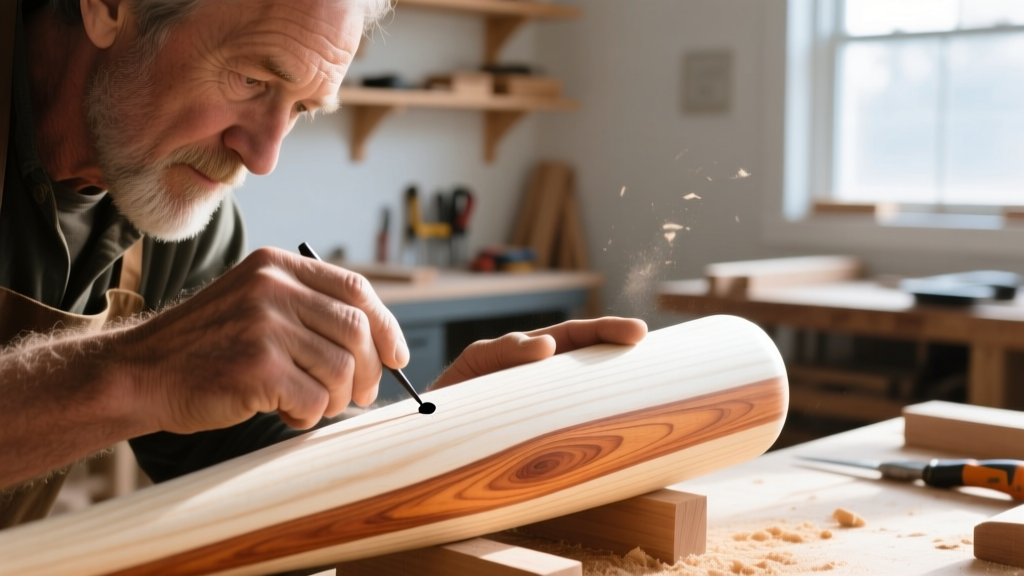
Because maple is prone to catastrophic, multi-piece shattering (creating dangerous projectiles), Major League Baseball mandated the 'Ink Dot Test' in 2009. Manufacturers must apply a drop of ink to the bare wood handle; the ink bleeds along the grain lines. If the slope of the grain deviates more than 3 degrees from the vertical axis, the bat is rejected for MLB play. Always look for the ink dot stamp when purchasing maple bats for high-level amateur or pro leagues, as detailed in the official MLB Bat Regulations.
White Ash (Fraxinus americana): The Flexible Classic
Before the maple revolution, white ash was the undisputed king of baseball. Ash is a ring-porous wood, characterized by distinct, alternating bands of highly porous earlywood and dense latewood. This unique cellular structure gives ash its signature 'whip' or flex during the swing.
The Trampoline Effect and Grain Flaking
When an ash bat strikes a baseball, the porous earlywood layers compress slightly, creating a localized trampoline effect that launches the ball. However, this same structure dictates its failure mode. Ash bats rarely shatter into dangerous shards; instead, they flake, splinter, and eventually hinge-break, often staying in one piece even when structurally compromised.
Pro-Tip for Ash Maintenance: Historically, players used a technique called 'bone rubbing'—vigorously rubbing the barrel with a dried animal bone or a porcelain rod. This physically crushes the open pores of the earlywood, artificially increasing the surface hardness and delaying the flaking process. While modern factory finishes reduce the need for this, many purists still bone-rub their ash bats before game use.
Yellow Birch (Betula alleghaniensis): The Hybrid Alternative
Yellow birch represents the perfect middle ground for hitters who want the surface hardness of maple but the flex and forgiveness of ash. Birch is a semi-ring-porous wood that behaves uniquely over its lifespan.
The Mandatory Break-In Period
Unlike maple, which is game-ready the moment it leaves the lathe, birch requires a mandatory break-in period. Out of the wrapper, birch is relatively soft and prone to denting. Hitters must take 100 to 150 controlled swings off a tee or during soft-toss to compress the wood fibers. Once broken in, the surface hardens significantly, approaching the Janka hardness of maple, while retaining a flex profile that reduces hand sting on mishits. Retail pricing for premium birch models (like the Victus TAV) generally sits between $110 and $150.
Hickory and European Beech: Niche and Legacy Species
While maple, ash, and birch account for over 95% of the professional market, two other species warrant mention for specialized use cases.
- Hickory: The heaviest and hardest wood used in baseball (Janka hardness of 1,820 lbf). Babe Ruth famously swung a 54-ounce hickory bat. Today, hickory is virtually extinct in professional play because its extreme specific gravity (0.72+) prevents modern hitters from achieving the bat speeds necessary to catch up to 95+ mph fastballs. It is now primarily used for heavy 'overload' training bats designed to build forearm strength.
- European Beech: An emerging species in the European and independent leagues. Beech offers a density profile very similar to sugar maple but with a slightly higher modulus of elasticity, granting it a bit more flex. It is currently being tested by boutique manufacturers as a sustainable alternative to North American maple.
Hitter Profile Decision Framework
Selecting the right wood species requires an honest assessment of your swing mechanics, contact point consistency, and power profile. Use the following decision matrix to choose your next bat:
1. The Power Hitter (High Bat Speed, Consistent Barrel Contact)
Recommendation: Sugar Maple.
Why: Your swing speed generates the force; maple's stiffness ensures maximum energy transfer without power loss to barrel flex. Opt for a medium-to-large barrel profile (e.g., 244 or 13 turn models) to maximize the dense sweet spot.
2. The Contact / Gap Hitter (Whip-heavy Swing, High Mishit Tolerance)
Recommendation: White Ash.
Why: The flex profile of ash allows the bat to 'whip' through the zone, aiding in barrel control. The forgiving nature of the wood means that hits off the end of the bat won't result in a broken bat or severe vibration.
3. The Transitioning Amateur (Moving from BBCOR Aluminum to Wood)
Recommendation: Yellow Birch.
Why: Aluminum bats have massive sweet spots and vibration dampening. Birch provides a familiar 'give' on mishits while teaching the hitter the discipline of finding the barrel, eventually hardening to provide pro-level pop.
Understanding Dimensional Regulations and Drop Weights
Regardless of the species chosen, all competitive wooden baseball bats must adhere to strict dimensional parameters. In high school, collegiate (NCAA), and professional leagues, the maximum allowable barrel diameter is 2.61 inches. Furthermore, the 'drop weight'—the numerical difference between the bat's length in inches and its weight in ounces—is strictly regulated.
For adult and professional play, the mandatory drop weight is -3. Therefore, a 34-inch bat must weigh a minimum of 31 ounces. Because maple and hickory are naturally denser, manufacturers must carefully cup the end of the barrel (removing up to 0.5 inches of depth) to achieve the -3 drop weight without making the bat feel overly end-loaded. Ash and birch, being slightly lighter, often require less aggressive cupping, allowing for a more balanced swing weight distribution.
Written by
Elena RodriguezElena Rodriguez is a civil engineer and technical writer specializing in concrete technology, masonry systems, and ASTM/ACI compliance. She earned her B.S. in Civil Engineering from Texas A&M University and spent a decade at a materials testing laboratory, performing over 2,000 concrete compressive strength tests and masonry prism evaluations. Elena is an ACI-certified Field Testing Technician (Grade I) and a member of ASTM Committee C12 on Natural Building Stone. She currently consults on forensic engineering cases involving concrete failures and moisture intrusion. Based in San Antonio, TX, Elena is a proud member of the Society of Women Engineers (SWE) and coaches her daughter's FIRST Robotics team.
More from Elena Rodriguez
View all
Walls & Panels
Cost Analysis: Light Gauge Steel Framing Advantages and Disadvantages
Evaluate light gauge steel framing advantages and disadvantages through a strict cost analysis lens, comparing material, labor, and lifecycle expenses.
Aug 4, 2026

Walls & Panels
Gypsum Board Types: Exact Specifications, Thickness & Dimensions
Compare standard, Type X, and moisture-resistant gypsum board types. Get exact specifications, thicknesses, dimensions, and ASTM standards for your project.
Aug 4, 2026

Fire Resistance
Best Fire-Resistant Outdoor Decking Materials: 2026 Buyer Guide
Discover the best fire-resistant outdoor decking materials for 2026. Compare Class A PVC, aluminum, and hardwood options for WUI compliance and safety.
Aug 4, 2026