How to Treat and Preserve Wood Decking Material for Maximum Lifespan
Master the preservation of wood decking material. Learn penetrating sealer science, species-specific treatment schedules, and failure troubleshooting.

The Science of Wood Decking Material Degradation
Untreated wood decking material faces three primary degradation vectors: ultraviolet (UV) photodegradation, moisture-induced dimensional cycling, and biological attack. When UV radiation strikes bare wood, it breaks down lignin—the structural polymer that binds wood cells together. This results in surface erosion, graying, and a loss of structural integrity at the microscopic level. Simultaneously, moisture absorption and evaporation cause tangential and radial shrinkage, leading to checking, cupping, and splintering.
Effective preservation requires interrupting these mechanisms at the cellular level. According to the EPA guidelines on wood preservatives, modern treatments must balance water repellency with vapor permeability. Trapping moisture inside the wood via impermeable film-forming sealers accelerates rot from the inside out, a common failure mode in poorly maintained decks.
Matching the Preservative to the Wood Species
Not all wood decking material absorbs preservatives equally. The Janka hardness and cellular density of the species dictate the required solvent carrier and pigment load. High-density tropical hardwoods reject standard water-based sealers, requiring low-viscosity, solvent-borne oils to achieve adequate penetration.
| Wood Species | Avg. Density (lbs/ft³) | Ideal Sealer Chemistry | UV Pigment Requirement | Reapplication Cycle |
|---|---|---|---|---|
| Pressure-Treated Southern Pine | 35 - 40 | Water-Based Alkyd Emulsion | Medium (Trans-oxide) | 12 - 18 Months |
| Western Red Cedar / Redwood | 22 - 25 | Penetrating Oil (Alkyd/Linseed) | High (Trans-oxide) | 18 - 24 Months |
| Ipe / Cumaru (Tropical) | 65 - 70 | Hardwood-Specific Solvent Oil | Very High (Heavy Trans-oxide) | 6 - 12 Months |
Film-Forming vs. Penetrating Sealers: A Technical Breakdown
The most critical decision in preserving wood decking material is choosing between film-forming and penetrating sealers. Film-forming products (acrylics, polyurethanes, and solid-color stains) sit on top of the wood, creating a physical barrier. While they offer high initial UV protection, they are fundamentally incompatible with horizontal decking surfaces.
Why Film-Forming Sealers Fail on Decks
- Moisture Vapor Transmission: Wood naturally off-gasses moisture. When trapped beneath an acrylic film, this vapor creates hydrostatic pressure, causing the sealer to blister and peel.
- Foot Traffic Abrasion: Horizontal surfaces endure constant mechanical wear. Once a film-forming sealer is scratched, water infiltrates the breach, delaminating the coating from the substrate.
- Maintenance Nightmare: Removing failed film-forming sealers requires aggressive chemical strippers (sodium hydroxide) or heavy mechanical sanding, damaging the wood profile.
The Superiority of Penetrating Oils
Penetrating sealers utilize alkyd resins and natural oils (linseed, tung, or modified soy) that soak into the wood's vascular structure. They do not form a surface film, meaning they cannot peel or blister. As outlined by the American Wood Protection Association (AWPA) standards, penetrating treatments preserve the wood by binding to the cell walls, providing internal water repellency while allowing the surface to breathe and wear naturally.
The 2026 Preservation Protocol: Step-by-Step
Proper application is just as critical as product selection. Follow this exact protocol to ensure maximum preservative uptake.
Step 1: Mill Glaze Removal and Cleaning
New wood decking material often suffers from 'mill glaze'—a burnished surface created by the heat of planer blades during milling, which compresses the pores and blocks sealer penetration. Wash the deck using a sodium percarbonate-based cleaner (oxygen bleach). Never use sodium hypochlorite (chlorine bleach), as it destroys lignin and leaves behind salt residues that inhibit oil penetration. For severe mill glaze, follow the wash with an oxalic acid brightener to open the wood pores.
Step 2: Moisture Content Verification
Applying sealer to damp wood traps moisture and causes premature failure. Use a pin-type moisture meter to test the wood at a depth of 1/4 inch. The moisture content (MC) must be below 15% (ideally 12%) before application. If the wood reads above 15%, allow 48-72 hours of dry, sunny weather before proceeding.
Step 3: Application Parameters
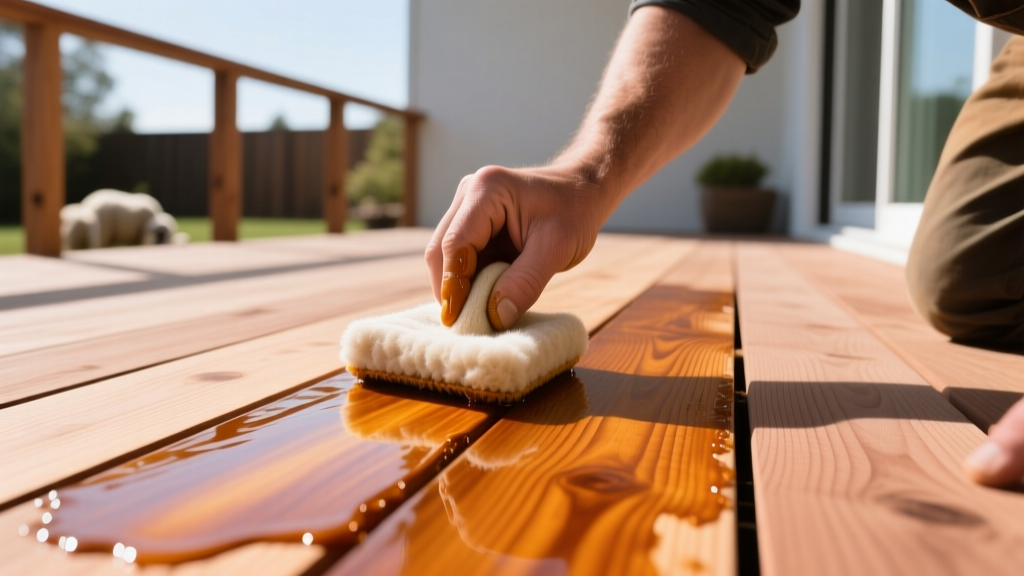
Apply penetrating sealers when ambient temperatures are between 50°F and 85°F, and surface temperatures are below 95°F. Applying oil to hot wood causes the solvent carrier to flash off too quickly, leaving excess pigment on the surface (a sticky, tacky finish). Use a lamb's wool applicator pad to push the sealer into the end-grain and joints, which are the primary entry points for moisture.
Cost Analysis: DIY vs. Professional Treatment
Budgeting for deck preservation requires looking at both material costs and labor. High-end penetrating oils have seen price adjustments due to 2026 VOC compliance reformulations, but they offer superior longevity that offsets the initial cost.
| Treatment Approach | Material Cost (per sq. ft.) | Labor Cost (per sq. ft.) | Total Cost (per sq. ft.) |
|---|---|---|---|
| DIY (Premium Penetrating Oil) | $0.65 - $0.95 | $0.00 | $0.65 - $0.95 |
| DIY (Mid-Grade Water-Based) | $0.35 - $0.50 | $0.00 | $0.35 - $0.50 |
| Professional (Clean & Seal) | $0.70 - $1.10 | $2.50 - $4.00 | $3.20 - $5.10 |
For a standard 400-square-foot deck, a DIY application using a premium hardwood oil will cost approximately $320 in materials and require 6 hours of labor. Professional services will range from $1,280 to $2,040, but they include industrial-grade surface preparation and commercial spray-and-back-brush techniques that ensure uniform penetration.
Troubleshooting Common Preservation Failures
When wood decking material fails prematurely, it is almost always due to improper surface preparation or product mismatching. Use this diagnostic guide to correct existing issues.
- Symptom: Surface is sticky and tacky weeks after application.
Cause: Over-application. The wood reached its absorption capacity, and the excess oil polymerized on the surface.
Fix: Wipe the surface with a rag dampened in mineral spirits to dissolve the uncured surface oil, then wipe dry. Do not apply more sealer until the next scheduled cycle. - Symptom: Black or gray spotting in shaded areas.
Cause: Mildew growth trapped beneath a film-forming acrylic sealer, feeding on the organic binders in the product.
Fix: Strip the failing acrylic using a sodium hydroxide-based remover. Neutralize with an oxalic acid brightener. Switch to a penetrating oil formulated with mildewcides (such as zinc or copper naphthenate). - Symptom: Sealer turns gray and chalky within 6 months.
Cause: UV degradation of low-quality, transparent sealers lacking adequate pigment load.
Fix: Transparent sealers offer zero UV protection. You must transition to a semi-transparent sealer with a minimum of 3% trans-oxide pigment load by volume to physically block UV rays from destroying the lignin.
Written by
Sarah WhitfieldSarah Whitfield is a chartered quantity surveyor (MRICS) and construction cost analyst with 15 years of experience in material pricing, procurement strategy, and project budgeting. She earned her degree in Construction Management from the University of Reading (UK) and has worked on projects ranging from $2M custom homes to $180M mixed-use developments across North America and Europe. Sarah currently leads cost estimating for BuildMat Insight, maintaining a proprietary database of 4,000+ material price points updated quarterly. She is a frequent contributor to RSMeans cost data panels and has presented at the International Cost Engineering Council (ICEC) congress. Based in Denver, CO, Sarah is an avid trail runner and volunteer mentor for Women in Construction.
More from Sarah Whitfield
View all
Wood & Lumber
What Are the Different Types of Wood? A Builder's Guide
Compare structural softwoods, finish hardwoods, and engineered lumber. Analyze Janka ratings, MOE values, and 2026 pricing for construction.
Aug 4, 2026

Walls & Panels
Steel Framing vs Wood Framing: Corrosion and Moisture Defense
Compare steel framing vs wood framing for moisture resistance. Learn about galvanized coatings, condensation risks, and corrosion protection strategies.
Jul 21, 2026

Stone & Masonry
How to Cut Stone Veneer: Wet Saw vs Grinder Comparison
Compare the best tools for cutting stone veneer. We review wet saws, angle grinders, and chop saws to help you achieve clean, chip-free cuts.
Jul 21, 2026