Selecting Structural Lumber for Different Types of Wooden Boats
Discover the best structural lumber, marine plywood grades, and wood species for building various types of wooden boats, from cold-molded to carvel.

Structural Frameworks by Boat Type
Marine structural engineering requires a nuanced understanding of wood mechanics, moisture dynamics, and load distribution. Unlike terrestrial construction, wooden boat hulls face multi-axial hydrostatic pressure, torsional twisting, and constant cyclic loading. The selection of structural lumber is entirely dictated by the specific hull geometry and assembly method. Below is a structural matrix detailing how lumber requirements shift across the primary types of wooden boats.
| Boat Construction Type | Primary Structural Mechanism | Ideal Framing Lumber | Ideal Planking Material |
|---|---|---|---|
| Carvel Planked | Heavy internal framing (ribs/beams) with edge-joined planks relying on caulking for watertight integrity. | White Oak (Quercus alba), Hackberry | Longleaf Yellow Pine, Western Red Cedar |
| Cold-Molded | Monocoque strength via 3-4 diagonal layers of thin veneers encapsulated in an epoxy matrix. | Douglas Fir, Laminated Mahogany | Okoume or Meranti veneers (1/8' to 1/4') |
| Stitch-and-Glue | Panel stiffness derived from marine plywood reinforced by structural fiberglass tape and epoxy joints. | Douglas Fir (for internal stringers/frames) | BS 1088 Okoume Marine Plywood (6mm-18mm) |
| Clinker / Lapstrake | Overlapping planks riveted to closely spaced steam-bent frames, creating a highly flexible, shock-absorbing hull. | White Oak (steam-bent frames) | Atlantic White Cedar, Sitka Spruce |
Species Selection for Marine Framing and Planking
When sourcing lumber for marine structural applications, standard architectural grading rules (like those from the American Softwood Lumber Standard) are insufficient. Boatbuilders must prioritize specific gravity (SG), Modulus of Rupture (MOR), dimensional stability, and natural rot resistance. The USDA Forest Products Laboratory provides exhaustive mechanical data on these species, which we have synthesized for marine application below.
White Oak (Quercus alba)
White oak remains the undisputed standard for heavy internal framing, stems, and knees in traditional carvel and lapstrake construction. With a specific gravity of 0.68 and an MOR of 15,200 psi, it possesses the sheer crushing strength required to support the hull's longitudinal and transverse loads. Crucially, white oak has a closed cellular structure (tyloses) that makes it highly impermeable to water. Application constraint: White oak contains high levels of tannic acid. If exposed to moisture, it will rapidly corrode standard steel and galvanized fasteners. You must exclusively use silicon bronze (ASTM B98) or hot-dipped galvanized hardware when framing with white oak.
Douglas Fir (Pseudotsuga menziesii)
For longitudinal stringers, masts, and cold-molded structural backbones, Douglas Fir is the optimal choice. Its exceptional strength-to-weight ratio (SG 0.51, MOR 12,400 psi) and remarkably straight grain allow for long, continuous structural members without weak points. When sourcing Douglas Fir for marine use, specify 'Clear All-Heart' (FOHC) grade. Sapwood must be entirely excluded, as it lacks the natural extractives required to resist marine borers and fungal decay.
Western Red Cedar (Thuja plicata)
With a low specific gravity of 0.37 and excellent dimensional stability, Western Red Cedar is the premier choice for strip-planking and lightweight carvel planking. It exhibits minimal swelling and shrinking during wet-dry cycles, reducing the stress on caulking seams and fasteners. While its bending strength (MOR 10,900 psi) is lower than oak or fir, its flexibility allows it to be easily spiled and bent over tight bilge curves without fracturing.
Marine Plywood Standards and Veneer Integrity
In stitch-and-glue and cold-molded construction, plywood acts as both the hull skin and a primary structural diaphragm. Standard exterior-grade plywood (APA Rated Sheathing) is structurally inadequate due to permissible core voids and overlapping veneer patches, which create hard spots and resin-starved joints. Marine plywood must strictly adhere to British Standard BS 1088 or the equivalent Lloyd's Register certification.
- Veneer Quality: BS 1088 mandates 'A-A' grade face and back veneers, with no surface patches permitted.
- Core Gaps: Inner plies may have edge gaps, but they must not exceed 3mm in width, and gaps in adjacent layers must not overlap. This prevents structural delamination under torsional hull stress.
- Adhesives: Only Weather and Boil Proof (WBP) phenol-formaldehyde or melamine-formaldehyde structural adhesives are permitted, ensuring the glue line will not degrade during continuous submersion or prolonged UV/moisture exposure.
- Species Constraints: Okoume (Aucoumea klaineana) is preferred for its uniform density and superior epoxy wet-out characteristics, though Meranti is acceptable for heavier structural bulkheads.
Fastener Metallurgy and Epoxy Encapsulation
The structural integrity of a wooden boat relies entirely on the fasteners holding the timber matrix together. In modern wooden boatbuilding, structural adhesives often supersede mechanical fasteners, but metallurgy remains critical in traditional builds.
For epoxy-encapsulated plywood structures, 316L marine-grade stainless steel screws (ASTM F879) provide excellent shear strength. However, in solid timber framing where moisture ingress is inevitable, 316L stainless is prone to crevice corrosion in the oxygen-depleted environment of a wood grain pocket. In these scenarios, silicon bronze (alloy 655) is mandatory. Silicon bronze maintains structural ductility and does not suffer from the galvanic degradation that plagues stainless steel in wet timber.
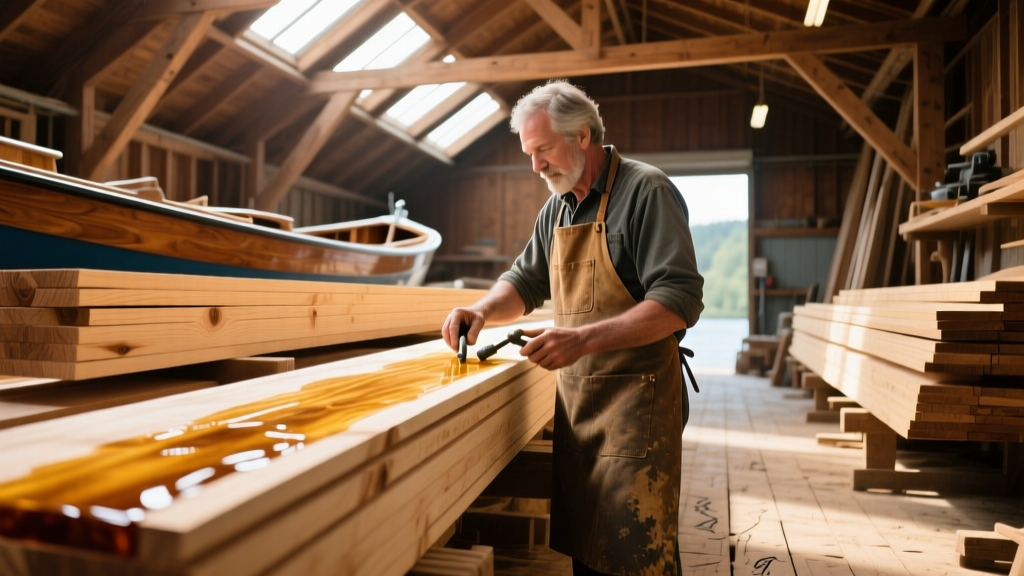
Epoxy encapsulation is the defining factor in modern wood-epoxy saturation technique (WEST). As detailed by Gougeon Brothers, applying a penetrating marine epoxy system seals the wood's cellular structure, stabilizing the moisture content below the 20% threshold required for fungal decay. When coating structural white oak or dense Douglas Fir, the surface must be wiped with a solvent (like acetone or denatured alcohol) immediately before epoxy application to remove surface oils and tannins that inhibit cross-linking.
2026 Material Cost and Yield Matrix
Budgeting for marine-grade structural lumber requires accounting for high waste factors. Unlike stick-framing a house, boatbuilding involves complex beveling, spiling, and steam-bending, which drastically reduces the usable yield from rough-sawn timber. Below is a current market snapshot for marine-grade materials.
| Material Specification | Estimated Unit Cost (2026) | Expected Structural Yield | Primary Use Case |
|---|---|---|---|
| White Oak, 8/4 Rough Sawn (FAS) | $8.50 - $11.00 / Board Foot | 60% - 70% | Heavy framing, stems, floors, knees |
| Douglas Fir, 4/4 Clear All-Heart | $12.00 - $16.00 / Board Foot | 75% - 85% | Longitudinal stringers, masts, clamps |
| Okoume Marine Plywood (BS 1088, 12mm) | $160.00 - $210.00 / Sheet | 85% - 95% | Stitch-and-glue hull panels, bulkheads |
| Marine Epoxy System (Resin + Slow Hardener) | $195.00 - $235.00 / Gallon Kit | N/A (Liquid Volume) | Encapsulation, fillets, structural fillet joints |
| Silicon Bronze Wood Screws (#10 x 1.5') | $0.45 - $0.65 / Screw | N/A | Planking to frame fastening in solid timber |
When ordering solid timber for structural framing, always specify quarter-sawn or rift-sawn grain orientation. Flat-sawn boards will cup and twist as they equilibrate to the marine environment, compromising the critical faying surfaces where the frame meets the hull planking. By aligning your lumber selection strictly with the mechanical demands of your chosen boat type, you ensure a hull structure capable of withstanding decades of hydrostatic and dynamic loading.
Written by
Sarah WhitfieldSarah Whitfield is a chartered quantity surveyor (MRICS) and construction cost analyst with 15 years of experience in material pricing, procurement strategy, and project budgeting. She earned her degree in Construction Management from the University of Reading (UK) and has worked on projects ranging from $2M custom homes to $180M mixed-use developments across North America and Europe. Sarah currently leads cost estimating for BuildMat Insight, maintaining a proprietary database of 4,000+ material price points updated quarterly. She is a frequent contributor to RSMeans cost data panels and has presented at the International Cost Engineering Council (ICEC) congress. Based in Denver, CO, Sarah is an avid trail runner and volunteer mentor for Women in Construction.
More from Sarah Whitfield
View all
Wood & Lumber
What Are the Different Types of Wood? A Builder's Guide
Compare structural softwoods, finish hardwoods, and engineered lumber. Analyze Janka ratings, MOE values, and 2026 pricing for construction.
Aug 4, 2026

Walls & Panels
Steel Framing vs Wood Framing: Corrosion and Moisture Defense
Compare steel framing vs wood framing for moisture resistance. Learn about galvanized coatings, condensation risks, and corrosion protection strategies.
Jul 21, 2026

Stone & Masonry
How to Cut Stone Veneer: Wet Saw vs Grinder Comparison
Compare the best tools for cutting stone veneer. We review wet saws, angle grinders, and chop saws to help you achieve clean, chip-free cuts.
Jul 21, 2026