Types of Hard Wood Floor: Solid vs Engineered Compared
Compare the top types of hard wood floor for your remodel. We break down solid vs. engineered hardwood costs, Janka ratings, and installation.

The Core Debate: Solid vs. Engineered Hardwood
When evaluating the primary types of hard wood floor for residential and commercial projects, the decision inevitably narrows to two structural categories: solid hardwood and engineered hardwood. While both feature a genuine timber wear layer, their internal anatomy dictates entirely different performance profiles regarding moisture tolerance, installation methods, and long-term refinishing potential. Understanding these mechanical differences is critical for avoiding catastrophic failures like cupping, gapping, or delamination.
Quick Decision Framework
- Choose Solid Hardwood if: You are installing above-grade over a wood subfloor, desire the maximum number of lifetime refinishes (5-7), and prefer traditional nail-down installation.
- Choose Engineered Hardwood if: You are installing below-grade (basements), over concrete slabs, over radiant heating systems, or require wide-plank formats (over 5 inches) without severe seasonal gapping.
Structural Anatomy and Dimensional Stability
Solid hardwood is milled from a single piece of timber, typically measuring 3/4-inch thick. Because wood is an anisotropic and hygroscopic material, it absorbs and releases ambient moisture. Solid wood expands and contracts primarily across the grain (tangentially and radially). In environments with fluctuating relative humidity (RH), solid planks wider than 4 inches are highly susceptible to cupping and severe seasonal gapping.
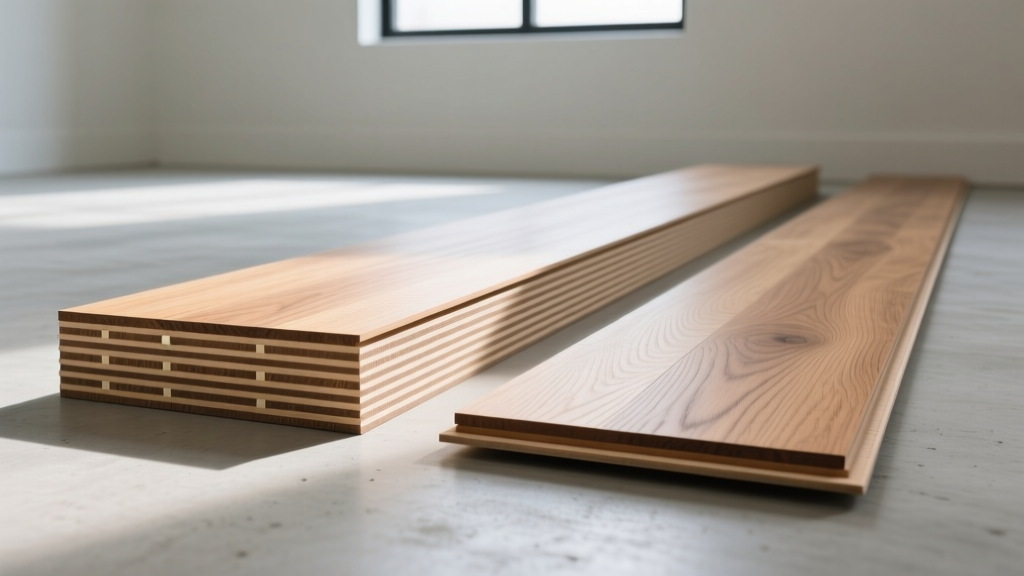
Engineered hardwood solves this dimensional instability through cross-lamination. The core consists of 3 to 9 stacked plies of Baltic birch plywood, softwood, or High-Density Fiberboard (HDF), with the grain of each layer running perpendicular to the adjacent layer. This cross-ply construction restricts lateral movement, making engineered wood up to 70% more dimensionally stable than solid wood. According to structural guidelines from APA - The Engineered Wood Association, this cross-lamination is what allows engineered boards to be manufactured in ultra-wide formats (up to 10 inches) without the structural risks associated with solid timber.
Moisture Tolerance and Subfloor Requirements
Moisture is the primary enemy of any wood flooring system. The National Wood Flooring Association (NWFA) strictly advises against installing solid hardwood below grade or directly over concrete due to the risk of capillary moisture migration.
Concrete Moisture Testing Protocols
Before installing any wood flooring over a concrete slab, installers must perform moisture testing per ASTM F2170 (in-situ relative humidity probes) or ASTM F1869 (calcium chloride test).
- Solid Hardwood: Requires a minimum 3/4-inch CDX plywood subfloor. Never glue or nail solid wood directly to concrete.
- Engineered Hardwood: Can be glued directly to concrete using a moisture-curing urethane adhesive (e.g., Bostik GreenForce or Mapei Ultrabond ECO 995), provided the concrete's RH levels do not exceed the adhesive manufacturer's maximum threshold (typically 75% to 85% RH). If RH exceeds this limit, a two-part epoxy moisture mitigation system must be applied first.
Janka Hardness, Species, and 2026 Cost Matrix
The Janka hardness test measures the force required to embed a 0.444-inch steel ball halfway into the wood, providing a baseline for dent resistance. Below is a comparison of popular species available in both solid and engineered formats, reflecting current 2026 material pricing for select-grade, prefinished planks.
| Wood Species | Janka Rating (lbf) | Solid Material Cost (per sq ft) | Engineered Material Cost (per sq ft) |
|---|---|---|---|
| Red Oak | 1,290 | $5.50 - $8.00 | $7.00 - $10.50 |
| White Oak | 1,360 | $7.00 - $11.00 | $8.50 - $14.00 |
| Hickory | 1,820 | $6.50 - $9.50 | $8.00 - $12.00 |
| European Oak | 1,120 | N/A (Rare in Solid) | $11.00 - $18.00 |
| Brazilian Walnut (Ipe) | 3,680 | $12.00 - $16.00 | $14.00 - $22.00 |
Note: Engineered flooring often carries a higher upfront material cost due to the complex manufacturing of the cross-ply core and the precision milling required for click-lock or tongue-and-groove profiles.
The Wear Layer Myth: Refinishing Lifespan
A pervasive misconception is that engineered hardwood cannot be sanded and refinished. The refinishing capacity is dictated entirely by the thickness of the top veneer (the wear layer), not the overall thickness of the board.
Expert Insight: A standard 3/4-inch solid hardwood floor has approximately 5/16-inch of refinishable wood above the tongue, yielding 5 to 7 sandings over its lifespan. A premium engineered board with a 6mm (approx. 1/4-inch) wear layer can be sanded 4 to 5 times. Considering a professional refinish is typically required only once every 15 to 20 years, a 6mm engineered wear layer easily provides a 75-to-100-year functional lifespan, matching solid wood in practical terms.
When purchasing engineered wood, avoid budget options with a 1.2mm or 2mm wear layer if you anticipate needing to sand out deep scratches or change the stain color in the future. Specify a minimum 4mm wear layer for long-term residential viability.
Surface Finishes: Aluminum Oxide vs. Hardwax Oil
The factory-applied finish determines the floor's scratch resistance and maintenance cycle. The two dominant finish types in the current market are:
1. UV-Cured Aluminum Oxide Urethane
This is a surface-barrier finish embedded with microscopic aluminum oxide particles for extreme abrasion resistance. Brands typically apply 6 to 9 coats. It offers superior protection against pet claws and high foot traffic but cannot be spot-repaired. When it eventually wears through to the raw wood, the entire floor must be professionally screened and recoated.
2. Penetrating Hardwax Oil (e.g., Rubio Monocoat, Osmo Polyx)
Hardwax oils penetrate the wood fibers and cure to form a matte, natural-feeling surface. While less resistant to standing water and heavy abrasion than aluminum oxide, hardwax oil offers a massive maintenance advantage: it can be spot-repaired. High-traffic pathways or isolated scratches can be lightly sanded and re-oiled without having to refinish the entire room.
Environmental Impact and Certifications
Because engineered wood uses a plywood or HDF core, it utilizes fast-growing, plantation-sourced softwoods for the base, reserving slow-growth hardwoods only for the top veneer. This makes it inherently more resource-efficient. However, the adhesives used in the core lamination can off-gas volatile organic compounds (VOCs). Always specify engineered flooring that is CARB Phase 2 compliant or TSCA Title VI certified for formaldehyde emissions. For sustainable forestry verification, look for the Forest Stewardship Council (FSC) label, which ensures the timber was harvested from responsibly managed forests.
Frequently Asked Technical Questions
Can I install solid hardwood over radiant heating systems?
Generally, no. The intense, localized heat from hydronic or electric radiant systems will rapidly dry out solid wood, causing severe checking, splitting, and gapping. If you must use solid wood over radiant heat, you are restricted to narrow planks (under 3 inches) that are quartersawn or rift-sawn for vertical grain stability. Engineered hardwood is vastly superior for radiant applications because its cross-laminated core resists the drying effects of the heat.
What is the difference between an HDF core and a Baltic Birch plywood core?
High-Density Fiberboard (HDF) cores are incredibly dense and provide excellent impact resistance, making them the preferred choice for floating, click-lock engineered floors. However, HDF is highly susceptible to swelling if exposed to standing water. Baltic Birch plywood cores offer superior screw-holding strength and better moisture tolerance, making them the mandatory choice for glue-down or nail-down engineered installations.
Final Specification Verdict
For above-grade installations over wood subfloors where traditional nail-down methods are preferred and maximum plank thickness is desired, 3/4-inch solid White Oak remains the industry benchmark. However, for modern construction involving concrete slabs, below-grade basements, radiant heating, or wide-plank aesthetics (7 inches and wider), a multi-ply engineered hardwood with a minimum 4mm wear layer and a Baltic Birch core is the structurally superior choice.
Written by
Marcus ChenMarcus Chen is a licensed structural engineer (PE) and building materials analyst with over 12 years of experience across residential, commercial, and industrial construction. He holds a Master of Science in Civil Engineering from UC Berkeley and spent six years at Thornton Tomasetti before transitioning to independent consulting and technical writing. Marcus specializes in material selection for seismic-prone regions, concrete reinforcement strategies, and lifecycle cost analysis. His work has been cited by the American Concrete Institute (ACI) and the Structural Engineers Association of California (SEAOC). When he is not on a job site or at his desk, you will find him hiking the Sierra Nevada or restoring a 1920s craftsman bungalow in Oakland, CA.
More from Marcus Chen
View all
Construction Cost
How Much Did the Eiffel Tower Cost to Build?
How much did the Eiffel Tower cost to build in 1889? We adjust for inflation and compare its budget to modern skyscraper construction.
Aug 4, 2026

Fire Resistance
What Is a Fire Resistant Material? Testing & Certification Guide
Discover what is a fire resistant material through ASTM and UL testing. Learn how fire ratings, certifications, and assemblies work in construction.
Aug 4, 2026

Construction Cost
How Much Did the Burj Khalifa Cost to Build?
How much did the Burj Khalifa cost to build? We break down the $1.5B project and extract 5 money-saving strategies for your next build.
Jul 30, 2026