The 4 Types of Wood Preservatives: A Quality & Grade Guide
Master the 4 types of wood preservatives with our grade guide. Compare ACQ, CA-C, MCA, and borate retention levels, AWPA stamps, and fastener specs.

Wood degradation from fungal decay and insect infestation costs the construction industry billions annually in premature structural replacements. While selecting the correct lumber grade (e.g., Select Structural, No. 1, No. 2) ensures baseline mechanical strength, it offers zero protection against biological deterioration. To achieve the design life required by the 2026 International Building Code (IBC), structural timber must be paired with the correct chemical treatment. Understanding the 4 types of wood preservatives is critical for architects, engineers, and quality assurance inspectors to verify that the retained chemical volume matches the environmental exposure category.
The Chemistry of Preservation and Grade Integrity
Preservative treatment does not alter the structural grading of lumber; a No. 2 grade Southern Yellow Pine (SYP) retains its No. 2 bending and shear values after treatment. However, the incising process required to force chemicals into the heartwood of certain species (like Douglas Fir) can reduce bending strength by up to 10%, a factor that must be accounted for in structural calculations. The American Wood Protection Association (AWPA) dictates that treatment quality is measured by two metrics: penetration depth (how far the chemical reaches into the wood cross-section) and retention level (the weight of chemical retained per cubic foot of wood, measured in pcf).
The 4 Types of Wood Preservatives Explained
Modern residential and commercial construction relies heavily on waterborne preservatives. Below is a technical breakdown of the four primary chemistries currently specified in AWPA Standard U1.
1. Alkaline Copper Quaternary (ACQ)
ACQ replaced Chromated Copper Arsenate (CCA) in residential markets. It relies on dissolved copper as the primary fungicide and a quaternary ammonium compound (quat) as the insecticide. Because the copper is dissolved in an alkaline solution (often using ethanolamine), ACQ is highly corrosive to standard steel fasteners. It imparts a dark greenish-brown color to the wood that weathers to gray over time.
- Best Application: Ground contact, freshwater marine, and high-decay hazard areas.
- Quality Indicator: Look for deep, uniform penetration; ACQ struggles to penetrate refractory species without heavy incising.
2. Copper Azole (CA-C)
Copper Azole Type C utilizes dissolved copper combined with tebuconazole, an organic co-biocide that boosts fungal resistance. This synergy allows CA-C to achieve the same decay resistance as ACQ but with significantly lower total copper loading. The reduced copper content slightly lowers the corrosion rate compared to ACQ, though it still mandates heavily galvanized or stainless steel fasteners.
- Best Application: Above-ground decking, sill plates, and general ground-contact framing.
- Quality Indicator: Surface appearance is similar to ACQ, but inspectors should verify the specific tebuconazole-to-copper ratio on the end-tag.
3. Micronized Copper Azole (MCA)
MCA represents a significant leap in treatment technology. Instead of dissolving copper in an alkaline solvent, the copper is ground into sub-micron particles and suspended in water. Because the copper is particulate rather than ionic, MCA exhibits drastically lower leaching rates and a corrosion profile that closely mirrors untreated, raw wood. It yields a lighter, more natural brown color.
- Best Application: Landscaping timbers, retaining walls, and applications where fastener corrosion is a primary engineering concern.
- Quality Indicator: Ensure the micronized particles have not settled in the treatment cylinder, which can lead to uneven retention in the final charge.
4. Borate (DOT - Disodium Octaborate Tetrahydrate)
Borate treatments are unique because they are applied via thermal diffusion to green (unseasoned) lumber rather than pressure impregnation. Borates are highly mobile in wood and provide excellent protection against termites and wood-decaying fungi. However, they are completely water-soluble and will leach out if exposed to liquid water.
- Best Application: Interior framing, sill plates over concrete, and roof trusses in dry environments (AWPA Use Category 2 only).
- Quality Indicator: Quality verification requires a chemical dye test (like curcumin) on-site, as borate leaves no visible color change or odor.
Decoding the Grade Stamp: AWPA Use Categories
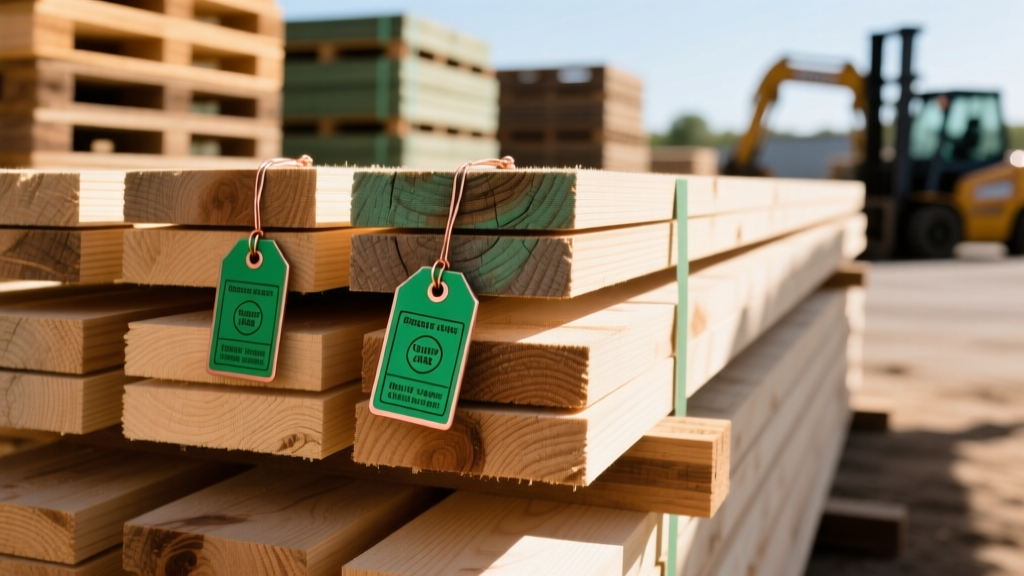
A quality grade stamp on treated lumber must display the AWPA Use Category (UC), the preservative type, and the minimum retention level. According to the Environmental Protection Agency (EPA), using a UC3B (above ground) rated board for a UC4A (ground contact) application will result in rapid structural failure. The table below maps the 4 types of wood preservatives to their required retention levels across common use categories.
| Preservative | UC2 (Interior/Dry) | UC3B (Above Ground) | UC4A (Ground Contact) | Corrosion Risk |
|---|---|---|---|---|
| ACQ | 0.15 pcf | 0.25 pcf | 0.40 pcf | Severe |
| CA-C | 0.06 pcf | 0.15 pcf | 0.15 pcf | Moderate-High |
| MCA | 0.06 pcf | 0.15 pcf | 0.15 pcf | Low |
| Borate (DOT) | 0.28 pcf (BAE) | Not Approved | Not Approved | None |
Fastener Compatibility and Corrosion Thresholds
The most frequent failure mode in treated wood assemblies is not the decay of the wood, but the corrosion of the metal connectors and fasteners. The alkaline nature of ACQ and CA-C acts as an electrolyte, accelerating galvanic corrosion when in contact with standard zinc coatings. When inspecting a job site, verify the following fastener specifications against the preservative type:
- For ACQ and CA-C (Ground Contact): You must specify hot-dip galvanized fasteners meeting ASTM A153 Class D with a minimum G185 coating (1.85 ounces of zinc per square foot). Standard G90 electro-galvanized nails will fail within 2 to 4 years in damp conditions. Alternatively, use Type 304 or Type 316 stainless steel.
- For MCA: Standard G90 galvanized fasteners are generally acceptable for above-ground applications (UC3B) due to the low ionic copper content. However, for UC4A ground contact, G185 or stainless steel remains the engineering best practice to guarantee a 50-year service life.
- For Borate: Standard uncoated or lightly zinc-plated fasteners are perfectly acceptable, as borates are neutral and non-corrosive to steel and aluminum.
- Aluminum Warning: Never use untreated aluminum flashing or connectors in direct contact with ACQ or CA-C. The alkaline copper solution will rapidly destroy aluminum. Always use a heavy rubberized membrane or PVC spacer to isolate aluminum from copper-based treated lumber.
Field Verification: Assaying Preservative Penetration
Quality assurance on large commercial projects requires more than just reading the end-tag. The USDA Forest Products Laboratory outlines specific protocols for verifying that the preservative has reached the required depth, particularly in thick timbers or refractory species. Field inspectors should follow this protocol to verify treatment quality:
- Core Extraction: Use a 5/16-inch increment borer to extract a core sample from the treated member, ensuring the sample reaches the geometric center of the timber.
- Visual Splitting: Split the core longitudinally to expose the untreated heartwood boundary. In copper-based treatments (ACQ, CA-C), the treated zone will be visibly green or brown, while the untreated core will remain the natural color of the wood species.
- Chemical Dye Application: For MCA or lightly treated CA-C where visual boundaries are faint, spray the split core with a 1% solution of Chrome Azurol S. This indicator dye turns the copper-treated zone a vivid blue within 60 seconds, allowing the inspector to measure the exact millimeter depth of penetration using calipers.
- Borate Diffusion Testing: Because borate leaves no visual trace, spray the split core with a curcumin/turmeric-based indicator solution. In the presence of borates, the yellow solution will turn a distinct red-orange, confirming the diffusion depth.
Inspector's Warning: Never accept treated lumber for critical structural shear walls or retaining structures if the end-tags are missing or illegible. The grade stamp must clearly show the AWPA U1 designation, the specific Use Category (e.g., UC4A), and the QC agency mark (such as SPIB or ALSC). Without this traceability, the material is legally classified as untreated and will fail municipal building inspections.
Selecting the correct preservative requires matching the chemical's retention capabilities and corrosion profile to the specific environmental exposure and structural demands of the project. By rigorously verifying AWPA Use Categories, mandating correct fastener coatings, and conducting field penetration assays, construction professionals can ensure the long-term integrity of treated wood assemblies.
Written by
Marcus ChenMarcus Chen is a licensed structural engineer (PE) and building materials analyst with over 12 years of experience across residential, commercial, and industrial construction. He holds a Master of Science in Civil Engineering from UC Berkeley and spent six years at Thornton Tomasetti before transitioning to independent consulting and technical writing. Marcus specializes in material selection for seismic-prone regions, concrete reinforcement strategies, and lifecycle cost analysis. His work has been cited by the American Concrete Institute (ACI) and the Structural Engineers Association of California (SEAOC). When he is not on a job site or at his desk, you will find him hiking the Sierra Nevada or restoring a 1920s craftsman bungalow in Oakland, CA.
More from Marcus Chen
View all
Construction Cost
How Much Did the Eiffel Tower Cost to Build?
How much did the Eiffel Tower cost to build in 1889? We adjust for inflation and compare its budget to modern skyscraper construction.
Aug 4, 2026

Fire Resistance
What Is a Fire Resistant Material? Testing & Certification Guide
Discover what is a fire resistant material through ASTM and UL testing. Learn how fire ratings, certifications, and assemblies work in construction.
Aug 4, 2026

Construction Cost
How Much Did the Burj Khalifa Cost to Build?
How much did the Burj Khalifa cost to build? We break down the $1.5B project and extract 5 money-saving strategies for your next build.
Jul 30, 2026