Types of Maple Wood Grain: A Selection Framework for Custom Millwork
Master the selection framework for types of maple wood grain. Compare curly, birdseye, and straight grain for cabinetry, flooring, and luthiery.

The Core Matrix: Standard vs. Figured Maple Grain
When specifying Hard Maple (Acer saccharum) for architectural millwork, fine furniture, or specialty applications, understanding the types of maple wood grain is critical to predicting both machining behavior and final aesthetic yield. Hard Maple registers at 1,450 lbf on the Janka hardness scale, making it exceptionally durable, but its interlocked or wavy grain variants introduce severe tearout risks if not handled correctly.
The selection framework below categorizes the primary grain figures found in maple, detailing their structural origins and 2026 market positioning. According to the Wood Database, figure in maple is typically a result of localized growth stress, genetic mutations, or environmental factors rather than a distinct subspecies.
| Grain Type | Visual Characteristic | Primary Cause | Machining Difficulty | 2026 Avg Cost (FAS/BF) |
|---|---|---|---|---|
| Straight / Standard | Uniform, linear, subtle medullary rays | Normal vertical growth | Low | $6.50 - $9.00 |
| Curly / Flame | 3D chatoyance, perpendicular ripples | Wavy longitudinal fibers | High (Severe tearout) | $12.00 - $18.00 |
| Birdseye | Small, swirling 'eyes' or dimples | Localized cambial growth stress | Extreme | $15.00 - $28.00 |
| Quilted | Blistered, bubbly 3D topography | Compressed wavy grain (often soft maple) | High | $22.00 - $40.00+ |
Decoding NHLA Grades for Grain Selection
The National Hardwood Lumber Association (NHLA) grading rules dictate the usable clear-face yield of a board, which directly impacts how continuous a grain pattern will appear across a large surface area like a cabinet run or dining table.
Grade-to-Application Matching
- FAS (Firsts and Seconds): Minimum board size 6" x 8'. Provides long, continuous clear cuts. Mandatory for seamless grain-matching on high-end architectural paneling and large conference tables.
- Select Grade: One clear FAS face, one #1 Common face. Ideal for cabinet doors and drawer fronts where only one side is visible, reducing material costs by 15-20% without sacrificing the visible grain aesthetic.
- #1 Common: Yields smaller clear sections. Best utilized for smaller millwork components, turnings, or intentional 'rustic' designs where knots and grain interruptions are desirable.
Decision Tree: Matching Grain Type to Application
Selecting the correct types of maple wood grain requires balancing structural stability, acoustic properties, and visual impact. Use this framework to route your material selection:
- High-Traffic Flooring: Select Straight Grain Hard Maple. The interlocking linear fibers provide maximum dimensional stability against seasonal humidity swings. Figured maple is prone to uneven wear and splintering in high-shear environments.
- Custom Cabinetry & Millwork: Select FAS Straight Grain or Mild Curly. Straight grain accepts opaque paints and uniform pigment stains without blotching. Mild curly adds depth to clear-coated shaker panels.
- Luthiery (Stringed Instruments): Select Tight Curly / Flame Maple. The wavy grain structure reflects light dynamically (chatoyance) and is traditionally used for violin and guitar backs due to its specific acoustic impedance and stiffness-to-weight ratio.
- Decorative Veneers & Inlays: Select Birdseye or Quilted. These grains are notoriously unstable when milled to solid 3/4" thickness due to internal tension release. Slicing them into 1/40" veneers and pressing them onto an MDF or Baltic birch substrate neutralizes movement while maximizing visual impact.
Machining Framework for Difficult Figured Grains
Figured maple is notorious for catastrophic tearout because the grain direction reverses every few millimeters. Standard planer knives will dig into the opposing grain and rip out chunks of the 3D figure.
Tooling and Setup Specifications
To machine curly or birdseye maple successfully, implement the following parameters:
- Cutterhead Geometry: Use a helical/spiral carbide cutterhead rather than straight knives. The sheer cutting angle slices the wood fibers rather than chopping them.
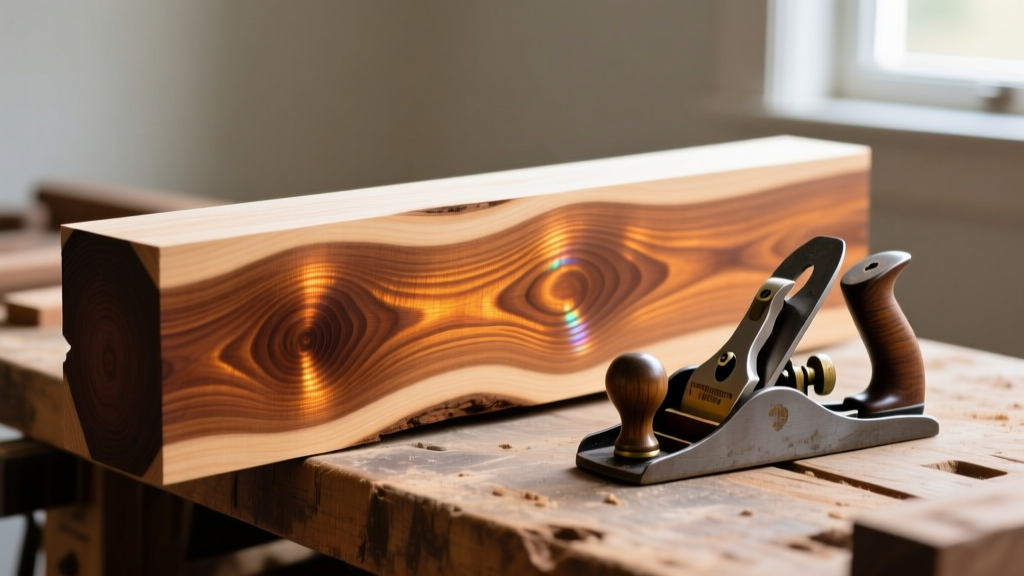
- Hook Angle: If using a hand plane or custom molder, reduce the cutting angle. A standard 45-degree bench plane will tear figured maple. Use a 50-degree (York pitch) or 55-degree frog, or employ a back-bevel on the iron to increase the effective cutting angle.
- Feed Rate: Reduce planer feed rates to 10-12 feet per minute and take maximum cuts of 1/64" per pass to minimize fiber deflection.
- Final Surfacing: Rely on cabinet scrapers and random orbital sanding (progressing strictly through 120, 150, 180, and 220 grits) to finalize the surface. Sanding across the grain will obliterate the 3D chatoyance.
Finishing Protocols: Enhancing Figure Without Blotching
Maple's dense, closed-pore structure makes it highly susceptible to blotching when using traditional oil-based pigment stains. The pigments pool in the dense end-grain areas of the figure, creating dark, muddy spots that hide the 3D effect.
1. Sand to 220 grit. Do not exceed 220, or you will burnish the wood and prevent dye penetration.
2. Apply a water-soluble aniline dye (e.g., TransTint or similar concentrated dyes). Dyes penetrate the cell walls rather than sitting in the pores, highlighting the figure uniformly.
3. Seal with a 1-lb cut of dewaxed shellac to lock in the dye and prevent subsequent topcoats from lifting the water-raised grain.
4. Apply a clear, high-build catalyzed polyurethane or conversion varnish to build depth and amplify the chatoyance.
Sourcing and True Cost Yield Calculation
When budgeting for figured maple, the nominal price per board foot (BF) is misleading due to the high waste factor associated with sapwood inclusion and defect clustering. Use this formula to calculate your true material cost:
True Cost = (Required Net BF / Usable Yield Percentage) * Nominal Price per BF
Example Calculation for Birdseye Maple:
If a project requires 20 BF of clear, heavily figured wood, and you are purchasing FAS Birdseye at $20.00/BF. The usable yield of dense figure in FAS boards is typically around 65% (accounting for sapwood removal and tearout salvage).
True Cost = (20 / 0.65) * $20.00 = 30.76 BF * $20.00 = $615.20.
The effective cost per usable board foot is $30.76, not the quoted $20.00. Factoring this into your initial estimate prevents severe budget overruns on custom millwork projects.
Written by
Elena RodriguezElena Rodriguez is a civil engineer and technical writer specializing in concrete technology, masonry systems, and ASTM/ACI compliance. She earned her B.S. in Civil Engineering from Texas A&M University and spent a decade at a materials testing laboratory, performing over 2,000 concrete compressive strength tests and masonry prism evaluations. Elena is an ACI-certified Field Testing Technician (Grade I) and a member of ASTM Committee C12 on Natural Building Stone. She currently consults on forensic engineering cases involving concrete failures and moisture intrusion. Based in San Antonio, TX, Elena is a proud member of the Society of Women Engineers (SWE) and coaches her daughter's FIRST Robotics team.
More from Elena Rodriguez
View all
Walls & Panels
Cost Analysis: Light Gauge Steel Framing Advantages and Disadvantages
Evaluate light gauge steel framing advantages and disadvantages through a strict cost analysis lens, comparing material, labor, and lifecycle expenses.
Aug 4, 2026

Walls & Panels
Gypsum Board Types: Exact Specifications, Thickness & Dimensions
Compare standard, Type X, and moisture-resistant gypsum board types. Get exact specifications, thicknesses, dimensions, and ASTM standards for your project.
Aug 4, 2026

Fire Resistance
Best Fire-Resistant Outdoor Decking Materials: 2026 Buyer Guide
Discover the best fire-resistant outdoor decking materials for 2026. Compare Class A PVC, aluminum, and hardwood options for WUI compliance and safety.
Aug 4, 2026