How to Identify Types of Wood and Avoid Costly Lumber Mistakes
Learn how to identify types of wood to prevent budget overruns. Compare species costs, master grain analysis, and maximize lumber value.

The Financial Stakes of Lumber Misidentification
Understanding how to identify types of wood is not merely a botanical exercise; it is a critical procurement and project management skill. In the 2026 construction and custom woodworking market, the price gap between visually similar species can exceed 300%. Misidentifying a wood species at the lumber yard or failing to catch a substitution on the job site directly erodes profit margins and compromises structural longevity.
This guide provides a cost-driven framework for wood identification, focusing on the physical markers that dictate a species' true market value and appropriate application.
Core Identification Markers for Value Assessment
Surface color and basic grain patterns are easily faked with stains, wire brushing, and printing techniques. To accurately assess lumber value, you must examine the physical anatomy of the wood. According to the The Wood Database, true identification relies on end-grain analysis, density testing, and fluorescence.
1. End-Grain Pore Structure
The end-grain (the cross-section of the board) reveals the vascular structure of the tree. Hardwoods are broadly categorized into two groups that dictate their finishing costs and exterior viability:
- Ring-Porous (e.g., Oak, Ash, Hickory): Large earlywood pores form distinct rings. These woods require grain fillers for a glass-smooth finish, adding $1.50 to $3.00 per square foot in labor and material costs for high-end cabinetry.
- Diffuse-Porous (e.g., Maple, Birch, Poplar): Pores are uniform and evenly distributed. These yield a smooth finish directly from sanding, reducing finishing labor costs by up to 20%.
2. The Tyloses Factor: White Oak vs. Red Oak
This is the most costly misidentification in the industry. Both are ring-porous oaks with similar tangential grain patterns. However, White Oak (Quercus alba) contains tyloses—cellular outgrowths that plug the vascular pores, making the wood virtually impermeable to water. Red Oak (Quercus rubra) lacks tyloses; its open pores act like a bundle of straws, wicking moisture directly into the heartwood.
Cost Impact: White Oak commands $8.50–$12.00 per board foot (BF), while Red Oak sits at $5.50–$7.50/BF. Using Red Oak for an exterior deck or marine application because it was misidentified as White Oak will result in catastrophic rot failure, voiding warranties and requiring total replacement.
3. Janka Hardness and Wear Value
The Janka hardness test measures the force required to embed a 0.444-inch steel ball halfway into the wood. This metric directly correlates to the lifecycle value of flooring and high-traffic millwork. The USDA Forest Products Laboratory Wood Handbook provides definitive Janka ratings for structural and finish applications.
2026 Lumber Cost & Identification Matrix
The following matrix aligns physical identification traits with current market pricing to help procurement managers verify they are receiving the species they paid for.
| Species | Key Identification Marker | Avg Cost (BF) | Best Value Application |
|---|---|---|---|
| Hard Maple | Diffuse-porous; tight, uniform grain; Janka 1450 lbf | $7.00 - $9.50 | High-traffic commercial flooring, butcher blocks |
| Yellow Poplar | Diffuse-porous; distinct green/brown mineral streaks | $3.50 - $5.00 | Painted interior millwork, hidden structural blocking |
| Genuine Mahogany | Diffuse-porous; ribbon stripe on quartersawn; Janka 900 lbf | $14.00 - $18.00 | Premium exterior doors, marine brightwork |
| Southern Yellow Pine | Distinct earlywood/latewood contrast; high resin scent | $2.50 - $4.00 | Structural framing, heavy timber trusses |
| Black Walnut | Semi-ring-porous; rich chocolate heartwood, Janka 1010 lbf | $12.00 - $16.00 | High-end accent walls, luxury custom cabinetry |
The 'Fake Premium' Trap: Stained Wood vs. Solid Hardwood
A pervasive practice in mid-tier cabinet manufacturing and tract-home flooring is the use of secondary, low-cost species stained to mimic premium hardwoods. Identifying the base wood beneath the stain is crucial for assessing true replacement value and structural integrity.
How to see through the stain: Look at the end-grain. If the wood is sold as Walnut but the end-grain shows the large, distinct earlywood pores characteristic of Ash or Oak, you are looking at a stained secondary species. Furthermore, scratch a hidden area with a utility knife; Walnut will reveal a dark brown underlayer, while stained Alder or Poplar will reveal pale, almost white raw wood beneath the pigment.
Field Verification Protocols for Procurement Managers
When a lumber delivery arrives on the dock, rely on these systematic checks to verify species and grade before signing the bill of lading. The National Hardwood Lumber Association (NHLA) grading rules dictate yield, but species verification requires physical inspection.
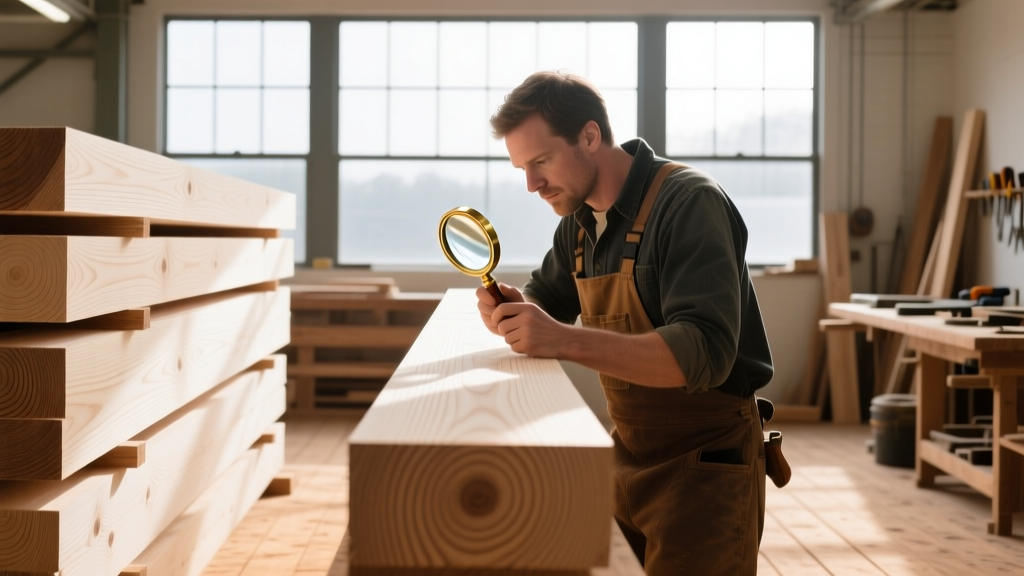
- The End-Grain Loupe Test: Carry a 10x or 20x jeweler's loupe. Examine the end-grain of at least three random boards per bundle. Verify the pore structure matches the invoiced species (e.g., checking for the tyloses in White Oak).
- The Moisture Meter Cross-Check: Use a pin-type moisture meter. While this doesn't identify the species, it identifies improper storage. Kiln-dried interior hardwoods (like Maple or Cherry) must read between 6% and 8% moisture content (MC). If a bundle invoiced as 'KD Interior' reads 14% MC, the wood has been compromised or substituted with air-dried exterior stock.
- The Scent Test: Many species have distinct odors when machined or scratched. Eastern Red Cedar smells sharply of camphor; White Oak has a distinct, slightly acidic tannin scent when damp; Southern Yellow Pine has a strong, sharp resinous aroma. If a board invoiced as Cedar lacks the camphor scent, it may be a substituted, less rot-resistant softwood.
- Weight and Density Heuristics: Lift one end of a standard 8-foot board. Hard Maple and Hickory are noticeably heavier than Poplar or Soft Maple of the exact same dimensions. If a bundle of 'Hard Maple' feels suspiciously light, demand a moisture and density verification.
Decoding Lumber Stamps and Grade Marks
For structural softwoods (SPF, Douglas Fir, Southern Yellow Pine), identification is heavily reliant on the ink stamp applied at the mill. Misreading these stamps leads to structural failures and code violations.
- Species Stamp: 'S-GRN' indicates Southern Pine (green/unseasoned). 'DF-L' indicates Douglas Fir-Larch. 'SPF' is Spruce-Pine-Fir. Never substitute SPF for Douglas Fir in high-load bending applications; Douglas Fir has a significantly higher modulus of elasticity (E) and bending strength (Fb).
- Mill Number: A 3-to-5 digit number identifying the specific manufacturing facility. If a structural failure occurs, this number traces the lumber back to the exact mill and production shift.
- Grade Designation: 'Select Structural' (Sel Str) offers the highest visual grade and strength. 'No. 2' is the standard for most residential framing. Paying Select Structural prices for No. 2 lumber is a common invoicing error; always verify the stamp matches the purchase order.
Frequently Asked Questions
Can I use a smartphone app to identify wood species accurately?
Current smartphone camera resolutions and AI image models are insufficient for definitive species identification, particularly between closely related species like Red and White Oak or Hard and Soft Maple. Apps can identify broad categories (e.g., Pine vs. Oak) based on macro-grain patterns, but procurement decisions require physical end-grain analysis with a loupe to prevent costly errors.
Does the origin of the wood affect its identification and cost?
Yes. Growth rate dictated by climate affects ring density. Southern Yellow Pine grown in dense, managed plantations will have wider earlywood bands and lower density than old-growth or slower-grown timber from natural stands. Always verify the geographic origin on the grading stamp, as it directly impacts the structural load tables and the market price per BF.
How do I identify engineered wood vs. solid wood under a veneer?
Inspect the edge profile and the end-grain. Solid wood will show continuous grain wrapping from the face to the edge. Engineered wood (like MDF or particleboard core) will show a distinct, repetitive seam line where the 1/42-inch veneer is glued to the substrate. Additionally, engineered panels will have uniform, manufactured edges, whereas solid wood will show natural growth variations and end-grain pores.
Written by
Marcus ChenMarcus Chen is a licensed structural engineer (PE) and building materials analyst with over 12 years of experience across residential, commercial, and industrial construction. He holds a Master of Science in Civil Engineering from UC Berkeley and spent six years at Thornton Tomasetti before transitioning to independent consulting and technical writing. Marcus specializes in material selection for seismic-prone regions, concrete reinforcement strategies, and lifecycle cost analysis. His work has been cited by the American Concrete Institute (ACI) and the Structural Engineers Association of California (SEAOC). When he is not on a job site or at his desk, you will find him hiking the Sierra Nevada or restoring a 1920s craftsman bungalow in Oakland, CA.
More from Marcus Chen
View all
Construction Cost
How Much Did the Eiffel Tower Cost to Build?
How much did the Eiffel Tower cost to build in 1889? We adjust for inflation and compare its budget to modern skyscraper construction.
Aug 4, 2026

Fire Resistance
What Is a Fire Resistant Material? Testing & Certification Guide
Discover what is a fire resistant material through ASTM and UL testing. Learn how fire ratings, certifications, and assemblies work in construction.
Aug 4, 2026

Construction Cost
How Much Did the Burj Khalifa Cost to Build?
How much did the Burj Khalifa cost to build? We break down the $1.5B project and extract 5 money-saving strategies for your next build.
Jul 30, 2026