How to Identify Different Types of Wood: A Complete Species Guide
Master how to identify different types of wood using endgrain analysis, specific gravity, and chemical tests in this complete species guide.

The Science of Wood Identification: Beyond Face Grain
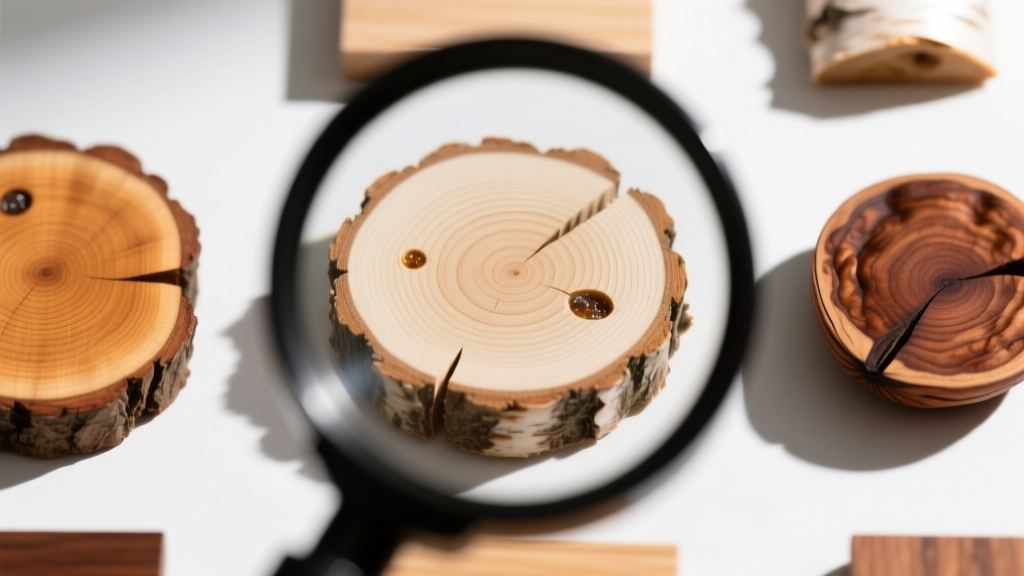
Learning how to identify different types of wood requires moving past surface-level color and face grain patterns, which are easily altered by stains, aging, and UV exposure. Professional wood identification relies on macroscopic and microscopic anatomical features that remain constant regardless of the wood's finish or age. The most critical tool in a woodworker or inspector's arsenal is a 10x Hastings triplet jeweler's loupe, used to examine the endgrain—the cross-section of the wood where the longitudinal cells are exposed.
Color can be deceptive. For instance, freshly cut Black Walnut (Juglans nigra) features a vibrant purple-brown heartwood that eventually oxidizes to a muted, lighter brown. Conversely, cheap woods like Tulipwood are frequently stained to mimic expensive Walnut. By analyzing the cellular structure on the endgrain, specifically the arrangement of pores, ray cells, and parenchyma bands, you can achieve definitive species identification. According to the Wood Database, endgrain analysis remains the gold standard for non-destructive field identification.
Hardwood vs. Softwood: The Botanical Divide
The terms "hardwood" and "softwood" are botanical classifications, not necessarily indicators of physical hardness. Balsa is a hardwood, while Longleaf Pine is a softwood that is harder than many hardwoods. Understanding this divide is the first step in narrowing down your identification matrix.
| Feature | Hardwoods (Angiosperms) | Softwoods (Gymnosperms) |
|---|---|---|
| Botanical Origin | Broad-leafed, deciduous trees (mostly) | Needle-leafed, cone-bearing evergreens |
| Water Transport | Vessels (pores) visible on endgrain | Tracheids (no visible pores on endgrain) |
| Resin Canals | Absent (except in specific tropical species) | Frequently present (appear as tiny white dots) |
| Ray Cells | Often prominent, varying in width | Generally uniform, narrow, and difficult to see |
| Common Examples | Oak, Maple, Walnut, Mahogany | Pine, Spruce, Fir, Cedar |
Step-by-Step Endgrain Analysis Framework
To accurately read the endgrain, you cannot simply look at a rough-sawn board. The cellular structure must be prepared correctly. Follow this standardized framework utilized by the USDA Forest Products Laboratory:
- Preparation: Cut a clean cross-section perpendicular to the grain. Sand the endgrain progressively through 120, 220, and finally 320-grit sandpaper. A razor-sharp utility knife slice can work for softwoods, but sanding is mandatory for hardwoods.
- Moisture Application: Wipe the sanded endgrain with a damp cloth or a drop of mineral oil. This increases contrast and makes the cellular cavities stand out under magnification.
- Pore Arrangement: Under your 10x loupe, observe how the pores (vessels) are distributed.
- Ring-porous: Large earlywood pores form a distinct ring at the start of each growth ring (e.g., Oak, Ash, Hickory).
- Diffuse-porous: Pores are relatively uniform in size and evenly distributed across the growth ring (e.g., Maple, Birch, Poplar).
- Semi-ring-porous: A gradual transition from larger earlywood pores to smaller latewood pores (e.g., Black Walnut, Cherry).
- Parenchyma Banding: Look for lighter-colored bands of parenchyma cells. In species like Genuine Mahogany, these form distinct marginal bands at the edges of the growth rings.
Top Construction & Furniture Woods: Field Identification Profiles
Red Oak vs. White Oak (The Tyloses Test)
Both are ring-porous hardwoods with prominent rays, but their structural applications differ vastly. White Oak is waterproof and used for exterior doors and boatbuilding; Red Oak is strictly interior. The definitive test involves examining the endgrain pores. In White Oak (Quercus alba), the pores are plugged with cellular growths called tyloses, appearing as bubbly, solid blockages. Red Oak (Quercus rubra) pores are completely open. If you place a small piece of the wood in water and blow through it, air will bubble through Red Oak, but not White Oak.
Hard Maple vs. Soft Maple
Visually, both are diffuse-porous, light-colored woods. Hard Maple (Acer saccharum) has a Janka hardness of 1,450 lbf, making it ideal for heavy-traffic flooring, while Soft Maple (~900 lbf) is used for painted cabinetry. Because their endgrain is nearly identical, use a chemical spot test. Apply a 10% solution of Iron Sulfate (FeSO4) to an inconspicuous area. Hard Maple will react by turning a pale gray-green, whereas Soft Maple will turn a stark blue-black.
Southern Yellow Pine (SYP)
SYP is a staple in structural framing due to its high bending strength. On the endgrain, SYP exhibits a very abrupt, sharp transition from light-colored earlywood to dense, dark-colored latewood. Additionally, you will clearly see normal resin canals appearing as tiny, distinct white or yellowish dots scattered within the latewood bands, a hallmark of the Pinus genus.
Genuine Mahogany vs. African Mahogany
Genuine Mahogany (Swietenia macrophylla) is prized for its stability and interlocked grain. African Mahogany (Khaya spp.) is a common, cheaper substitute. To tell them apart, examine the endgrain for marginal parenchyma. Genuine Mahogany features very distinct, continuous light-colored parenchyma bands marking the boundaries of the growth rings. African Mahogany lacks these prominent marginal bands, presenting a more uniform, diffuse-porous structure without clear ring boundaries.
Expert Insight: The Odor Profile
Never underestimate olfactory identification. When freshly sanded or machined, Eastern Red Cedar emits a distinct, sharp camphor-like scent. Black Walnut smells faintly of chocolate and earth, while Spanish Cedar (Cedrela odorata) smells exactly like a traditional cigar box. These volatile organic compounds are highly species-specific.
Advanced Identification: Specific Gravity and Fluorescence
When visual and chemical tests yield ambiguous results, advanced physical testing provides definitive data.
Specific Gravity (SG) Water Displacement
Specific gravity measures the density of the wood relative to water. To perform this test, cut a small, perfectly dry sample and weigh it in grams. Submerge the sample in a graduated cylinder of water and measure the volume of displaced water in milliliters (which equals cubic centimeters). Divide the dry weight by the displaced volume. For example, Lignum Vitae has an SG of 1.28 (it sinks), while Balsa has an SG of 0.15. Comparing your calculated SG against the Wood Anatomy Database can instantly rule out look-alike species.
Ultraviolet (UV) Fluorescence
Shining a standard 365nm UV blacklight on the heartwood of certain species triggers a fluorescent reaction due to extractives in the wood.
- Black Locust (Robinia pseudoacacia): Glows a brilliant yellow-green, easily distinguishing it from similar-looking Osage Orange or Honey Locust.
- Osage Orange: Fluoresces a dull yellow, but will bleed a vibrant yellow dye when a water-based finish is applied.
- Brazilian Rosewood: Does not fluoresce, which helps distinguish it from other Dalbergia species that do.
Common Misidentifications and How to Avoid Them
Do not rely on lifting a board to guess its species. Moisture content drastically alters weight. A piece of lightweight Basswood at 30% moisture content can weigh significantly more than a piece of dense Hard Maple that has been kiln-dried to 6%. Always rely on endgrain anatomy and specific gravity over subjective heft.
FAQ: Quick Field Tests
How can I identify wood that has been heavily painted or stained?
Paint and stain only penetrate the first few cell layers. Use a block plane or a belt sander to remove the top 1/16th of an inch of the surface to expose raw wood, then proceed with endgrain sanding and analysis.
What is the fastest way to tell Pine from Fir?
Look at the endgrain for resin canals. Pines have large, numerous, and easily visible resin canals. Firs (like Douglas Fir) lack normal resin canals entirely; if you see resin in Fir, it is usually the result of traumatic injury, appearing as a clustered, irregular line rather than scattered dots.
Can I use a smartphone macro lens instead of a 10x loupe?
While smartphone macro lenses (like the Moment Macro or built-in 15x modes on newer flagships) can capture endgrain, they often introduce digital distortion and struggle with the depth of field required to keep the entire pore structure in focus. A high-quality 10x Hastings triplet loupe remains the most reliable, distortion-free tool for field identification.
Written by
Priya KapoorPriya Kapoor is a real estate market analyst and construction economics researcher with expertise in housing affordability, development feasibility, and infrastructure investment. She holds a Master of Regional Planning from Cornell University and previously worked as a senior analyst at CBRE's Investment Properties group, where she modeled returns for $4B in mixed-use development pipelines. Priya now runs an independent research practice advising developers, municipalities, and REITs on construction cost forecasting and market timing. She publishes the quarterly "BuildMat Market Pulse" report tracking material price indices across 12 commodity categories. Based in Austin, TX, Priya serves on the board of Habitat for Humanity Austin and is a marathon runner.
More from Priya Kapoor
View all
Construction Cost
Cost to Build a 1600 Sq Ft Home in 2026: Full Breakdown
Accurate 2026 cost to build a 1600 sq ft home—material, labor, and regional pricing breakdowns included. Plan your budget with real-time estimates.
Aug 11, 2026

Wood & Lumber
Name the Types of Wood for Pressure Treatment and Preservation
Learn how to name the types of wood best suited for pressure treatment. Compare species treatability, chemical retention levels, and 2026 preservation costs.
Aug 4, 2026

Stone & Masonry
Stone Veneer Suppliers Lindenhurst: 2026 Cost Analysis
Analyze 2026 stone veneer costs in Lindenhurst, NY. Compare local supplier pricing, delivery fees, and Suffolk County installation labor rates.
Aug 4, 2026