Types of Strong Wood: Installation Best Practices for Dense Timber
Master the installation of the hardest types of strong wood. Learn pre-drilling techniques, fastener selection, and acclimation for dense timber.

The Unique Challenges of High-Density Timber
When evaluating different types of strong wood for structural, exterior, or flooring applications, installers must look beyond basic load-bearing capacities. Woods with a Janka hardness rating exceeding 1,800 lbf—such as Hickory (1,820 lbf), Ipe (3,680 lbf), and Cumaru (3,540 lbf)—behave fundamentally differently than standard framing lumber or softwoods. The extreme density and interlocking grain patterns that give these species their immense structural strength also make them highly resistant to traditional fastening, cutting, and nailing methods.
High-speed steel (HSS) drill bits and saw blades will dull after cutting just 10 to 15 linear feet of tropical hardwoods like Ipe or Lignum Vitae. Always use premium carbide-tipped or diamond-tipped tooling. For circular saws, a Triple Chip Grind (TCG) carbide blade with 80 to 100 teeth is mandatory to prevent scorching and tear-out on dense end grains.
Selecting the Right Fasteners and Hardware
The most common failure mode when installing the hardest types of strong wood is fastener shear or chemical incompatibility. Dense tropical woods contain high levels of natural oils, resins, and tannins that can rapidly corrode standard zinc-plated or hot-dipped galvanized (HDG) hardware. According to the USDA Forest Products Laboratory, the acidic extractives in woods like Ipe and White Oak will cause galvanized fasteners to degrade and leave permanent black stains on the surrounding timber.
| Wood Species | Recommended Fastener Material | Minimum Head/Shank Type | Application Context |
|---|---|---|---|
| Ipe / Cumaru | Type 316 Stainless Steel | Bugle head, ring shank | Exterior decking, coastal environments, ground contact |
| White Oak | Type 304 SS or Silicon Bronze | Flat head, smooth or ring shank | Interior timber framing, boat building, exterior trim |
| Hickory / Hard Maple | Hardened Steel (Interior) | 18-gauge cleat or staple | Interior hardwood flooring, cabinetry framing |
Pre-Drilling and Tooling Protocols
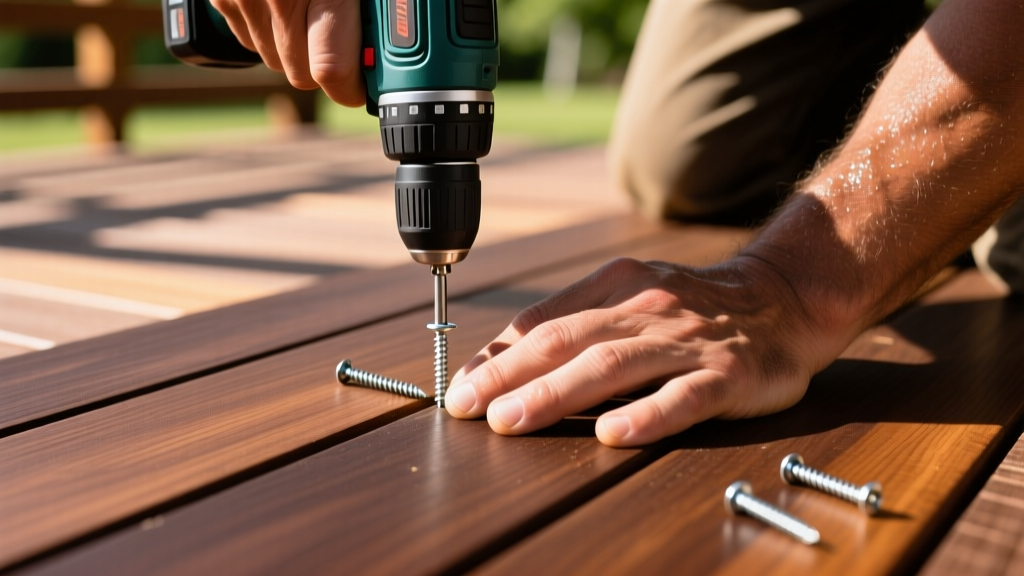
Attempting to drive a screw directly into any wood species with a Janka rating over 1,500 lbf will result in snapped screw shanks, stripped heads, or split boards. Pre-drilling is not optional; it is a strict requirement. The pilot hole must be precisely sized to allow the screw threads to bite into the wood while the shank passes through without creating outward radial pressure.
- Select the Correct Bit: Use a brad-point or carbide-tipped twist bit. Standard spade bits will wander and splinter the dense surface fibers.
- Determine Pilot Hole Diameter: For a standard #8 stainless steel wood screw (shank diameter 0.164"), drill a 5/32" (0.156") pilot hole in the top board (clearance hole) and a 3/32" (0.093") pilot hole in the bottom joist (threading hole).
- Countersink Depth: Dense woods do not compress easily. You must use a dedicated countersink bit to carve out a conical recess for the screw head. If the head is forced flush without a recess, it will act as a wedge and split the board edge.
- Clear the Flutes: When drilling deep holes (over 1.5 inches) into species like Cumaru, withdraw the bit every 1/2 inch to clear packed sawdust. Friction from packed dust will overheat and shatter the carbide tip.
Moisture Acclimation and Expansion Gaps
Dense woods are highly hygroscopic but react slower to ambient humidity changes than softwoods due to their tight cellular structure. However, when they do move, the sheer force of their expansion can buckle subfloors or crush deck joists. The National Wood Flooring Association (NWFA) mandates strict equilibrium moisture content (EMC) matching before interior installation.
- Interior Flooring (Hickory/Maple): Acclimate for 7–14 days. Target MC must be within 2% of the subfloor's MC (typically 6% to 9% depending on regional HVAC).
- Exterior Decking (Ipe/Cumaru): Target MC at delivery is usually 12% to 16%. In dry climates (Southwest US), expect up to 1/8" shrinkage per 5.5" board width. In humid climates, leave a strict 3/32" side gap for expansion.
Species-Specific Installation Protocols
Ipe and Cumaru (Exterior Decking and Siding)
Because of their extreme density and natural oils, gluing Ipe or Cumaru is virtually impossible with standard polyurethane or PVA adhesives. Rely entirely on mechanical fastening. For a clean aesthetic, use hidden stainless steel clip systems (such as Tiger Claw or CAMO edge fasteners) that route into pre-cut grooves on the board edges. If face-screwing, use a plug cutter to harvest end-grain plugs from the off-cuts, and epoxy them over the screw heads. Sand the plugs flush immediately before the epoxy fully cures to prevent raised bumps.
Hickory and Hard Maple (Interior Flooring)
Hickory is notorious for its dramatic tension release; boards can warp significantly if ripped or cross-cut and left unfastened. When installing solid 3/4" Hickory flooring, blind-nail using an 18-gauge pneumatic cleat nailer. Do not use 16-gauge nails, as the thicker shank will cause the tongue to splinter on this ultra-dense wood. Set the compressor to 70–80 PSI. For boards wider than 5 inches, supplement the blind nails with face-nailing at the ends and edges, pre-drilling and countersinking every 12 inches to prevent seasonal cupping.
Common Failure Modes and Troubleshooting
Even experienced contractors encounter edge cases when working with the hardest types of strong wood. Use this diagnostic matrix to resolve on-site issues.
| Symptom | Root Cause | Corrective Action |
|---|---|---|
| Black staining around fastener heads on exterior decking. | Tannin reaction with HDG or zinc-coated screws; moisture ingress. | Switch to Type 316 SS. Sand stains and apply an oxalic acid-based wood brightener to neutralize the tannins. |
| Flooring boards splintering at the tongue during blind nailing. | Pneumatic nailer PSI too high or 16-gauge cleat used on Hickory. | Drop compressor to 70 PSI. Switch to 18-gauge cleats. Pre-drill the tongue at a 15-degree angle for boards over 5" wide. |
| Saw blade burning the cut edge and binding in the kerf. | Blade deflection due to dull teeth or internal board tension release. | Use a fresh 80-tooth TCG carbide blade. Insert plastic shims into the kerf behind the blade during long rip cuts to prevent binding. |
| Deck boards lifting or "popping" off joists after one season. | Insufficient fastener penetration depth into the structural joist. | Ensure screws penetrate the joist by a minimum of 1-1/4 inches. Use 3" or 3-1/2" structural screws for 5/4x6 decking profiles. |
Mastering the installation of dense, high-Janka timber requires abandoning softwood habits. By matching the correct metallurgy to the wood's chemical extractives, adhering to strict pilot-hole tolerances, and respecting the material's hygroscopic movement, builders can ensure that these incredibly strong woods perform flawlessly for decades. For further structural span tables and load-bearing metrics, consult the American Wood Council's design aids to ensure your sub-structure can support the immense dead load of dense hardwood assemblies.
Written by
Priya KapoorPriya Kapoor is a real estate market analyst and construction economics researcher with expertise in housing affordability, development feasibility, and infrastructure investment. She holds a Master of Regional Planning from Cornell University and previously worked as a senior analyst at CBRE's Investment Properties group, where she modeled returns for $4B in mixed-use development pipelines. Priya now runs an independent research practice advising developers, municipalities, and REITs on construction cost forecasting and market timing. She publishes the quarterly "BuildMat Market Pulse" report tracking material price indices across 12 commodity categories. Based in Austin, TX, Priya serves on the board of Habitat for Humanity Austin and is a marathon runner.
More from Priya Kapoor
View all
Construction Cost
Cost to Build a 1600 Sq Ft Home in 2026: Full Breakdown
Accurate 2026 cost to build a 1600 sq ft home—material, labor, and regional pricing breakdowns included. Plan your budget with real-time estimates.
Aug 11, 2026

Wood & Lumber
Name the Types of Wood for Pressure Treatment and Preservation
Learn how to name the types of wood best suited for pressure treatment. Compare species treatability, chemical retention levels, and 2026 preservation costs.
Aug 4, 2026

Stone & Masonry
Stone Veneer Suppliers Lindenhurst: 2026 Cost Analysis
Analyze 2026 stone veneer costs in Lindenhurst, NY. Compare local supplier pricing, delivery fees, and Suffolk County installation labor rates.
Aug 4, 2026