Types of Light Wood: 2026 Cost and Value Analysis
Compare types of light wood for 2026 construction. Analyze costs, structural value, and ROI for SPF, pine, poplar, and maple in building projects.

The Dual Definition of Light Wood in Construction
When architects, builders, and millworkers specify 'light wood,' they are typically referring to one of two distinct material properties: low volumetric density (weight) or pale heartwood coloration. In the 2026 building materials market, conflating these two categories leads to severe value-engineering errors. A light-colored hardwood like Hard Maple is incredibly dense and expensive, while a light-density softwood like Basswood is structurally inadequate for load-bearing applications but highly prized for intricate millwork.
This cost and value analysis dissects the most common types of light wood used in modern construction and interior fit-outs. By evaluating retail board-foot pricing, structural modulus of elasticity (MOE), and machining yield rates, we can determine the exact return on investment (ROI) for each species in specific building applications.
Structural Lightwoods: SPF and Eastern White Pine Economics
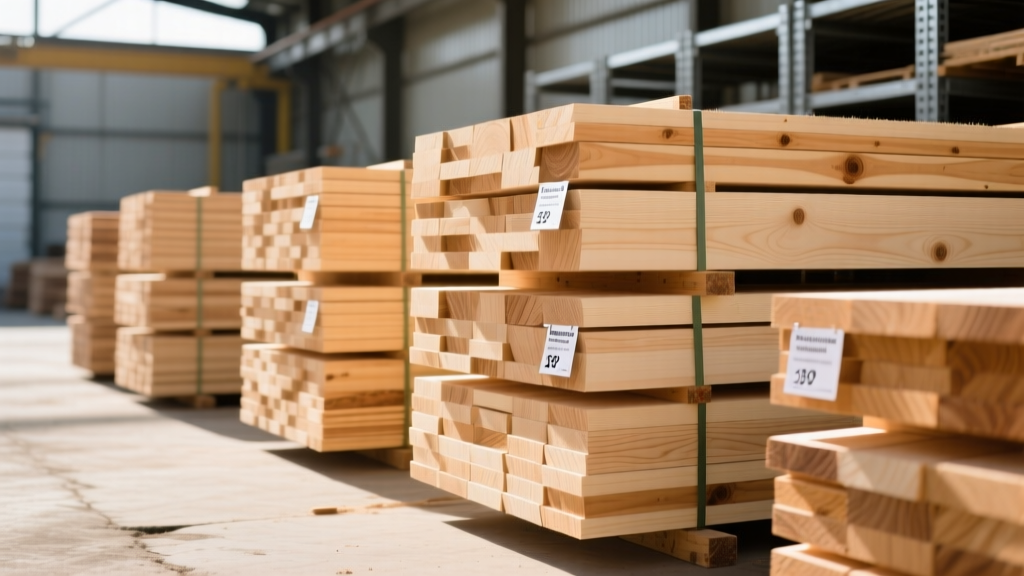
For framing, sheathing, and structural timber, light-density softwoods dominate the North American market. The primary commodity grouping is SPF (Spruce-Pine-Fir), governed by the NLGA (National Lumber Grades Authority) grading rules. Eastern White Pine, while often sold separately as a premium appearance-grade softwood, also sees use in light structural timber framing.
Structural Performance Matrix
| Species Group | Avg. Retail Cost (per BF) | Janka Hardness (lbf) | Modulus of Elasticity (MOE) | Primary Value Application |
|---|---|---|---|---|
| SPF (Spruce-Pine-Fir) | $1.80 - $2.40 | 480 - 540 | 1.50 x 10^6 psi | Standard 2x4 / 2x6 wall framing |
| Eastern White Pine | $3.50 - $5.00 | 380 | 1.20 x 10^6 psi | Exposed timber trusses, interior beams |
| Sitka Spruce | $4.20 - $6.50 | 510 | 1.60 x 10^6 psi | Aircraft/Marine, specialized acoustic builds |
According to the USDA Forest Products Laboratory Wood Handbook, Eastern White Pine exhibits exceptional dimensional stability, shrinking only 3.8% radially from green to oven-dry. This makes it vastly superior to standard SPF for exposed interior timber framing where seasonal HVAC fluctuations cause joint separation in denser woods.
Finish-Grade Lightwoods: Poplar, Basswood, and Maple Value
When 'light wood' refers to color rather than weight, the conversation shifts to finish carpentry, cabinetry, and flooring. The value proposition here is dictated by machining characteristics, paint-grade suitability, and clear-cutting yields.
Poplar (Tulipwood): The Paint-Grade Workhorse
Yellow Poplar (Liriodendron tulipifera) is the undisputed king of light-colored, paint-grade millwork. With a Janka hardness of 540 lbf, it is soft enough to route intricate profiles without burning router bits, yet hard enough to hold edge details.
Cost Analysis: FAS (Firsts and Seconds) grade Poplar retails for $4.50 to $6.00 per BF in 2026. However, buyers must account for 'mineral stain'—the dark green and purple streaks inherent to the species. While these streaks are invisible under opaque paint, they render the board useless for clear-coat applications. If your project requires stained or clear-coated light wood, Poplar's effective yield drops by up to 40%, destroying its cost advantage.
Basswood: The Carver's Choice
Basswood (Tilia americana) is exceptionally light (26 lbs/ft³) and features a completely uniform, pale white-to-cream color. It lacks the structural integrity for cabinetry frames but offers unparalleled value for hand-carved architectural details, corbels, and acoustic paneling. At $5.00 to $7.50 per BF, it is a specialized purchase. Its primary drawback is poor screw-holding strength; joints must be reinforced with dowels or specialized adhesives.
Hard Maple: The Heavyweight Light Wood
Hard Maple (Acer saccharum) provides a brilliant, pale cream color but is incredibly dense (44 lbs/ft³) with a Janka rating of 1,450 lbf. It is the premium choice for light-colored, high-traffic commercial flooring and heavy-use butcher block countertops. Retail pricing for FAS Hard Maple sits between $7.50 and $10.50 per BF. According to The Wood Database Janka Scale, Hard Maple is nearly three times harder than Poplar, justifying its higher material and machining costs in high-wear environments.
Value Engineering Framework: Selecting the Right Species
To maximize your project budget, use this decision matrix to select the correct light wood based on your specific structural and aesthetic requirements:
- If the application is concealed structural framing: Use SPF #2 & Btr. Do not pay the premium for Eastern White Pine unless local code requires higher nail-withdrawal resistance for high-wind shear walls.
- If the application is exposed interior timber beams: Use Eastern White Pine (Select Structural). The lower cost compared to Oak or Douglas Fir, combined with its resistance to checking and splitting, provides the highest aesthetic ROI.
- If the application is painted baseboards, crown molding, or cabinet face frames: Use FAS Poplar. The smooth grain and lack of resin canals prevent tannin bleed-through, reducing the required primer coats from three to one.
- If the application is light-colored commercial flooring: Use Hard Maple. While the upfront material cost is 2.5x that of Pine, the lifecycle cost is lower due to its resistance to denting from foot traffic and rolling loads.
- If the application is intricate CNC-routed acoustic wall panels: Use Basswood. Its low density reduces CNC machine wear and tear, and its uniform color requires no edge-banding or fillers.
Hidden Costs: Yield Loss and Moisture Management
The most frequent error in light wood procurement is ignoring moisture content (MC) differentials and grading yield losses. Softwoods like SPF and White Pine are typically sold at 19% MC (S-DRY) for framing. If these materials are used for interior finish work without secondary kiln-drying to 8-10% MC, they will shrink, causing miter joints to open and nail pops in drywall.
Purchasing #2 Common Poplar instead of FAS grade to save $2.00 per BF often results in a net financial loss. #2 Common boards contain frequent knots, wane, and severe mineral staining. In a cabinet door manufacturing run, the yield loss from #2 Common can exceed 45%, whereas FAS yields 85-90% usable material. Always calculate the cost per usable board foot, not just the sticker price.
Furthermore, light-colored woods like Maple and Poplar are highly susceptible to fungal staining (sticker stain) if not properly stickered and dried immediately after milling. When sourcing from local sawmills to cut costs, verify that the lumber was kiln-dried to a core temperature of at least 140°F to kill any latent fungi, a standard outlined by the APA - The Engineered Wood Association and related industry grading bodies for interior-grade materials.
Final Procurement Strategy
In 2026, the smartest builders do not simply specify 'light wood' on their cut sheets. They specify the exact species, grade, and moisture content required for the end-use environment. By aligning the mechanical properties of low-density softwoods with structural needs, and the aesthetic properties of light-colored hardwoods with finish applications, you eliminate material waste and secure the highest possible value for your construction budget.
Written by
Marcus ChenMarcus Chen is a licensed structural engineer (PE) and building materials analyst with over 12 years of experience across residential, commercial, and industrial construction. He holds a Master of Science in Civil Engineering from UC Berkeley and spent six years at Thornton Tomasetti before transitioning to independent consulting and technical writing. Marcus specializes in material selection for seismic-prone regions, concrete reinforcement strategies, and lifecycle cost analysis. His work has been cited by the American Concrete Institute (ACI) and the Structural Engineers Association of California (SEAOC). When he is not on a job site or at his desk, you will find him hiking the Sierra Nevada or restoring a 1920s craftsman bungalow in Oakland, CA.
More from Marcus Chen
View all
Construction Cost
How Much Did the Eiffel Tower Cost to Build?
How much did the Eiffel Tower cost to build in 1889? We adjust for inflation and compare its budget to modern skyscraper construction.
Aug 4, 2026

Fire Resistance
What Is a Fire Resistant Material? Testing & Certification Guide
Discover what is a fire resistant material through ASTM and UL testing. Learn how fire ratings, certifications, and assemblies work in construction.
Aug 4, 2026

Construction Cost
How Much Did the Burj Khalifa Cost to Build?
How much did the Burj Khalifa cost to build? We break down the $1.5B project and extract 5 money-saving strategies for your next build.
Jul 30, 2026