Structural Types of Wood Materials for Framing and Load-Bearing Walls
Compare the best structural types of wood materials for framing and load-bearing walls. Includes span data, LVL vs glulam costs, and grading specs.

The Structural Hierarchy: Solid Sawn vs. Engineered Wood
When evaluating the various types of wood materials for structural applications, engineers and builders must navigate a strict hierarchy based on load paths, span requirements, and moisture tolerance. The selection is not merely about choosing 'wood'; it requires specifying exact species, grading stamps, and manufacturing processes. Structural wood broadly bifurcates into two categories: solid-sawn dimensional lumber and engineered wood products (EWP). While solid-sawn lumber remains the backbone of light-frame residential construction for vertical load-bearing walls, EWPs have become mandatory for long-span headers, heavy point loads, and commercial mass timber assemblies.
- Choose Solid Sawn: For vertical studs (walls), short-span floor joists (under 14 feet), and top/bottom plates where high tensile strength is secondary to compressive capacity and fastener withdrawal.
- Choose Engineered (LVL/Glulam): For headers over wide openings, continuous beams, rim boards, and any application requiring spans exceeding 16 feet or high shear resistance without the risk of checking or warping.
Dimensional Lumber: Species, Grades, and Moisture Metrics
Not all dimensional lumber is interchangeable in load-bearing scenarios. The structural capacity of a 2x6 or 2x10 is dictated by its species group and visual or machine-stress-rated (MSR) grade. According to the USDA Forest Products Laboratory Wood Handbook, the design values for Fiber in Bending (Fb) and Modulus of Elasticity (E) vary wildly between species.
Species Selection for Vertical and Horizontal Loads
For vertical load-bearing studs, Douglas Fir-Larch (DF-L) is the industry benchmark in western North America due to its high specific gravity and excellent nail-holding capacity. A standard No. 2 grade DF-L 2x6 stud can support significant axial compressive loads. In the southern and eastern regions, Southern Pine (SP) dominates. Southern Pine is notably denser and possesses higher natural resin content, making it superior for floor joists where high bending strength (Fb) and stiffness (E) are required to prevent floor bounce.
Decoding the Grading Stamp and Moisture Content
A critical failure point in structural framing occurs when builders ignore the moisture content designation on the lumber stamp. You will typically see either S-DRY (surfaced dry, moisture content ≤ 19%) or S-GRN (surfaced green, moisture content > 19%).
- S-GRN Lumber: Cheaper upfront but shrinks significantly as it acclimates to the interior environment. Using S-GRN for multi-story load-bearing walls or floor joists will result in differential shrinkage, leading to drywall cracking, sloping floors, and compromised plumbing connections.
- S-DRY or MC-15: Mandatory for interior load-bearing partitions and engineered wood integration. When connecting dimensional lumber to steel hangers or EWP beams, moisture content must be stabilized to prevent fastener withdrawal as the wood shrinks away from the connector.
Engineered Wood Products (EWP) for Heavy Load-Bearing
When the structural types of wood materials shift from light framing to heavy load transfer, Engineered Wood Products take over. EWPs are manufactured by bonding wood strands, veneers, or laminations with structural resins, effectively randomizing natural defects like knots and slope-of-grain.
Laminated Veneer Lumber (LVL)
LVL is produced by peeling logs into thin veneers (typically 1/8 inch), drying them, grading them, and laminating them with the grain running parallel to the long axis. LVL is the standard for residential headers, flush beams, and rim boards.
Specifications: Standard depths match dimensional lumber (9-1/4", 11-7/8", 14") to allow for flush framing.
Cost Profile: Expect to pay between $3.50 and $6.50 per linear foot for standard 1-3/4" x 11-7/8" LVL beams, depending on the stress grade (e.g., 2800Fb-2.0E vs. 3100Fb-2.2E).
Glued Laminated Timber (Glulam)
Glulam consists of thick dimensional lumber laminations (typically 1.5 inches) bonded with waterproof adhesives. Unlike LVL, glulam is often used in exposed architectural applications and can be manufactured in massive depths (up to 60 inches) and curved profiles. For commercial or heavy timber residential projects, a 24F-V4 DF/DF glulam beam offers superior load capacity over spans ranging from 20 to 40 feet. According to American Wood Council span guidelines, glulam beams must be properly cambered during manufacturing to offset dead-load deflection.
Cross-Laminated Timber (CLT) for Mass Timber
CLT represents the frontier of structural wood. It consists of 3, 5, or 7 layers of dimensional lumber stacked orthogonally (at 90-degree angles) and glued under pressure. This cross-lamination provides bi-directional strength, allowing CLT panels to serve as load-bearing shear walls, floor diaphragms, and roof slabs in multi-story mass timber buildings. CLT panels are manufactured to the PRG 320 standard and can replace concrete tilt-up panels in commercial construction.
Structural Wood Material Comparison Matrix
| Material Type | Max Typical Span | Est. Cost (per LF) | Primary Structural Role |
|---|---|---|---|
| #2 Southern Pine (2x10) | 14' - 16' (Joist) | $1.80 - $2.40 | Floor joists, roof rafters |
| DF-L Stud (2x6) | 10' (Vertical Wall) | $1.20 - $1.60 | Exterior/Interior load walls |
| LVL (1-3/4" x 11-7/8") | 18' - 22' (Beam) | $4.50 - $6.50 | Headers, flush beams, rims |
| Glulam (5-1/8" x 15") | 24' - 32' (Beam) | $18.00 - $28.00 | Main girders, exposed beams |
| CLT (5-Ply Panel) | 20' - 25' (Slab) | $12.00 - $18.00 / sq ft | Floor/roof diaphragms, shear walls |
Real-World Failure Modes and Mitigation Strategies
Specifying the correct structural wood material is only half the battle; understanding how these materials fail in the field is what separates adequate construction from enduring structures. Resources available through WoodWorks frequently highlight the following edge cases in structural wood design:
- Creep in Long-Span LVL: While LVL has immense initial stiffness, it is susceptible to 'creep' (long-term deflection under sustained dead loads). When designing LVL floor beams for spans over 16 feet, engineers must calculate long-term deflection using a creep factor (typically 1.5x the initial elastic deflection) to prevent sagging over a 10-year period.
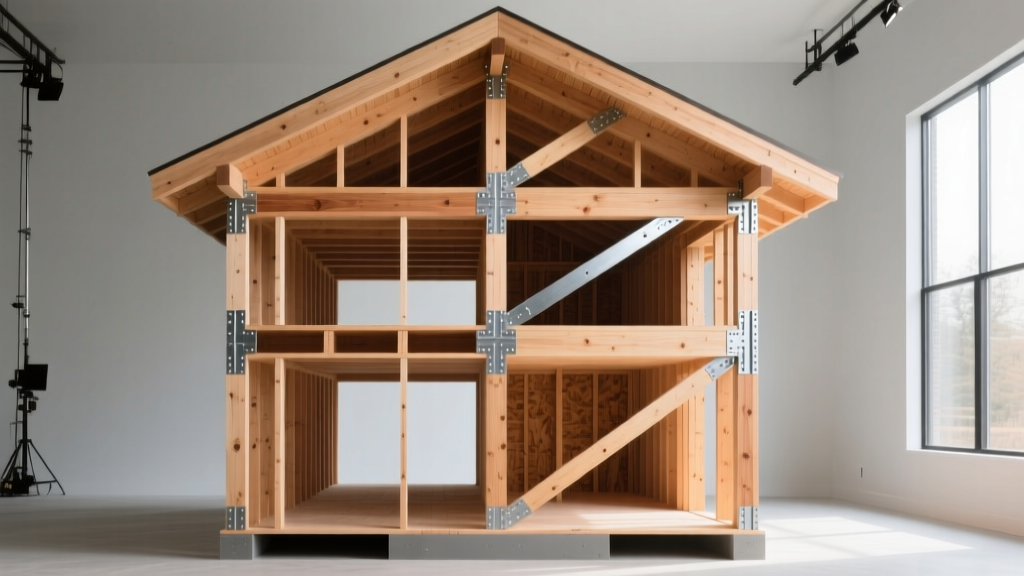
- Lateral Torsional Buckling: Deep, narrow joists (like 2x12s or 14-inch I-joists) are prone to twisting under load if not properly braced. Solid blocking at mid-span or continuous lateral restraint via structural subfloor adhesives and nailed diaphragms is mandatory to transfer lateral forces and prevent buckling.
- Fastener Corrosion in Treated Wood: When structural lumber is pressure-treated for ground contact or moisture exposure using Alkaline Copper Quaternary (ACQ) or Copper Azole (CA-C), the high copper content acts as a galvanic catalyst. Standard zinc-plated joist hangers will corrode and fail within a few years. You must specify G185 hot-dipped galvanized or stainless steel connectors for all treated structural lumber.
- Checking in Glulam Beams: While glulam is highly stable, wide laminations can develop surface checks (cracks parallel to the grain) as the outer laminations dry faster than the core. While surface checks rarely affect structural bending capacity, they can compromise shear capacity if they propagate to the neutral axis. Specifying 'framing grade' or ensuring proper factory end-sealing mitigates severe checking.
Code Compliance and Integration Tolerances
Integration between different types of wood materials requires strict adherence to the International Building Code (IBC) and manufacturer tolerances. For instance, when framing a load-bearing wall with S-DRY DF-L studs that bear onto an LVL beam, the top plate must be perfectly level. LVL beams are manufactured to tight tolerances (typically ±1/8 inch over 40 feet), whereas solid-sawn lumber can vary by 1/4 inch or more in depth. Failure to shim the top plates or plane the studs to a uniform height will result in point-loading the LVL beam, potentially causing localized crushing perpendicular to the grain.
Ultimately, selecting the right structural wood material requires matching the specific mechanical properties of the product—whether the high shear strength of Southern Pine, the dimensional stability of LVL, or the bi-directional rigidity of CLT—to the exact load path and environmental conditions of the build. Relying on verified span tables, understanding moisture dynamics, and specifying compatible hardware ensures the structural integrity of the wood frame for decades.
Written by
Sarah WhitfieldSarah Whitfield is a chartered quantity surveyor (MRICS) and construction cost analyst with 15 years of experience in material pricing, procurement strategy, and project budgeting. She earned her degree in Construction Management from the University of Reading (UK) and has worked on projects ranging from $2M custom homes to $180M mixed-use developments across North America and Europe. Sarah currently leads cost estimating for BuildMat Insight, maintaining a proprietary database of 4,000+ material price points updated quarterly. She is a frequent contributor to RSMeans cost data panels and has presented at the International Cost Engineering Council (ICEC) congress. Based in Denver, CO, Sarah is an avid trail runner and volunteer mentor for Women in Construction.
More from Sarah Whitfield
View all
Wood & Lumber
What Are the Different Types of Wood? A Builder's Guide
Compare structural softwoods, finish hardwoods, and engineered lumber. Analyze Janka ratings, MOE values, and 2026 pricing for construction.
Aug 4, 2026

Walls & Panels
Steel Framing vs Wood Framing: Corrosion and Moisture Defense
Compare steel framing vs wood framing for moisture resistance. Learn about galvanized coatings, condensation risks, and corrosion protection strategies.
Jul 21, 2026

Stone & Masonry
How to Cut Stone Veneer: Wet Saw vs Grinder Comparison
Compare the best tools for cutting stone veneer. We review wet saws, angle grinders, and chop saws to help you achieve clean, chip-free cuts.
Jul 21, 2026