The Most Expensive Types of Wood: A Grade and Quality Guide
Discover the most expensive types of wood for premium millwork. Learn NHLA grading rules, exotic timber pricing, and procurement strategies.

The Economics of Premium Timber: Why Grade Dictates Price
When sourcing the most expensive types of wood for high-end architectural millwork, luxury furniture, or specialty turning, the sticker price is only half the equation. The true cost of premium timber is dictated by a complex intersection of biological scarcity, international trade regulations, and rigorous grading systems. A board of Black Walnut might cost $8 per board foot (BF) at a retail hardwood dealer, while a meticulously graded, kiln-dried FAS (Firsts and Seconds) plank of the same species with premium figure can command $18 to $22 per BF from a specialty wholesaler.
Understanding how to evaluate wood quality requires separating the market into two distinct categories: ultra-premium exotics, which are graded by weight and purity, and high-end domestic hardwoods, which are governed by the National Hardwood Lumber Association (NHLA) grading rules. This guide breaks down the exact specifications, pricing metrics, and procurement strategies required to navigate the top tier of the global lumber market.
Ultra-Premium Exotics: Beyond Standard Board-Foot Grading
The absolute most expensive types of wood in the world do not follow standard dimensional grading. Species like African Blackwood, Agarwood, and Pink Ivory are evaluated on entirely different metrics, primarily density, resin/oil content, and the complete absence of sapwood.
African Blackwood (Dalbergia melanoxylon)
Often cited as the most expensive commercially available timber, African Blackwood is prized for its extreme density (specific gravity of 1.2 to 1.3) and jet-black heartwood. It is rarely sold by the board foot. Instead, it is merchandised by the pound or kilogram in small turning blanks. As of current market rates, premium, wax-sealed turning blanks equate to roughly $120 to $160 per board-foot equivalent. According to The Wood Database, the wood's high natural oil content makes it incredibly stable but notoriously difficult to machine, requiring carbide-tipped tooling and slow feed rates to prevent burning.
Agarwood (Aquilaria spp.)
Agarwood represents the extreme upper limit of wood pricing, though it is used almost exclusively for incense, perfume extraction, and small carvings rather than structural or millwork applications. The wood only produces its valuable dark, resinous heartwood when the tree is infected by a specific type of mold. Top-grade wild-harvested Agarwood can exceed $100,000 per kilogram. Because of severe overharvesting, all Aquilaria species are heavily regulated.
High-End Domestic Hardwoods: Where NHLA Grading Shines
For interior millwork, cabinetry, and flooring, North American domestic hardwoods offer the best balance of luxury and workability. The National Hardwood Lumber Association (NHLA) established the grading rules that dictate the price and yield of these woods. The most expensive domestic species—Black Walnut, Quartersawn White Oak, and Hard Maple—see massive price jumps between grade tiers.
| Species | Grade | Min. Board Size | Clear Cutting Yield | Est. Price (Per BF) |
|---|---|---|---|---|
| Black Walnut | FAS | 6" wide x 8' long | 83.3% to 100% | $14.00 - $18.00 |
| #1 Common | 3" wide x 4' long | 66.6% to 83.3% | $7.50 - $9.50 | |
| Quartersawn White Oak | FAS | 6" wide x 8' long | 83.3% to 100% | $16.00 - $22.00 |
| Select | 4" wide x 6' long | 83.3% to 100% | $12.00 - $15.00 | |
| Hard Maple (Birdseye) | FAS (Figured) | 6" wide x 8' long | 83.3% to 100% | $25.00 - $40.00+ |
| #1 Common | 3" wide x 4' long | 66.6% to 83.3% | $11.00 - $14.00 |
The FAS Advantage: FAS (Firsts and Seconds) is the highest standard grade. While it commands a premium, it guarantees long, wide cuttings that are essential for continuous runs of baseboards, stair treads, or large dining tables. If you are building small cabinet doors or drawer fronts, downgrading to #1 Common will save you 30% to 40% on material costs, as the smaller clear-cut areas are perfectly adequate for short components.
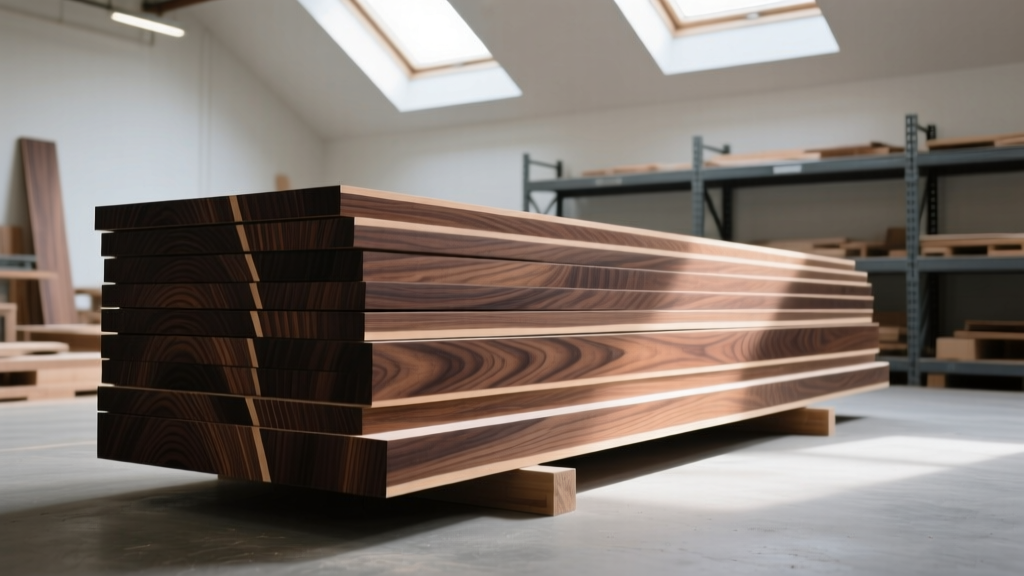
Decoding the Grade Stamp: Surfacing and Moisture Content
When purchasing the most expensive types of wood, the NHLA grade only tells you about the visual defects and board dimensions. It does not account for moisture content or surfacing, both of which drastically alter the final usable price.
Moisture Content (MC) and Kiln Drying
Premium hardwoods must be kiln-dried to specific Equilibrium Moisture Content (EMC) targets based on their end use. According to the USDA Forest Products Laboratory, interior millwork and furniture in climate-controlled environments require an MC of 6% to 8%. Exterior applications require 12% to 15%. Buying premium Walnut that is air-dried (typically 15-20% MC) for interior use will result in catastrophic shrinking, joint failure, and finish cracking once introduced to a heated home.
Expert Insight: Always use a pinless moisture meter to verify the core moisture content of thick premium stock (8/4 or 12/4). Surface readings can be deceiving. If a 2-inch thick slab of Quartersawn White Oak reads 8% on the surface but 14% in the core, it is case-hardened and will warp violently once you rip it on a table saw.
Surfacing: Rough Sawn vs. S4S
Lumber is typically sold in random widths and lengths in a rough-sawn state. Having a dealer plane it to S4S (Surfaced Four Sides) to a specific thickness (e.g., 3/4") and rip it to straight edges adds significant cost. Expect to pay an additional $2.50 to $4.50 per BF for S4S milling on premium species. For high-end projects, buying rough-sawn FAS and milling it yourself on a jointer and planer allows you to control the grain orientation and remove minimal material, preserving the maximum thickness of your expensive stock.
Procurement Strategy: Sourcing Premium Lumber Without Overpaying
Acquiring top-tier hardwood requires a methodical approach to inspection and negotiation. Follow this sequence when visiting a specialty hardwood dealer:
- Inspect the End Seals: Premium thick stock (8/4 and above) should have wax or paint sealed ends to prevent moisture loss and end-checking. If the ends are bare and show deep radial cracks, the usable length of the board is compromised, and you should negotiate a discount or pass.
- Check for Honeycomb Checks: Look closely at the face grain for tiny, parallel splits. These are 'honeycomb checks' caused by overly aggressive kiln drying. They often do not show up until the board is planed, rendering expensive FAS stock useless for clear finishes.
- Calculate the True Waste Factor: A board graded FAS guarantees 83.3% clear yield, meaning up to 16.7% of the board you are paying top dollar for will be waste (wane, knots, or splits). Factor this into your total board-foot requirements before purchasing.
- Specify Color Sorting: For Black Walnut, the heartwood is dark brown, while the sapwood is pale yellow. FAS grade allows for a certain percentage of sapwood. If your design requires 100% dark heartwood, you must specifically request 'steamed' Walnut (which darkens the sapwood) or pay a premium for 'all-heart' custom sorting.
Frequently Asked Questions
Is FAS grade always the best choice for expensive wood?
Not necessarily. While FAS provides the longest and widest clear cuttings, it is overkill for projects with many small parts, such as segmented turning, small jewelry boxes, or intricate inlay work. In those cases, #1 Common or even #2 Common provides the necessary small clear areas at a fraction of the cost, allowing you to allocate your budget toward highly figured or rare species rather than paying for unused board length.
Why is Quartersawn White Oak so much more expensive than plain-sawn?
Quartersawing is a specific milling technique where the log is cut into quarters and then sliced radially toward the center. This process exposes the medullary rays, creating the prized 'tiger stripe' or 'flake' figure, and significantly increases the wood's dimensional stability and resistance to cupping. However, the process generates more waste and requires more labor than plain-sawing, driving the price up by 40% to 60% over standard plain-sawn White Oak.
How does steaming affect the grade and price of Black Walnut?
Steaming Black Walnut involves introducing steam into the kiln to draw the dark pigments from the heartwood into the pale sapwood, creating a more uniform color. While this is highly desirable for production furniture makers who want consistent color without using dark stains, it slightly reduces the wood's overall structural stiffness and can sometimes introduce a grayish-purple hue if not done correctly. Steamed Walnut usually carries a 5% to 10% price premium over unsteamed stock due to the extra processing step.
Written by
David NakamuraDavid Nakamura is a licensed architect (AIA) and construction technology writer focused on sustainable building methods, mass timber engineering, and high-performance building envelopes. He holds a Master of Architecture from the University of Washington and is a certified Passive House Consultant (CPHC). David spent eight years at the Seattle firm Mithun, where he led the design of three LEED Platinum projects, before founding his own practice specializing in net-zero residential design. He serves on the editorial advisory board of GreenBuilder Magazine and has authored peer-reviewed papers on cross-laminated timber (CLT) connections for the Journal of Structural Engineering. In his spare time, David teaches woodworking at Pratt Fine Arts Center and kayaks the Puget Sound.
More from David Nakamura
View all
Construction Cost
Labor Cost to Build a Deck Per Sq Ft: 2026 Installation Guide
Discover the exact labor cost to build a deck per sq ft in 2026. This installation guide breaks down contractor rates, complexity factors, and hidden fees.
Aug 4, 2026

Construction Cost
How Much Does It Cost to Build a 3 Bedroom House? Financing Guide
Learn exactly how much it costs to build a 3 bedroom house and explore 2026 financing options, construction loan types, and budget frameworks for your build.
Aug 4, 2026

Construction Cost
Cost to Build a Tennis Court: 2026 Guide
How much does it cost to build a tennis court in 2026? Breakdowns for asphalt, concrete, and synthetic surfaces plus fencing and lighting.
Jul 30, 2026