How to Name Types of Wood for Construction: Selection Framework
Master the builder's framework to accurately name types of wood. Compare species, decode grading stamps, and select timber for structural and finish uses.
The Taxonomy of Timber: Structural vs. Finish Classifications
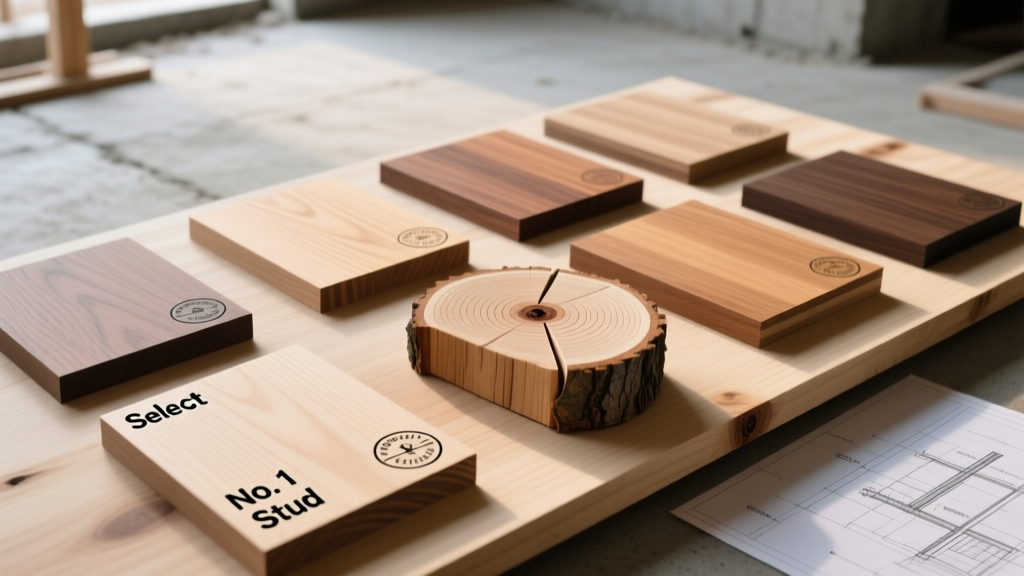
When architects, engineers, and builders need to accurately name types of wood for project specifications, relying on common names like 'pine' or 'oak' is insufficient and legally risky. Professional wood selection requires a precise taxonomy based on botanical classification, grading agency designations, and mechanical properties. The fundamental divide in construction timber is between softwoods (gymnosperms) used primarily for structural framing and engineered panels, and hardwoods (angiosperms) specified for finish carpentry, flooring, and architectural millwork.
Understanding how to correctly name and classify these materials ensures compliance with the International Building Code (IBC) and prevents catastrophic structural deflection or premature finish failure. According to the USDA Forest Products Laboratory Wood Handbook, the mechanical properties of wood vary wildly even within the same genus, making precise species-group naming mandatory on structural blueprints.
| Species Grouping (Stamp Name) | Botanical Type | Specific Gravity (Ovendry) | Avg. Janka Hardness (lbf) | Primary Construction Application |
|---|---|---|---|---|
| Douglas Fir-Larch (DF-L) | Softwood | 0.50 | 660 | Heavy timber framing, glulam beams, structural joists |
| Southern Pine (SYP) | Softwood | 0.54 | 690 | High-load floor joists, treated outdoor decking, trusses |
| Spruce-Pine-Fir (SPF) | Softwood | 0.42 | 490 | Standard wall studs, light-duty rafters, sheathing |
| White Oak (Quercus alba) | Hardwood | 0.68 | 1,360 | High-end flooring, exterior millwork, marine applications |
| Hard Maple (Acer saccharum) | Hardwood | 0.63 | 1,450 | Commercial gymnasium flooring, high-traffic stair treads |
Decoding the Stamp: How to Name and Read Lumber Grades
To correctly name types of wood in a procurement context, you must be able to read the ink stamp applied at the sawmill. This stamp is a legally binding certification of the board's structural capacity. The APA - The Engineered Wood Association and specialized bureaus like the Southern Pine Inspection Bureau (SPIB) enforce these grading standards.
A standard framing stamp contains five critical data points. For example, a stamp reading 'S-DRY DF-L No. 2 WWPA' translates to:
1. Moisture Condition: S-DRY (Surfaced Dry, meaning 19% maximum moisture content at time of surfacing).
2. Species: DF-L (Douglas Fir-Larch).
3. Grade: No. 2 (Standard structural grade for joists and rafters).
4. Agency: WWPA (Western Wood Products Association).
5. Mill ID: A numeric code identifying the specific manufacturing facility.
The Danger of 'White Wood' Misidentification
A common procurement error occurs when builders order 'white wood' studs. 'White wood' is not a botanical species; it is a colloquial catch-all for SPF (Spruce-Pine-Fir) or Hem-Fir. If your structural engineer calculated live and dead loads based on the allowable bending stress (Fb) of Douglas Fir-Larch (Fb = 1,500 psi for No. 2 grade), substituting SPF (Fb = 1,150 psi for No. 2 grade) without recalculating the spans can lead to bouncy floors and code violations. Always name the exact species group on the purchase order.
The 4-Step Wood Selection Framework
Selecting the right timber requires moving beyond basic aesthetics. Use this four-step framework to evaluate wood for any building envelope or interior application.
Step 1: Structural Load and Span Requirements
For framing, evaluate the Modulus of Elasticity (E) and allowable bending stress (Fb).
- High-Load/Long-Span: Specify Southern Yellow Pine (SYP) or Douglas Fir-Larch (DF-L). SYP No. 1 grade offers an Fb of 1,850 psi and an E of 1,900,000 psi, allowing for wider joist spacing and longer spans than SPF.
- Standard Vertical Loads: SPF Stud grade or Hem-Fir No. 3 is sufficient for interior, non-load-bearing partition walls where straightness is prioritized over sheer load capacity.
Step 2: Environmental Exposure and Decay Resistance
Wood exposed to the elements or concrete must be evaluated for natural durability or treatability. The American Wood Protection Association (AWPA) categorizes wood into Use Categories (UC).
- UC4A (Ground Contact): Requires pressure-treated SYP. SYP's high sapwood content makes it highly permeable to preservative chemicals like Alkaline Copper Quaternary (ACQ) or Copper Azole (CA-C).
- Naturally Decay Resistant: If chemical treatment is undesirable, specify the heartwood of Western Red Cedar, Redwood, or White Oak. Note that only the heartwood contains the extractives (like thujaplicins in cedar) that resist fungal decay; sapwood of these same species will rot quickly.
Step 3: Dimensional Stability and Moisture Content
Wood moves as it exchanges moisture with the ambient air. The ratio of tangential shrinkage (parallel to the growth rings) to radial shrinkage (perpendicular to the rings) dictates how much a board will warp or cup.
- High Stability: Quarter-sawn White Oak has a tangential-to-radial shrinkage ratio of 1.6:1, making it exceptionally stable for wide-plank flooring.
- Low Stability: Flat-sawn Hard Maple has a ratio of 2.1:1, making it prone to cupping in wide formats if interior relative humidity fluctuates below 30% or above 55%.
Never install hardwood flooring directly from the delivery truck. As of 2026, modern HVAC systems create extreme micro-climates. Hardwood must be acclimated in the installation space for 7 to 14 days until the moisture content (MC) of the wood is within 2% to 4% of the plywood subfloor's MC. Use a pin-type moisture meter to verify this delta; visual inspection is entirely unreliable.
Step 4: Aesthetics, Hardness, and Finish Compatibility
For finish carpentry and flooring, the Janka hardness test (ASTM D143) dictates dent resistance, while grain structure dictates finish compatibility.
- Commercial/High Traffic: Specify Ipe (Janka: 3,510 lbf) or Hard Maple (1,450 lbf). Note that ultra-dense woods like Ipe require specialized carbide tooling and cannot be nailed; they must be pre-drilled and screwed, or installed with hidden clip systems.
- Staining and Finishing: Woods with large, open pores (Red Oak, Ash) require a grain filler before applying a high-gloss polyurethane to achieve a glass-smooth surface. Closed-pore woods (Maple, Cherry) accept film-forming finishes directly but are prone to blotching when stained with penetrating dyes, requiring a pre-stain wood conditioner.
Application-Specific Species Cheat Sheet
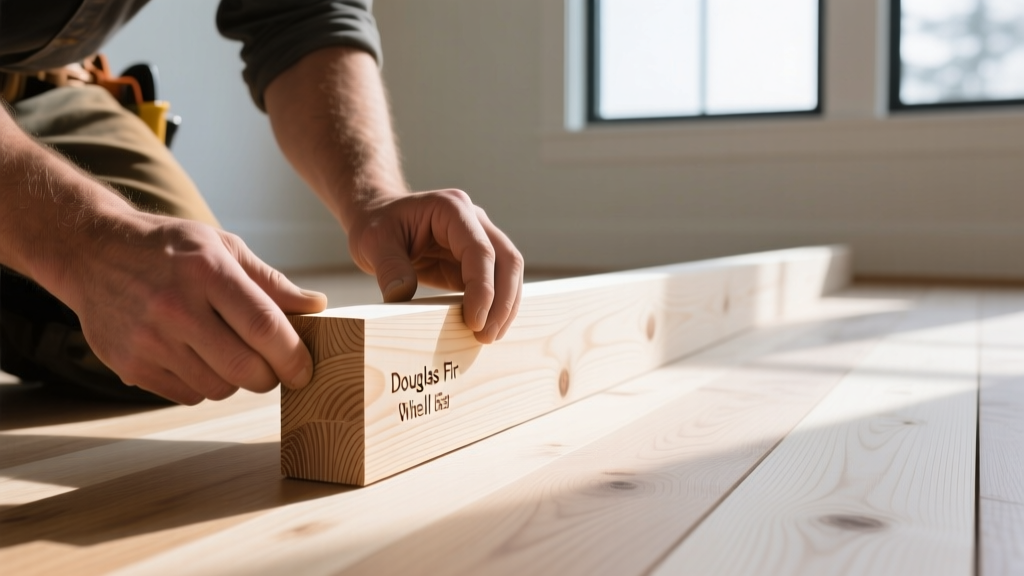
Use this quick-reference matrix to align your project requirements with the correct botanical and commercial wood names.
| Application Scenario | Required Specification Name | Key Technical Justification |
|---|---|---|
| Exterior Siding / Rainscreen | Western Red Cedar (Clear, Vertical Grain) | Natural decay resistance, low density (0.32 SG) provides high thermal insulation, vertical grain minimizes surface checking. |
| Glulam Beams for Atriums | Douglas Fir-Larch (Industrial or Architectural Grade) | High strength-to-weight ratio, excellent glue-bonding characteristics with structural melamine or polyurethane adhesives. |
| Heavy-Duty Warehouse Flooring | Southern Yellow Pine (No. 1 Dense Industrial 6x) | High specific gravity and interlocked grain withstand repetitive impact from heavy forklift traffic without splintering. |
| Custom Architectural Stair Treads | White Oak (Quarter-Sawn, FAS Grade) | Prominent ray fleck pattern, high abrasion resistance, and superior dimensional stability under fluctuating stairwell humidity. |
Procurement and Supply Chain Considerations
Naming the correct type of wood also involves specifying the certification and sourcing standards required by your local jurisdiction or the project's sustainability mandate. For commercial projects pursuing LEED v4.1 or Living Building Challenge certification, you must specify FSC (Forest Stewardship Council) 100% or FSC Mix Credit certified timber. When writing the specification, do not simply write 'FSC Wood.' The exact phrasing must be: 'All structural framing lumber shall be SPF No. 2 or better, S-DRY, stamped and certified FSC Mix [Percentage], with Chain of Custody (CoC) documentation provided by the supplier prior to installation.' This level of specificity prevents contractors from substituting uncertified commodity lumber and ensures the project's environmental compliance is documented for the final building audit.
Written by
David NakamuraDavid Nakamura is a licensed architect (AIA) and construction technology writer focused on sustainable building methods, mass timber engineering, and high-performance building envelopes. He holds a Master of Architecture from the University of Washington and is a certified Passive House Consultant (CPHC). David spent eight years at the Seattle firm Mithun, where he led the design of three LEED Platinum projects, before founding his own practice specializing in net-zero residential design. He serves on the editorial advisory board of GreenBuilder Magazine and has authored peer-reviewed papers on cross-laminated timber (CLT) connections for the Journal of Structural Engineering. In his spare time, David teaches woodworking at Pratt Fine Arts Center and kayaks the Puget Sound.
More from David Nakamura
View all
Construction Cost
Labor Cost to Build a Deck Per Sq Ft: 2026 Installation Guide
Discover the exact labor cost to build a deck per sq ft in 2026. This installation guide breaks down contractor rates, complexity factors, and hidden fees.
Aug 4, 2026

Construction Cost
How Much Does It Cost to Build a 3 Bedroom House? Financing Guide
Learn exactly how much it costs to build a 3 bedroom house and explore 2026 financing options, construction loan types, and budget frameworks for your build.
Aug 4, 2026

Construction Cost
Cost to Build a Tennis Court: 2026 Guide
How much does it cost to build a tennis court in 2026? Breakdowns for asphalt, concrete, and synthetic surfaces plus fencing and lighting.
Jul 30, 2026