Different Types of Petrified Wood: Cost & Value Analysis Guide
Compare the cost, durability, and architectural value of different types of petrified wood for high-end interior finishes, slabs, and custom flooring.

The Architectural Reality of Fossilized Timber
Petrified wood occupies a unique intersection in luxury building materials: it possesses the visual warmth and organic grain patterns of natural lumber, but the physical properties of solid quartz. For architects and high-end residential builders, sourcing the different types of petrified wood requires navigating a complex matrix of geological origins, structural limitations, and highly variable pricing. Unlike standard dimensional lumber or engineered hardwoods, petrified wood is a fossilized stone where organic carbon has been entirely replaced by silica minerals over millions of years.
According to the National Park Service's geological surveys, the permineralization process preserves the exact cellular structure of the original tree, resulting in a material with a Mohs hardness of 7. This extreme density makes it highly resistant to scratching and heat, ideal for luxury countertops, feature walls, and custom flooring. However, its weight, brittleness, and the presence of natural micro-fractures demand specialized fabrication and structural support. This guide breaks down the cost, value retention, and architectural application of the primary petrified wood varieties available on the global market.
Cost & Value Matrix: Global Petrified Wood Sources
The market for architectural-grade petrified wood is dominated by three primary geological sources, each offering distinct visual characteristics, slab dimensions, and price points. The value of a slab is driven by the vibrancy of its mineral inclusions (iron oxides create reds and yellows; manganese creates purples and blacks), the diameter of the original log, and the rarity of the species.
| Origin & Species | Avg. Cost (Per Sq Ft) | Max Slab Dimensions | Primary Architectural Use | Value Driver |
|---|---|---|---|---|
| Indonesian (Dipterocarpus/Teak) | $45 - $95 | 10 ft x 4 ft | Kitchen islands, dining tables, large flooring tiles | Massive log diameters allow for seamless, continuous island tops without bookmatching. |
| Madagascar (Araucariaceae) | $80 - $160 | 7 ft x 3 ft | Vanities, accent wall panels, boutique retail counters | Exceptional color saturation and high translucency when backlit with LED arrays. |
| Arizona, USA (Araucarioxylon arizonicum) | $150 - $350+ | 3 ft x 2 ft (Tiles/Small slabs) | Backsplashes, inlays, luxury powder room vanities | Extreme rarity due to strict federal protection; highly prized for vibrant red hematite inclusions. |
| Egyptian (Palmoxylon) | $60 - $110 | 5 ft x 2.5 ft | Decorative tabletops, low-traffic flooring, wall veneers | Unique dotted 'palm' grain structure distinct from traditional coniferous rings. |
Fabrication Realities: Cutting, Polishing, and Resin Filling
Because petrified wood is essentially solid quartz, standard woodworking tools and standard masonry saws will fail. As of 2026, advanced 5-axis waterjet CNC machines have become the industry standard for cutting these slabs, reducing edge-profile costs and minimizing the risk of thermal shock fractures that occur with traditional diamond blade friction cutting.
The Resin Stabilization Requirement
Nearly all architectural-grade petrified wood contains natural voids, checks, and cellular collapse zones. Before polishing, slabs must undergo vacuum-chamber resin stabilization. Fabricators use low-viscosity, UV-stable epoxy resins to penetrate deep into the silica matrix. If a supplier skips this step to cut costs, the slab will inevitably harbor bacteria in the micro-voids and may fracture under the point-load of heavy kitchen appliances.
- Rough Cutting: Waterjet or large-diameter diamond gang saws ($15-$25 per linear foot).
- Void Filling: Vacuum-assisted epoxy injection ($10-$18 per sq ft).
- Polishing: Progressive diamond pad polishing up to 3000-grit for a glass-like finish ($20-$35 per sq ft).
- Edge Profiling: CNC-routed ogee or waterfall edges ($40-$80 per linear foot).
Installation and Structural Engineering Considerations
Installing petrified wood requires treating it as a heavy, brittle natural stone rather than lumber. The installation methodology varies drastically depending on the application.
Countertops and Islands
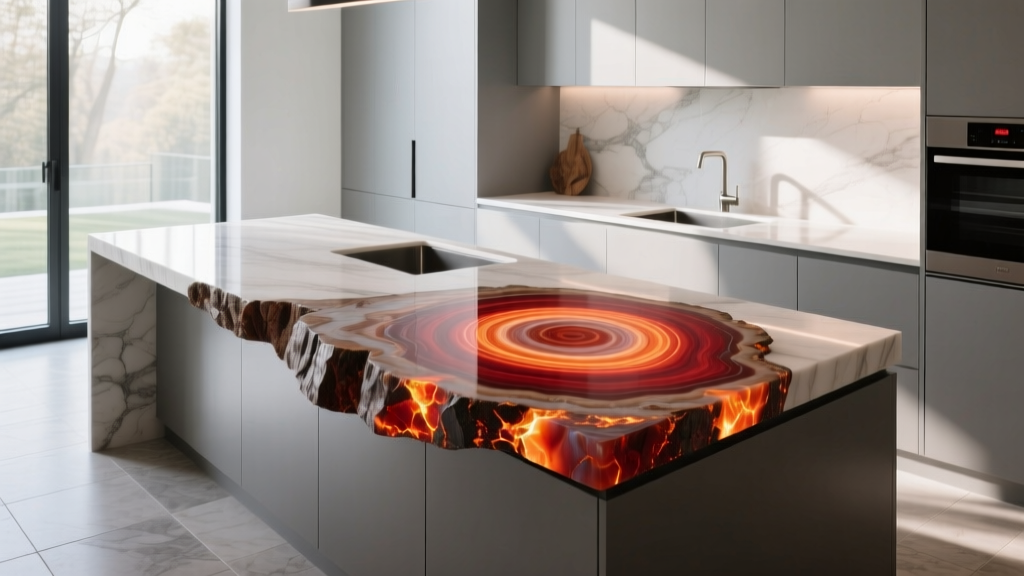
For kitchen islands, the overhang is the critical failure point. Because petrified wood lacks the tensile strength of engineered quartz or steel-reinforced concrete, any overhang exceeding 8 inches requires concealed steel corbels or structural aluminum support beams integrated into the cabinetry. Seam placement must be planned around the slab's natural fault lines; a skilled fabricator will map the slab using ultrasonic testing to identify internal fractures before making any cuts.
Flooring and Wall Cladding
When used as flooring, petrified wood tiles must be set on a fully decoupled, reinforced mortar bed. Standard thinset adhesives are insufficient due to the stone's weight and lack of porosity. Installers must use large-format, polymer-modified mortars with high non-sag properties. For wall cladding, mechanical anchoring (Z-clips or kerf-mounted pins) is mandatory in addition to adhesive, as the shear weight will cause adhesive-only installations to delaminate over time.
Authentication and Sourcing Ethics
The high market value of premium petrified wood has spawned a secondary market of counterfeit and heavily altered materials. The most common deception involves taking low-grade, heavily fractured Indonesian wood, grinding it into dust, and compressing it with polyester resin into molds, or injecting massive amounts of tinted resin into cheap, porous logs to simulate rare Arizona coloration.
'Authenticity in architectural stone is paramount for appraisal value. A genuine, minimally stabilized petrified wood slab will retain its geological integrity and appraise as a natural semi-precious stone, whereas resin-heavy composites are classified as manufactured agglomerates and hold zero premium resale value in luxury real estate markets.'
— Senior Architectural Appraiser, Luxury Materials Valuation Report
Verification Protocols for Buyers
- UV Fluorescence Test: Shine a 365nm UV flashlight over the slab. Natural quartz and silica will remain mostly inert or show faint natural fluorescence, while injected polyester resins and cyanoacrylates will glow brightly, revealing the true extent of artificial stabilization.
- Thermal Conductivity: Genuine petrified wood feels instantly cold to the touch and draws heat away from the skin rapidly, similar to granite. Resin-heavy composites feel closer to room temperature.
- Legal Provenance: Arizona petrified wood is strictly protected under federal law. It is illegal to collect it from public lands. Legitimate Arizona slabs must come with documented proof of private land extraction or historical grandfathered inventory. Always request a chain-of-custody document for US-sourced material.
ROI and Long-Term Value in Luxury Construction
Integrating the different types of petrified wood into a build is a significant capital expenditure, but it offers distinct value retention. According to the Natural Stone Institute, premium natural stones with unique geological provenance consistently outperform manufactured alternatives in high-end property appraisals. A kitchen island topped with a continuous, 9-foot Indonesian petrified wood log slice serves as a functional piece of natural art, often becoming the primary focal point of the home's marketing material.
While the initial material and fabrication costs can exceed $250 per square foot installed, the lifecycle cost is remarkably low. Unlike hardwood, which requires refinishing, or marble, which etches from acidic spills, properly polished and sealed petrified wood is impervious to household acids, heat, and UV fading. For builders and homeowners focused on legacy materials that bridge organic aesthetics with geological permanence, petrified wood remains an unparalleled investment in the luxury building sector.
Written by
Marcus ChenMarcus Chen is a licensed structural engineer (PE) and building materials analyst with over 12 years of experience across residential, commercial, and industrial construction. He holds a Master of Science in Civil Engineering from UC Berkeley and spent six years at Thornton Tomasetti before transitioning to independent consulting and technical writing. Marcus specializes in material selection for seismic-prone regions, concrete reinforcement strategies, and lifecycle cost analysis. His work has been cited by the American Concrete Institute (ACI) and the Structural Engineers Association of California (SEAOC). When he is not on a job site or at his desk, you will find him hiking the Sierra Nevada or restoring a 1920s craftsman bungalow in Oakland, CA.
More from Marcus Chen
View all
Construction Cost
How Much Did the Eiffel Tower Cost to Build?
How much did the Eiffel Tower cost to build in 1889? We adjust for inflation and compare its budget to modern skyscraper construction.
Aug 4, 2026

Fire Resistance
What Is a Fire Resistant Material? Testing & Certification Guide
Discover what is a fire resistant material through ASTM and UL testing. Learn how fire ratings, certifications, and assemblies work in construction.
Aug 4, 2026

Construction Cost
How Much Did the Burj Khalifa Cost to Build?
How much did the Burj Khalifa cost to build? We break down the $1.5B project and extract 5 money-saving strategies for your next build.
Jul 30, 2026