Preservation Guide for Structural Types of Wood Beams
Discover the best preservation and treatment methods for different types of wood beams to prevent rot, insect damage, and structural decay.

The Critical Role of Beam Preservation in Structural Integrity
Structural timber defines the skeleton of countless residential and commercial buildings, but its organic nature leaves it vulnerable to biological degradation. When specifying or maintaining different types of wood beams, understanding the intersection of wood species, engineered manufacturing processes, and chemical preservatives is non-negotiable. Failure to match the correct treatment to the specific beam type and environmental exposure category leads to premature deflection, fungal decay, and catastrophic structural failure.
The American Wood Protection Association (AWPA) categorizes exposure risks from UC1 (interior, dry) to UC4 (ground contact). Selecting the right preservative for your specific beam type requires navigating the physical limitations of the wood's cellular structure and the chemical constraints of modern engineered adhesives.
Matching Treatment to Specific Types of Wood Beams
Not all beams absorb preservatives equally. The manufacturing process and the botanical species dictate how deep and how evenly chemical treatments can penetrate the wood fibers.
Solid Sawn Timber (Southern Yellow Pine vs. Douglas Fir)
Solid sawn beams behave entirely differently based on their species. Southern Yellow Pine (SYP) has a high percentage of sapwood, which is highly permeable. SYP beams can be easily pressure-treated with Copper Azole (CA-C) or Micronized Copper Quaternary (MCQ) to achieve full sapwood penetration, making them ideal for UC3B (exterior above ground) and UC4A (ground contact) applications.
Conversely, Douglas Fir and Hemlock are classified as 'refractory' species. Their heartwood contains tyloses and extractives that block liquid penetration. To pressure-treat Douglas Fir beams to AWPA standards, the lumber must undergo mechanical incising—creating thousands of small slits on the surface to force preservatives to a minimum 2.5-inch depth. For existing, un-incised Douglas Fir beams in the field, surface-applied disodium octaborate tetrahydrate (DOT) solutions are the only viable chemical intervention.
Glulam (Glued Laminated Timber)
Glulam beams are manufactured by bonding dimensional lumber laminations with structural adhesives, typically melamine-formaldehyde or phenol-resorcinol. These dense adhesive lines act as impenetrable barriers to liquid preservatives. According to APA - The Engineered Wood Association, pressure-treating a fully laminated glulam beam is ineffective and can compromise the structural glue lines. Instead, preservation for glulam relies on treating the individual laminations prior to gluing (for severe environments) or applying heavy-bodied, water-repellent surface coatings and borate pastes to the exposed exterior faces post-lamination.
LVL (Laminated Veneer Lumber)
LVL beams are engineered from thin wood veneers peeled from a log and glued under heat and pressure. Like glulam, post-manufacturing pressure treatment is impossible. Factory-treated LVL is available, where veneers are treated with MCA (Micronized Copper Azole) before pressing. The critical vulnerability of LVL lies in field modifications. Any job-site cut, notch, or drill hole exposes untreated end-grain, which acts as a straw, wicking moisture deep into the beam's core.
Cross-Laminated Timber (CLT)
CLT panels and beams represent mass timber construction. Because CLT relies on alternating grain directions and massive cross-sections, internal moisture trapping is a primary failure mode. Borate-based surface treatments are applied during the manufacturing process to protect against insects and fungi during the construction phase. However, CLT must be detailed with breathable membranes to allow outward drying; trapping treated CLT behind vapor-impermeable cladding will cause internal rot regardless of the chemical treatment.
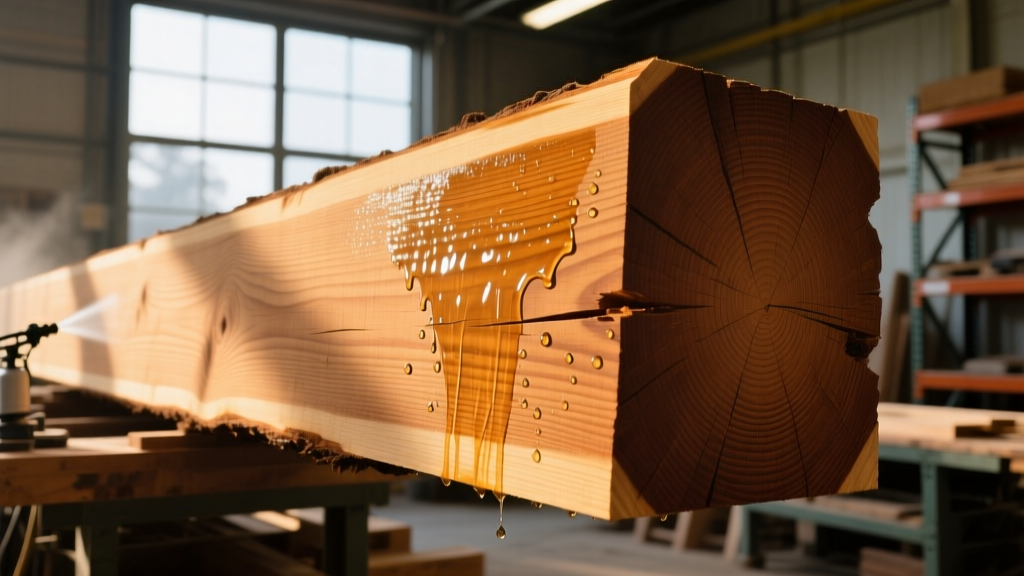
Chemical vs. Borate Treatments: A Comparative Matrix
Choosing the correct preservative requires balancing toxicity, penetration requirements, and environmental exposure. The EPA Wood Preservatives Guidelines outline the safety and efficacy profiles of these common agents.
| Preservative Type | Active Ingredient | Best Beam Application | AWPA Use Category | Leach Risk |
|---|---|---|---|---|
| Copper Azole (CA-C) | Copper + Tebuconazole | SYP Solid Sawn Beams | UC3B, UC4A | Low |
| Borates (DOT) | Disodium Octaborate Tetrahydrate | Glulam, CLT, Interior LVL | UC1, UC2 | High (Water Soluble) |
| Copper Naphthenate | Copper + Naphthenic Acid | Field Cuts on LVL/Glulam | UC3B, UC4A (Surface) | Moderate |
| Creosote | Coal Tar Distillate | Heavy Timber Bridge/Marine | UC4B, UC4C, UC5 | Very Low |
Step-by-Step Field Treatment Protocol for Beam Modifications
When structural engineers require HVAC chases or plumbing penetrations through treated LVL or solid sawn beams, the exposed end-grain must be immediately remediated. Failure to do so voids manufacturer warranties and invites localized decay. Follow this protocol using a copper naphthenate solution (e.g., Copper-Green) or a water-soluble borate gel (e.g., Bora-Care) for interior applications.
- Preparation (0-5 Minutes): Clear all sawdust from the cut surface using a stiff bristle brush and compressed air. Sawdust blocks the chemical from entering the wood's vascular structure.
- Saturation Pass 1 (5-10 Minutes): Apply the preservative heavily using a brush or low-pressure pump sprayer. The goal is to apply approximately 1 gallon per 50 square feet of exposed end-grain. You should see the liquid physically wicking into the wood fibers.
- Absorption Wait (20-30 Minutes): Allow the wood to absorb the initial dose. In dry conditions (below 15% MC), the end-grain will drink the solution rapidly.
- Saturation Pass 2 (30-40 Minutes): Apply a second heavy coat. This ensures the chemical penetrates past the first layer of cells, which often swell and close off after the first application.
- Sealing (24 Hours Later): Once the preservative carrier (water or mineral spirits) has flashed off, cap the end-grain with a moisture-blocking polyurethane sealant or butyl flashing tape to prevent future moisture ingress.
Galvanic Corrosion and Hardware Compatibility
A frequently overlooked consequence of treating types of wood beams is the corrosive effect the preservatives have on metal connectors. Modern copper-based preservatives like CA-C and MCQ are highly corrosive to standard electrogalvanized steel. The American Wood Protection Association (AWPA) strictly mandates upgraded hardware for treated timber.
- Hot-Dipped Galvanized (HDG): Connectors and fasteners must meet ASTM A153 Class D (minimum 1.0 oz/ft² of zinc coating, often referred to as G185). Standard G90 zinc coatings will corrode within 3 to 5 years when embedded in CA-C treated SYP beams.
- Stainless Steel: For highly corrosive environments (coastal areas, high humidity, or UC4A ground contact beams), Type 304 or Type 316 stainless steel joist hangers, through-bolts, and anchor rods are mandatory.
- Isolation Membranes: If upgrading hardware is structurally or financially unfeasible, heavy-duty elastomeric isolation membranes (e.g., Vycor or Grace Ice & Water Shield) must be installed between the treated beam and the standard steel connector to prevent the electrochemical reaction that causes galvanic corrosion.
Inspection Framework and Maintenance Intervals
Preservation is not a one-time event; it requires an ongoing inspection framework, particularly for exterior exposed beams like glulam overhangs or solid timber porch structures.
3-Year Moisture Meter Audit: Use a pin-type resistance moisture meter on the underside of exterior beams. Probe at the bearing points where the beam meets masonry or steel columns. If MC consistently reads above 18%, the beam requires localized borate rod insertion (e.g., Impel rods) to establish a chemical diffusion zone against fungal hyphae.
By aligning the specific biological vulnerabilities of your chosen beam type with the correct AWPA-specified chemical treatment and hardware compatibility standards, you ensure the structural framing will outlast the architectural finishes it supports.
Written by
Priya KapoorPriya Kapoor is a real estate market analyst and construction economics researcher with expertise in housing affordability, development feasibility, and infrastructure investment. She holds a Master of Regional Planning from Cornell University and previously worked as a senior analyst at CBRE's Investment Properties group, where she modeled returns for $4B in mixed-use development pipelines. Priya now runs an independent research practice advising developers, municipalities, and REITs on construction cost forecasting and market timing. She publishes the quarterly "BuildMat Market Pulse" report tracking material price indices across 12 commodity categories. Based in Austin, TX, Priya serves on the board of Habitat for Humanity Austin and is a marathon runner.
More from Priya Kapoor
View all
Construction Cost
Cost to Build a 1600 Sq Ft Home in 2026: Full Breakdown
Accurate 2026 cost to build a 1600 sq ft home—material, labor, and regional pricing breakdowns included. Plan your budget with real-time estimates.
Aug 11, 2026

Wood & Lumber
Name the Types of Wood for Pressure Treatment and Preservation
Learn how to name the types of wood best suited for pressure treatment. Compare species treatability, chemical retention levels, and 2026 preservation costs.
Aug 4, 2026

Stone & Masonry
Stone Veneer Suppliers Lindenhurst: 2026 Cost Analysis
Analyze 2026 stone veneer costs in Lindenhurst, NY. Compare local supplier pricing, delivery fees, and Suffolk County installation labor rates.
Aug 4, 2026