Best Types of Hard Wood for Flooring and Cabinets: A Comparison
Compare the top types of hard wood for flooring and cabinetry. Expert analysis of Janka hardness, dimensional stability, and board-foot pricing.

Understanding Hardwood: Angiosperms and the Janka Scale
In botanical terms, hardwood is derived from deciduous angiosperm trees that produce enclosed seeds, contrasting with the gymnosperm conifers that yield softwoods. However, when architects and contractors evaluate different types of hard wood for structural and aesthetic interior applications, botanical classifications take a backseat to mechanical performance. The industry standard for measuring the mechanical durability of wood species is the Janka hardness test, which calculates the force required to embed a 0.444-inch steel ball halfway into the wood grain. According to the Wood Database Janka scale, this metric directly correlates to a species' resistance to denting, wear, and fastener-holding capacity in high-traffic flooring and heavy-use cabinetry.
Selecting the correct species requires balancing three competing variables: surface hardness, dimensional stability (how much the wood expands and contracts with moisture fluctuations), and aesthetic workability. The 2026 North American lumber market has seen significant price stratification, with premium clear grades of White Oak commanding record premiums due to tight supply, while domestic Hard Maple remains a highly stable, cost-effective alternative for painted millwork.
2026 Market Pricing and Performance Matrix
| Species | Janka Hardness (lbf) | Tangential Shrinkage (%) | Avg Cost (USD/bf - FAS Grade) | Primary Application |
|---|---|---|---|---|
| White Oak | 1,360 | 10.5% | $7.50 - $11.00 | Wide-plank flooring, wet-area cabinets |
| Hard Maple | 1,450 | 9.9% | $5.50 - $8.00 | Painted cabinetry, high-traffic commercial floors |
| Hickory | 1,820 | 12.6% | $6.00 - $9.50 | Rustic flooring, heavy-duty workbench tops |
| Black Walnut | 1,010 | 10.0% | $12.00 - $18.00 | Luxury furniture, low-traffic aesthetic millwork |
Detailed Comparison: Top Domestic Types of Hard Wood
White Oak (Quercus alba): The Moisture-Resistant Standard
White Oak has dominated the premium flooring and cabinetry market for the last decade, and its structural anatomy explains why. Unlike Red Oak, which has open cellular pores, White Oak contains tyloses—membranous growths that plug the xylem vessels, rendering the wood nearly impermeable to water and rot. This closed-cell structure makes it the only domestic hardwood suitable for exterior applications, boatbuilding, and high-humidity interior zones like bathroom vanities and kitchen islands.
Workability & Finishing: White Oak's high tannin content requires careful chemical management. Using water-based polyurethanes or acidic cleaners can trigger a tannin reaction, turning the wood gray or black. Always apply a tannin-blocking sealer or use oil-based finishes. The prominent medullary rays in quarter-sawn boards provide a striking 'ray fleck' pattern highly prized in Arts and Crafts and modern transitional designs.
Hard Maple (Acer saccharum): The Durability and Paint-Grade King
Hard Maple, also known as Sugar Maple, offers a slightly higher Janka rating than White Oak (1,450 lbf) and possesses an exceptionally tight, uniform grain structure. This lack of prominent pore structure makes it the undisputed champion for painted cabinetry. When milled to a high grit (220+), Hard Maple provides a glass-smooth substrate that prevents grain telegraphing through painted finishes, a common failure mode when painting open-grained woods like Oak or Ash.
The Staining Challenge: Hard Maple's dense, closed grain makes it notoriously difficult to stain evenly. Traditional pigmented oil stains tend to pool in microscopic density variations, resulting in severe blotching. If a dark-stained Maple floor or cabinet is required, specify aniline dye stains or professional pre-conditioners rather than standard wiping stains. For flooring, Hard Maple's high shock resistance makes it the mandatory choice for bowling alleys, basketball courts, and heavy-traffic commercial corridors.
Hickory (Carya spp.): Maximum Impact Resistance
Boasting a Janka hardness of 1,820 lbf, Hickory is the hardest commercially available domestic hardwood. It is characterized by extreme density and high visual contrast between its pale, almost white sapwood and dark, reddish-brown heartwood. This dramatic color variation makes it a staple in rustic, cabin, and industrial design aesthetics.
Manufacturing and Installation Realities: Hickory's density comes with significant fabrication costs. It rapidly dulls standard high-speed steel (HSS) tooling; mills and site-installers must use carbide-tipped blades and router bits to prevent burning and tear-out. Furthermore, Hickory's high tangential shrinkage (12.6%) and high T/R (Tangential-to-Radial) ratio make it dimensionally volatile. It is generally not recommended for wide-plank solid flooring in environments with uncontrolled humidity, as the boards are highly prone to severe cupping and checking. Pre-drilling is absolutely mandatory for face-nailing or screwing, as the wood's density will easily shear standard fasteners or split the board ends.
Black Walnut (Juglans nigra): The Luxury Aesthetic
Black Walnut is prized for its rich, chocolate-brown heartwood and exceptional workability, despite its relatively low Janka rating (1,010 lbf). It machines beautifully, holds intricate routed profiles without tear-out, and finishes to a deep, natural luster without the need for heavy chemical stains. However, its low hardness makes it a poor candidate for high-traffic flooring; it will dent easily from dropped utensils, pet claws, and heavy foot traffic.
Steaming and Sapwood: Walnut logs naturally contain a wide band of pale sapwood, which is considered a defect in premium FAS (Firsts and Seconds) grading. To maximize yield, commercial mills frequently steam Walnut lumber. This process forces the dark pigments from the heartwood into the sapwood, homogenizing the color but often resulting in a slightly muted, grayish-brown tone compared to the vibrant, unstained heartwood. For high-end architectural millwork, specify 'unstained' or 'air-dried' Walnut and accept the higher waste factor associated with cutting around the pale sapwood.
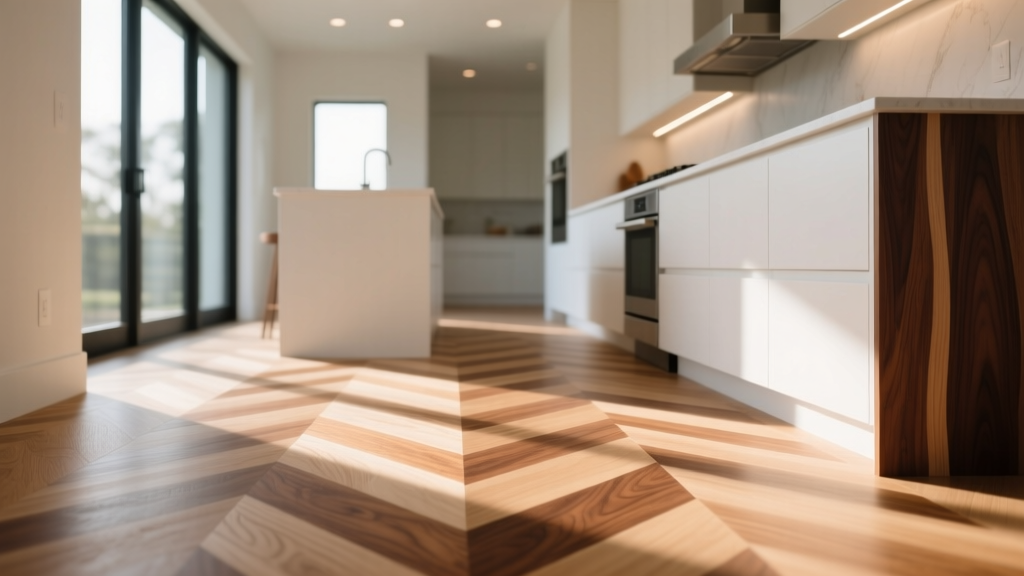
Dimensional Stability and Moisture Movement
According to research on the dimensional stability of wood, all hardwood is hygroscopic, meaning it continuously absorbs and releases moisture to reach equilibrium with the surrounding environment (Equilibrium Moisture Content, or EMC). The critical metric for builders is the Tangential Shrinkage percentage, which measures how much a board shrinks parallel to the growth rings when drying from a green state to oven-dry.
'A wood species with a lower tangential shrinkage percentage and a T/R ratio closer to 1.0 will exhibit superior dimensional stability, moving less across its width and resisting the tendency to warp or cup as indoor humidity fluctuates between winter and summer months.'
For projects utilizing engineered wood flooring or large-scale architectural paneling, Hard Maple and White Oak offer the most predictable movement characteristics. Hickory's high shrinkage rate requires strict acclimation protocols—the lumber must be stored in the installation environment for a minimum of 14 days with the HVAC system running at normal occupancy levels before fabrication or installation begins.
Application-Specific Selection Framework
- Kitchen & Bathroom Cabinetry: Specify White Oak for natural, moisture-prone environments due to its tyloses-plugged pores. Specify Hard Maple if the cabinets will receive an opaque painted finish.
- High-Traffic Commercial Flooring: Hard Maple is mandatory for its shock resistance and tight grain, which prevents dirt accumulation in the wood pores.
- Radiant Heat Subfloors: Quarter-sawn White Oak or engineered Walnut. Avoid solid Hickory entirely due to its aggressive dimensional movement when subjected to localized heat sources.
- Intricate Millwork & Moulding: Black Walnut. Its low density and uniform texture allow router bits to carve complex profiles cleanly without splintering.
Sourcing, Grading, and Sustainability
When procuring these types of hard wood, understanding the National Hardwood Lumber Association (NHLA) grading rules is essential for budget control. FAS (Firsts and Seconds) grade provides long, wide, clear cuttings ideal for continuous runs of cabinetry and wide-plank flooring, but carries a 30-50% price premium over #1 Common grade. #1 Common contains more knots and color variations but yields excellent short cuttings perfect for stair treads, furniture parts, and herringbone flooring patterns.
For commercial and institutional projects, specifying lumber certified by the Forest Stewardship Council (FSC) ensures the timber was harvested from responsibly managed forests that provide environmental, social, and economic benefits. While FSC-certified domestic hardwoods often carry a 10-15% premium and require longer lead times, they are increasingly mandated for LEED v4.1 certification and compliance with strict corporate ESG (Environmental, Social, and Governance) procurement policies. Always verify the chain-of-custody documentation upon delivery to ensure the material matches the architectural specifications.
Written by
Elena RodriguezElena Rodriguez is a civil engineer and technical writer specializing in concrete technology, masonry systems, and ASTM/ACI compliance. She earned her B.S. in Civil Engineering from Texas A&M University and spent a decade at a materials testing laboratory, performing over 2,000 concrete compressive strength tests and masonry prism evaluations. Elena is an ACI-certified Field Testing Technician (Grade I) and a member of ASTM Committee C12 on Natural Building Stone. She currently consults on forensic engineering cases involving concrete failures and moisture intrusion. Based in San Antonio, TX, Elena is a proud member of the Society of Women Engineers (SWE) and coaches her daughter's FIRST Robotics team.
More from Elena Rodriguez
View all
Walls & Panels
Cost Analysis: Light Gauge Steel Framing Advantages and Disadvantages
Evaluate light gauge steel framing advantages and disadvantages through a strict cost analysis lens, comparing material, labor, and lifecycle expenses.
Aug 4, 2026

Walls & Panels
Gypsum Board Types: Exact Specifications, Thickness & Dimensions
Compare standard, Type X, and moisture-resistant gypsum board types. Get exact specifications, thicknesses, dimensions, and ASTM standards for your project.
Aug 4, 2026

Fire Resistance
Best Fire-Resistant Outdoor Decking Materials: 2026 Buyer Guide
Discover the best fire-resistant outdoor decking materials for 2026. Compare Class A PVC, aluminum, and hardwood options for WUI compliance and safety.
Aug 4, 2026