Deck Materials Other Than Wood vs Wood Species (2026)
Compare top deck materials other than wood against traditional lumber. 2026 pricing, durability, and maintenance data for composite, PVC, and aluminum.

The Shift Away from Traditional Decking Species
For decades, the decking industry was dominated by a narrow selection of lumber species. Pressure-treated southern yellow pine served as the budget baseline, while Western Red Cedar and tropical hardwoods like Ipe occupied the premium tiers. However, material science advancements and shifting maintenance preferences have radically altered the landscape. Homeowners and commercial builders are increasingly specifying deck materials other than wood to eliminate the annual cycle of sanding, staining, and board replacement.
This guide bridges the gap between traditional wood species data and modern synthetic alternatives. By comparing the structural properties, 2026 market pricing, and long-term failure modes of natural lumber against capped composites, cellular PVC, and architectural aluminum, you can make an evidence-based material selection for your next build.
Traditional Wood Species: The Baseline Metrics
To evaluate synthetic alternatives, we must first establish the performance baseline of natural wood species. The Forest Products Laboratory Wood Handbook outlines the mechanical properties that dictate decking longevity, primarily Janka hardness and natural decay resistance.
- Ipe (Handroanthus spp.): Janka hardness of 3,680 lbf. Exceptionally dense and naturally resistant to rot and insects. However, it requires pre-drilling and 304 or 316 stainless steel fasteners, as the high tannic acid content rapidly corrodes standard galvanized steel.
- Western Red Cedar (Thuja plicata): Janka hardness of 350 lbf. Contains natural extractives (thujaplicins) that deter fungal decay. It is dimensionally stable but soft, making it highly susceptible to surface denting and splintering under heavy foot traffic.
- Pressure-Treated Southern Yellow Pine: Janka hardness of 690 lbf. Infused with micronized copper azole (MCA) or alkaline copper quaternary (ACQ) preservatives. It is prone to severe checking, warping, and twisting as the high moisture content from the treatment process equalizes with ambient humidity.
Top Deck Materials Other Than Wood
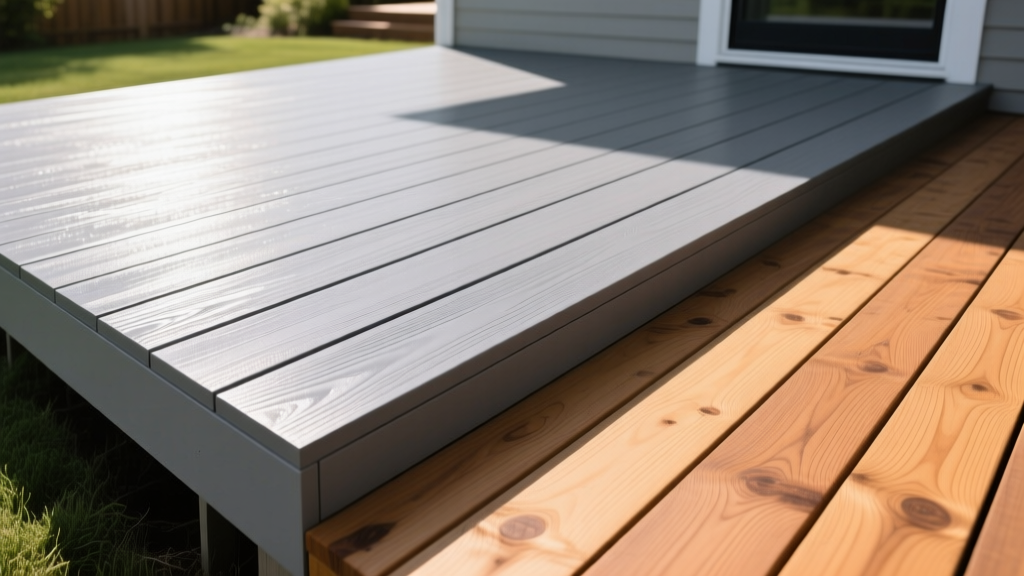
When architects and builders look beyond natural timber, three primary categories dominate the 2026 market: capped wood-plastic composites (WPC), cellular polyvinyl chloride (PVC), and powder-coated aluminum extrusions.
Capped Wood-Plastic Composite (WPC)
Modern composite decking consists of a core made from reclaimed wood fibers and high-density polyethylene (HDPE), fully encapsulated by a protective polymer cap. Early generation composites failed due to moisture intrusion and mold growth within the wood fiber matrix. Current premium lines, such as Trex Transcend Lineage and TimberTech Advanced PVC, utilize an Acrylonitrile Styrene Acrylate (ASA) cap that is completely impervious to water absorption.
According to the Trex Installation Guidelines, WPC boards are heavier and more flexible than natural wood. This necessitates stricter joist spacing. While standard wood decking can span 16 inches on-center (OC), composite boards typically require 12-inch OC spacing for diagonal installations to prevent sagging under load.
Cellular PVC (Polyvinyl Chloride)
Cellular PVC contains zero wood fibers. The manufacturing process creates a closed-cell foam core that is then co-extruded with a hard, UV-resistant outer shell. Products like AZEK Vintage offer superior stain resistance and do not harbor mold spores, making them the definitive choice for high-moisture environments, dock systems, and heavily shaded areas where composites might develop surface mildew.
Powder-Coated Aluminum
For non-combustible requirements and extreme longevity, architectural aluminum decking (such as Wahoo Decks or Craft-Bilt) is the premier alternative. Extruded aluminum planks feature integrated hidden fastener channels and interlocking water-shedding lips. Aluminum is impervious to rot, insects, and fire (achieving a Class A flame spread rating), and it dissipates heat significantly faster than dark-colored composites.
Head-to-Head Matrix: Wood Species vs. Synthetic Alternatives
The following matrix compares material-only costs and structural requirements for 2026. Labor, substructure, and fastener costs are excluded.
| Material Type | Avg Cost / Sq Ft (Material) | Max Joist Span (Straight) | Maintenance Cycle | Expected Lifespan |
|---|---|---|---|---|
| Pressure-Treated Pine | $3.50 - $5.50 | 16 in. OC | Annual Sealing | 10 - 15 Years |
| Western Red Cedar | $7.00 - $10.00 | 16 in. OC | Biennial Staining | 15 - 20 Years |
| Tropical Hardwood (Ipe) | $14.00 - $19.00 | 24 in. OC | Optional UV Oil | 40+ Years |
| Capped Composite (WPC) | $9.50 - $13.50 | 16 in. OC | Soap & Water Wash | 25 - 30 Years |
| Cellular PVC | $11.50 - $15.00 | 16 in. OC | Soap & Water Wash | 30 - 50 Years |
| Architectural Aluminum | $16.00 - $22.00 | 24 in. OC | None | 50+ Years |
Hidden Costs and Structural Failure Modes
When evaluating deck materials other than wood, builders must account for secondary costs and specific failure modes that do not appear on the initial material invoice.
Thermal Expansion and Fastener Shear
Wood expands and contracts primarily across its width (tangentially and radially) due to moisture content changes. Synthetics, particularly PVC and WPC, expand longitudinally (along the length of the board) due to temperature fluctuations. If a builder uses standard face-screws designed for wood on a PVC deck, the longitudinal movement will cause the screws to shear or the board to tear around the fastener head. Hidden clip systems engineered for synthetic movement are mandatory, adding $1.50 to $2.50 per square foot to the fastener budget.
Substructure Upgrades
Because composite and PVC boards lack the tensile strength of natural timber, they cannot span the same distances as 5/4x6 cedar or 2x6 Ipe. Upgrading the substructure from 16-inch OC to 12-inch OC joist spacing increases the framing lumber and joist hanger costs by approximately 25%. Furthermore, the North American Decking and Railing Association (NADRA) recommends using butyl flashing tape over all wooden joists when installing synthetic decking to prevent moisture trapping and premature joist rot, adding another $0.75 per linear foot of framing.
Heat Retention in Synthetics
A common failure in early composite adoption was severe heat retention. Dark brown and gray capped composites can reach surface temperatures of 140°F to 155°F in direct, 90°F ambient sunlight. Modern 2026 product lines incorporate infrared-reflective pigments in the polymer cap to mitigate this, but builders in southern climates should still specify lighter colorways (like coastal gray or sand) for barefoot-friendly surfaces.
Decision Framework: Which Material Fits Your Build?
Selecting between wood species and synthetic alternatives requires aligning the material properties with the specific environmental and usage parameters of the project.
- Choose Pressure-Treated Pine if: The project is strictly budget-constrained, the deck is elevated with excellent airflow, and the homeowner is committed to an annual maintenance regimen of cleaning and sealing.
- Choose Tropical Hardwood (Ipe) if: The design requires complex curves (which are difficult to achieve with rigid synthetics without specialized kerfing), the budget allows for premium material and high labor costs, and a natural, weathering silver patina is acceptable.
- Choose Capped Composite if: The client desires the visual texture of wood grain with zero staining requirements, and the deck is located in a temperate climate where extreme thermal expansion is manageable.
- Choose Cellular PVC if: The deck is built at grade, over water (docks/marinas), or in a heavily shaded, damp environment where organic wood fibers would be prone to mold and moisture degradation.
- Choose Aluminum if: The project is in a Wildland-Urban Interface (WUI) zone requiring non-combustible Class A materials, or if the deck serves as a roof for a lower-level patio (utilizing integrated water-shedding channels).
By moving beyond the default assumption that natural lumber is the only viable option, builders can leverage advanced deck materials other than wood to deliver structures that are structurally superior, code-compliant, and virtually maintenance-free over their multi-decade lifespans.
Written by
Sarah WhitfieldSarah Whitfield is a chartered quantity surveyor (MRICS) and construction cost analyst with 15 years of experience in material pricing, procurement strategy, and project budgeting. She earned her degree in Construction Management from the University of Reading (UK) and has worked on projects ranging from $2M custom homes to $180M mixed-use developments across North America and Europe. Sarah currently leads cost estimating for BuildMat Insight, maintaining a proprietary database of 4,000+ material price points updated quarterly. She is a frequent contributor to RSMeans cost data panels and has presented at the International Cost Engineering Council (ICEC) congress. Based in Denver, CO, Sarah is an avid trail runner and volunteer mentor for Women in Construction.
More from Sarah Whitfield
View all
Wood & Lumber
What Are the Different Types of Wood? A Builder's Guide
Compare structural softwoods, finish hardwoods, and engineered lumber. Analyze Janka ratings, MOE values, and 2026 pricing for construction.
Aug 4, 2026

Walls & Panels
Steel Framing vs Wood Framing: Corrosion and Moisture Defense
Compare steel framing vs wood framing for moisture resistance. Learn about galvanized coatings, condensation risks, and corrosion protection strategies.
Jul 21, 2026

Stone & Masonry
How to Cut Stone Veneer: Wet Saw vs Grinder Comparison
Compare the best tools for cutting stone veneer. We review wet saws, angle grinders, and chop saws to help you achieve clean, chip-free cuts.
Jul 21, 2026