Selection Framework: Navigating 53 Types of Wood for Builds
Master our 4-step selection framework to navigate 53 types of wood. Compare Janka hardness, structural grades, and 2026 pricing for your build.
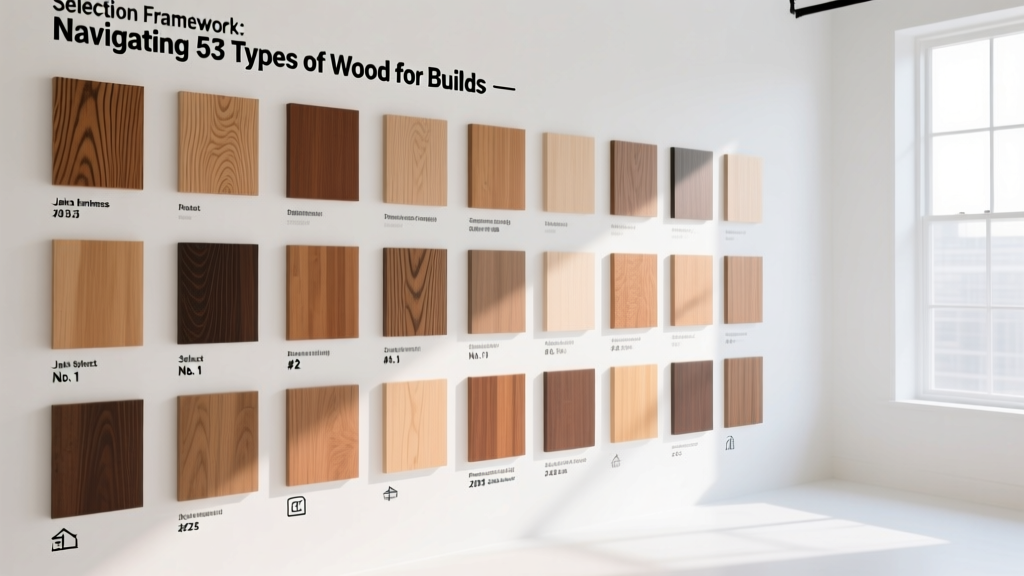
Architects, general contractors, and custom home builders face a paradox of choice when specifying natural timber. While local lumberyards may only stock a handful of staples, the global and domestic commercial supply chain offers access to at least 53 types of wood suitable for structural, exterior, and interior applications. Selecting the wrong species leads to catastrophic failure modes: structural deflection, galvanic fastener corrosion, tannin bleed, and severe dimensional instability.
Rather than relying on generic recommendations, professionals must apply a rigorous selection framework. This guide provides a systematic matrix to filter the 53 types of wood down to the single optimal species for your specific load, moisture, and aesthetic requirements.
The 4-Step Wood Selection Matrix
Filtering through dozens of species requires eliminating options based on hard physical constraints before considering aesthetics. Apply these four sequential filters to your project specifications.
Step 1: Structural Load vs. Aesthetic Cladding
Determine the primary mechanical demand. If the wood will bear dead and live loads (joists, beams, rafters), you must prioritize the Modulus of Elasticity (MOE) and bending strength (Fb). Structural softwoods like Douglas Fir and Southern Yellow Pine (SYP) dominate here due to their high strength-to-weight ratios and predictable grading. If the application is non-load-bearing (siding, decking, interior millwork), you can pivot to denser, heavier hardwoods that offer superior impact resistance but lack standardized structural span tables.
Step 2: Janka Hardness & Moisture Exposure
For flooring and exterior applications, the Janka hardness test (measuring the force required to embed a 0.444-inch steel ball into the wood) dictates dent resistance. Simultaneously, evaluate the Equilibrium Moisture Content (EMC) of the installation environment. Interior climate-controlled spaces require wood acclimated to 6-8% Moisture Content (MC), while exterior applications must tolerate 12-15% MC without catastrophic cupping or checking.
Step 3: Natural Decay Resistance vs. Pressure Treatment
When evaluating the 53 types of wood commonly available, note that natural decay resistance is confined to the heartwood of specific species. Western Red Cedar contains thujaplicins, and White Oak contains tyloses that block water penetration. If your budget restricts you to sapwood-heavy species like Pine or Fir for exterior use, you must specify ground-contact rated pressure treatment (UC4A or UC4B categories per AWPA standards).
Step 4: Sustainability & Chain of Custody
For commercial builds targeting LEED certification or strict municipal green codes, verify the chain of custody. Sourcing tropical hardwoods from the 53-species pool requires rigorous documentation to ensure compliance with the Lacey Act. Always specify Forest Stewardship Council (FSC) 100% or FSC Mix labels to guarantee legal, sustainable harvesting.
Categorizing the 53 Types of Wood
To streamline procurement, we categorize the 53 primary commercial species into three distinct performance tiers. Understanding these tiers prevents the common mistake of specifying an interior hardwood for an exterior application.
Tier 1: Heavy Structural Timbers (12 Species)
This tier consists primarily of gymnosperms (softwoods) engineered for framing, beams, and trusses. They are graded by the American Wood Council (AWC) and stamped for specific fiber stress values.
- Douglas Fir-Larch: The gold standard for structural beams. High stiffness (MOE of 1.95 x 10^6 psi) and excellent nail-holding capacity.
- Southern Yellow Pine (SYP): The densest structural softwood. Ideal for floor joists and pressure-treated decking substructures due to its high specific gravity (0.55).
- Hem-Fir & Spruce-Pine-Fir (SPF): Economical choices for standard wall framing (2x4, 2x6) where extreme load-bearing is not the primary constraint.
Tier 2: Exterior Cladding & Decking (18 Species)
Species in this tier are selected for dimensional stability, UV resistance, and natural extractives that repel insects and rot.
- Western Red Cedar: Low shrinkage factor (4.6% volumetric) makes it highly stable for siding and soffits. Requires stainless steel fasteners to prevent tannin streaking.
- Ipe (Handroanthus spp.): A tropical hardwood with a Class A fire rating (matching steel and concrete) and a Janka hardness of 3,510 lbf. Requires pre-drilling with carbide-tipped bits.
- Thermally Modified Ash: An increasingly popular 2026 alternative to tropical woods. Baked at 400°F+ in an oxygen-deprived kiln, the hemicellulose is altered, yielding exterior durability without chemical treatments.
Tier 3: Interior Millwork & Flooring (23 Species)
Selected for grain figure, machining properties, and finishing characteristics. These species are generally unsuitable for high-moisture or structural applications.
- Hard Maple (Sugar Maple): Janka rating of 1,450 lbf. The industry standard for heavy-traffic commercial flooring and butcher block countertops due to its tight, closed grain.
- White Oak: Preferred for modern interior millwork and wet-area applications. Its cellular structure is plugged with tyloses, making it virtually impervious to liquid penetration.
- Black Walnut: Prized for high-end cabinetry and accent walls. Lower Janka (1,010 lbf) requires careful protection in flooring applications.
2026 Pricing & Performance Data Matrix
The following table isolates top performers from the broader 53-species list, providing critical benchmarking data for budgeting and engineering.
| Species | Category | Janka (lbf) | Specific Gravity | 2026 Avg Cost (per BF) |
|---|---|---|---|---|
| Southern Yellow Pine | Structural | 870 | 0.55 | $3.50 - $5.50 |
| Douglas Fir | Structural | 660 | 0.50 | $4.00 - $7.00 |
| Western Red Cedar | Exterior | 350 | 0.36 | $6.50 - $9.00 |
| White Oak | Interior/Ext | 1,360 | 0.68 | $9.00 - $13.00 |
| Hard Maple | Interior | 1,450 | 0.63 | $8.50 - $12.00 |
| Ipe | Exterior | 3,510 | 0.92 | $15.00 - $20.00 |
Edge Cases & Failure Modes in Wood Selection
Even when the correct species is selected from the 53 available types, improper detailing leads to systemic failures. Review these critical edge cases before finalizing your bill of materials.
Species like Western Red Cedar, Redwood, and White Oak contain high levels of tannic and acetic acids. When paired with standard galvanized or aluminum fasteners, a galvanic reaction occurs, leading to rapid fastener degradation and black tannin streaks down the facade. Fix: Mandate 316-grade stainless steel or specialized polymer-coated fasteners (e.g., Simpson Strong-Tie SDWS with double-barrier coating) for all acidic timber connections.
When installing interior hardwoods (Tier 3) wider than 5 inches, standard acclimation is insufficient. Wide planks experience exponential tangential shrinkage. Action: Require the GC to log daily moisture meter readings (using pinless meters to avoid surface damage) until the wood's MC is within 2% of the subfloor's MC. Do not proceed with installation until this delta is achieved for 3 consecutive days.
Sourcing & Grade Stamping Verification
Specifying the species is only half the battle; verifying the grade stamp ensures the lumber meets engineering requirements. For structural framing, look for the mill identification, species classification, and grade designation (e.g., 'Select Structural' or 'No. 2').
Anatomy of a Structural Stamp:
'DF-L No. 2 1950f-1.7E S-DRY HL 945'
- DF-L: Douglas Fir-Larch
- No. 2: Visual grading classification
- 1950f-1.7E: Fiber stress (1,950 psi) and Modulus of Elasticity (1.7 million psi)
- S-DRY: Surfaced Dry (MC < 19% at time of surfacing)
For comprehensive species data, including specific gravity and shrinkage values for all 53 types of wood, professionals frequently reference The Wood Database, which maintains the most exhaustive, peer-reviewed repository of timber mechanical properties available online.
Frequently Asked Questions
Can I mix structural softwoods and hardwoods in the same load-bearing assembly?
No. Softwoods and hardwoods have vastly different Modulus of Elasticity (MOE) values and shrinkage rates. Under load, they will deflect at different rates, causing uneven stress distribution and potential fastener shear. Always maintain species uniformity within a single structural assembly.
Which of the 53 types of wood is best for radiant floor heating?
Engineered hardwood is superior to solid wood for radiant systems due to its cross-ply dimensional stability. If solid wood must be used, specify quarter-sawn White Oak or American Cherry. Avoid high-shrinkage species like Hickory or solid Maple, as the thermal cycling will cause severe checking and joint separation.
How do I verify the legality of imported tropical decking?
Require the supplier to provide a valid FSC certificate code and verify it via the FSC public database. Additionally, ensure the importer complies with the USDA APHIS Lacey Act declaration requirements, which mandate the exact scientific genus and species name on all customs documentation.
Written by
Priya KapoorPriya Kapoor is a real estate market analyst and construction economics researcher with expertise in housing affordability, development feasibility, and infrastructure investment. She holds a Master of Regional Planning from Cornell University and previously worked as a senior analyst at CBRE's Investment Properties group, where she modeled returns for $4B in mixed-use development pipelines. Priya now runs an independent research practice advising developers, municipalities, and REITs on construction cost forecasting and market timing. She publishes the quarterly "BuildMat Market Pulse" report tracking material price indices across 12 commodity categories. Based in Austin, TX, Priya serves on the board of Habitat for Humanity Austin and is a marathon runner.
More from Priya Kapoor
View all
Construction Cost
Cost to Build a 1600 Sq Ft Home in 2026: Full Breakdown
Accurate 2026 cost to build a 1600 sq ft home—material, labor, and regional pricing breakdowns included. Plan your budget with real-time estimates.
Aug 11, 2026

Wood & Lumber
Name the Types of Wood for Pressure Treatment and Preservation
Learn how to name the types of wood best suited for pressure treatment. Compare species treatability, chemical retention levels, and 2026 preservation costs.
Aug 4, 2026

Stone & Masonry
Stone Veneer Suppliers Lindenhurst: 2026 Cost Analysis
Analyze 2026 stone veneer costs in Lindenhurst, NY. Compare local supplier pricing, delivery fees, and Suffolk County installation labor rates.
Aug 4, 2026