How to Tell What Type of Wood: A Grading & Quality Guide
Learn how to tell what type of wood you have using lumber stamps, end-grain analysis, and physical tests, plus a guide to structural grading standards.

The Anatomy of a Lumber Stamp: Decoding Grade and Species
The fastest and most reliable way to identify structural lumber on a job site is not by looking at the grain, but by reading the ink stamp applied at the mill. In North America, structural timber is governed by strict grading agencies, and the stamp provides a forensic record of the wood’s species, moisture content, and structural grade. Misidentifying wood often happens when builders rely solely on visual color, which can be altered by kiln-drying, UV exposure, or weathering.
A standard structural stamp contains four critical data blocks:
- Species Identification: Look for acronyms like
S-P-F(Spruce-Pine-Fir),D.FIR-L(Douglas Fir-Larch),HEM-FIR(Hemlock-Fir), orSOUTHERN PINE. This dictates the design values used by structural engineers. - Grade Designation: Terms like
SELECT STRUCTURAL,NO. 1,NO. 2, orSTUDindicate the allowable visual defects (knots, slope of grain, wane) based on agency rules. - Condition of Seasoning:
S-DRY(Surfaced Dry, maximum 19% moisture content at time of surfacing),MC15(Maximum 15% moisture content), orKD-HT(Kiln-Dried and Heat Treated, required for international phytosanitary standards). - Grading Agency & Mill ID: Logos from agencies like the SPIB (Southern Pine Inspection Bureau), WWPA (Western Wood Products Association), or NLGA (National Lumber Grades Authority), followed by a unique mill number.
Visual Identification: End-Grain and Pore Structure
When lumber is reclaimed, unstamped, or milled for custom architectural applications, you must rely on physical wood anatomy. According to the USDA Forest Products Laboratory Wood Handbook, the most definitive visual identification occurs on the transverse (end-grain) plane, not the face grain.
Softwood vs. Hardwood Cellular Structure
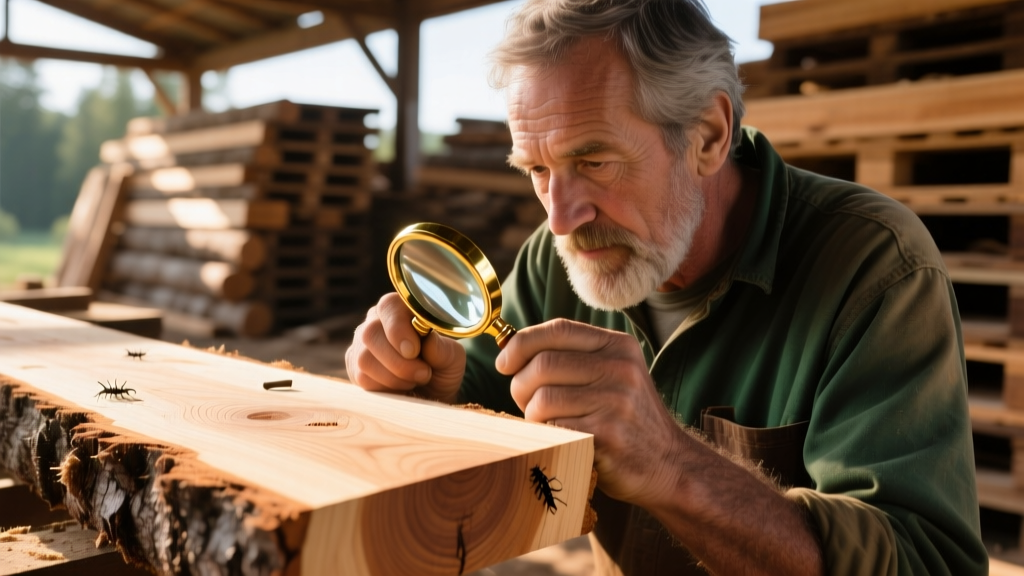
Softwoods (gymnosperms like pine, fir, and spruce) lack visible pores. Their end-grain appears as a uniform matrix of tracheids. Hardwoods (angiosperms like oak, maple, and ash) contain vessel elements (pores) that are visible under a 10x jeweler's loupe.
| Wood Category | End-Grain Pore Structure | Common Construction Species | Key Visual Identifier |
|---|---|---|---|
| Ring-Porous Hardwood | Large earlywood pores, small latewood pores | White Oak, Red Oak, Ash | Distinct concentric rings of large holes |
| Diffuse-Porous Hardwood | Uniform pore size throughout the growth ring | Maple, Birch, Poplar | Tight, even speckling on the end-grain |
| Softwood (Non-Porous) | No visible pores; solid cellular matrix | Douglas Fir, Southern Pine, Spruce | Resin canals visible as tiny white dots (in pine/fir) |
Distinguishing Lookalikes: Douglas Fir vs. Hemlock
Douglas Fir and Hemlock are frequently sold together as HEM-FIR, but when separated, Douglas Fir commands a premium for its superior bending strength (Fb). To tell them apart, examine the latewood transition. Douglas Fir has an abrupt, sharp transition from light earlywood to dark latewood, giving it a high-contrast striped appearance. Hemlock features a very gradual, blurred transition between earlywood and latewood, resulting in a more uniform, muted tan color with minimal contrast.
Physical and Chemical Testing for Ambiguous Species
When visual cues are obscured by finishes, stains, or weathering, physical and chemical tests provide definitive answers. The Wood Database outlines several non-destructive and micro-destructive tests used by lumber graders and restoration specialists.
The Janka Hardness Field Test
While you won't have a universal testing machine on site, you can use the "fingernail and awl" heuristic to separate species categories.
- Low Density (300-500 lbf Janka): Eastern White Pine, Spruce, Cedar. A firm thumbnail press leaves a deep, permanent crescent indentation.
- Medium Density (600-900 lbf Janka): Southern Yellow Pine (~870 lbf), Douglas Fir (~660 lbf). A thumbnail leaves a slight mark; a steel awl requires moderate pressure to penetrate 1/8 inch.
- High Density (1,200+ lbf Janka): Hard Maple (~1,450 lbf), Hickory (~1,820 lbf). A thumbnail leaves zero mark; an awl requires significant force and may skid off the surface.
The Water and Chemical Tests for Oak
White Oak and Red Oak look nearly identical when milled and finished, but White Oak is required for exterior or wet applications due to its rot resistance.
For a chemical confirmation, apply a 10% solution of sodium nitrite to the raw wood. Red Oak will turn a slight yellowish-brown, while White Oak will turn a deep, dark brown or black within minutes due to its high tannin content.
Structural Grading Standards: Allowable Defects
Identifying the species is only half the battle; assessing its structural grade dictates its load-bearing capacity. The Southern Pine Inspection Bureau (SPIB) and other agencies classify visual stress grades based on the size, location, and frequency of strength-reducing characteristics.
| Lumber Grade | Primary Use Case | Allowable Knot Size (Edge/Center) | Slope of Grain Limit |
|---|---|---|---|
| Select Structural | Maximum strength applications, long spans | Very small, tight knots only | 1 in 12 (Strict) |
| No. 1 | Heavy framing, rafters, joists | Small to medium tight knots | 1 in 10 |
| No. 2 | Standard residential framing (most common) | Medium knots, some edge knots allowed | 1 in 8 |
| No. 3 | Light framing, temporary bracing, blocking | Large knots, occasional loose knots | 1 in 4 |
| Stud | Vertical wall framing (studs) only | Similar to No. 3, but restricted to 2x4 and 2x6 | 1 in 4 |
Understanding Slope of Grain
Slope of grain is the most frequently misunderstood grading metric. It refers to the angle of the wood fibers relative to the longitudinal edge of the board. A slope of 1 in 8 means the grain lines deviate 1 inch from the straight edge over an 8-inch length. Boards with severe slope of grain are highly susceptible to warping, twisting, and catastrophic splitting under tension loads, which is why higher grades strictly limit this defect.
Common Job-Site Misidentifications and Corrections
Even experienced contractors fall victim to lumber misidentification. Here are three frequent errors and how to correct them:
- Mistaking Hemlock for Douglas Fir: Hemlock is lighter, lacks the distinct resin canals of Fir, and has a much lower withdrawal resistance for nails and screws. Always check the end-grain with a loupe for resin canals if the stamp is illegible.
- Confusing Southern Yellow Pine (SYP) with Ponderosa Pine: SYP is a dense, heavy structural timber. Ponderosa Pine is a lightweight, low-density wood used primarily for interior trim and millwork. SYP will feel noticeably heavier in the hand and will resist a fingernail dent, whereas Ponderosa Pine feels surprisingly light for its size and dents easily.
- Assuming "Cedar" means Western Red Cedar: In fencing and exterior siding, "cedar" is often used as a catch-all. True Western Red Cedar (Thuja plicata) has a distinct, sweet, aromatic scent and a straight, uniform grain. Eastern Red Cedar (Juniperus virginiana) is actually a juniper, features a mix of pale sapwood and dark reddish heartwood, and is highly knotty. They have vastly different dimensional stability and decay resistance profiles.
Accurate wood identification is not merely an academic exercise; it is a fundamental requirement for structural safety, moisture management, and finish longevity. By combining mill stamp literacy with end-grain analysis and physical testing, builders and inspectors can ensure the material on the truck matches the material specified in the engineering plans.
Written by
Sarah WhitfieldSarah Whitfield is a chartered quantity surveyor (MRICS) and construction cost analyst with 15 years of experience in material pricing, procurement strategy, and project budgeting. She earned her degree in Construction Management from the University of Reading (UK) and has worked on projects ranging from $2M custom homes to $180M mixed-use developments across North America and Europe. Sarah currently leads cost estimating for BuildMat Insight, maintaining a proprietary database of 4,000+ material price points updated quarterly. She is a frequent contributor to RSMeans cost data panels and has presented at the International Cost Engineering Council (ICEC) congress. Based in Denver, CO, Sarah is an avid trail runner and volunteer mentor for Women in Construction.
More from Sarah Whitfield
View all
Wood & Lumber
What Are the Different Types of Wood? A Builder's Guide
Compare structural softwoods, finish hardwoods, and engineered lumber. Analyze Janka ratings, MOE values, and 2026 pricing for construction.
Aug 4, 2026

Walls & Panels
Steel Framing vs Wood Framing: Corrosion and Moisture Defense
Compare steel framing vs wood framing for moisture resistance. Learn about galvanized coatings, condensation risks, and corrosion protection strategies.
Jul 21, 2026

Stone & Masonry
How to Cut Stone Veneer: Wet Saw vs Grinder Comparison
Compare the best tools for cutting stone veneer. We review wet saws, angle grinders, and chop saws to help you achieve clean, chip-free cuts.
Jul 21, 2026