Structural Types of Wood Fasteners for Load-Bearing Framing
Discover the best types of wood fasteners for structural framing. Compare lag screws, structural screws, and timber connectors for load-bearing builds.

The Mechanics of Load Transfer in Timber Connections
In structural timber framing, the fastener is the critical bottleneck where localized stresses concentrate. Selecting the correct types of wood fasteners for load-bearing applications requires understanding how forces transfer through the joint. Structural connections primarily resist two types of forces: shear (forces acting perpendicular to the fastener shaft, attempting to slice it) and withdrawal (forces acting parallel to the shaft, attempting to pull it from the wood). The American Wood Council’s National Design Specification (NDS) for Wood Construction provides the definitive engineering framework for calculating these capacities, applying specific adjustment factors based on moisture, temperature, and fastener geometry.
Primary Types of Wood Fasteners for Structural Applications
Modern structural engineering has largely moved away from traditional nails and basic lag bolts in favor of high-strength, precision-engineered fasteners. Below are the primary categories used in contemporary load-bearing wood construction.
1. Structural Wood Screws (STS)
Structural wood screws have revolutionized light-frame and timber construction. Unlike standard wood screws, STS feature hardened steel shafts, aggressive cutting threads, and specialized washer heads that eliminate the need for pre-drilling in most dimensional lumber.
- Simpson Strong-Drive SDWS: Features a double-barrel plating for high corrosion resistance and a 0.25-inch hex drive. Ideal for ledger boards, deck framing, and multi-ply lumber beams.
- GRK RSS (Rugged Structural Screws): Known for their W-Cut thread design and zip-tip, which reduces driving torque and prevents splitting in dense species like Douglas Fir and Southern Yellow Pine.
2. Through-Bolts and Heavy Hex Lag Screws
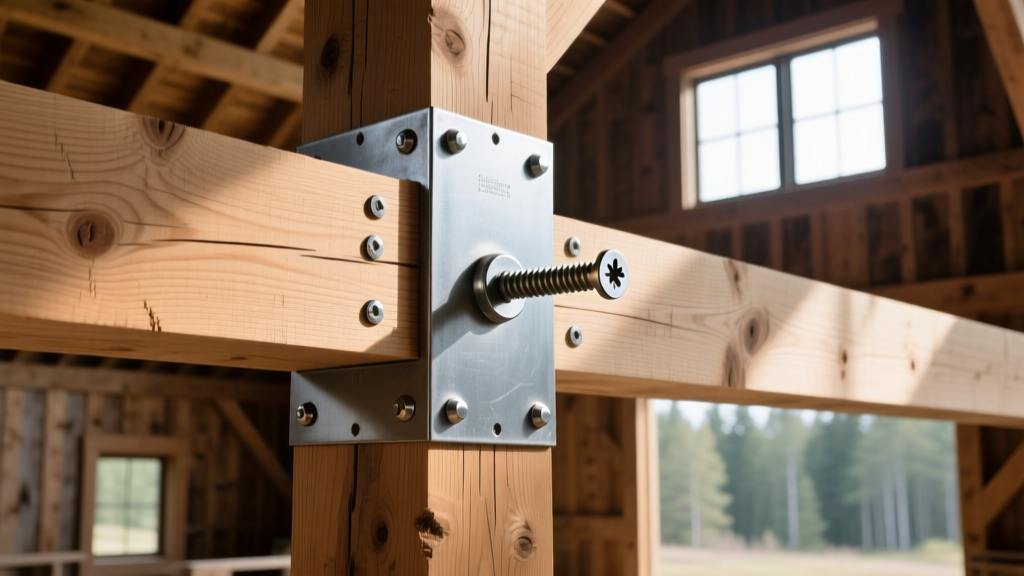
For heavy timber framing, post-and-beam construction, and steel-to-wood connections, through-bolts and heavy lag screws remain the standard.
- Through-Bolts: Provide the highest shear capacity because the steel shaft bears directly against the wood fibers across the entire joint. They require precise pre-drilling (typically 1/32-inch oversize to allow for wood shrinkage) and use steel washers under both the bolt head and the nut to prevent embedment into the timber.
- Heavy Hex Lag Screws: Used when access to the back of the joint is restricted. The withdrawal capacity of a lag screw is entirely dependent on the thread engagement length in the main member, not the side member.
3. Self-Tapping Screws (STS) for Mass Timber (CLT/Glulam)
The rise of Cross-Laminated Timber (CLT) and Glulam has introduced specialized fully-threaded self-tapping screws (such as the Rothoblaas VGZ or MyTiCon series). These fasteners are driven at 45-degree angles into the end-grain or edge of mass timber panels. They serve a dual purpose: acting as mechanical fasteners and providing shear reinforcement to prevent the timber from splitting along the glue lines under heavy vertical loads.
Structural Fastener Comparison Matrix
| Fastener Type | Approx. Shear Capacity (DF-L) | Withdrawal Strength | Primary Application | Avg. Cost (per unit) |
|---|---|---|---|---|
| 3" Structural Wood Screw (SDWS) | ~420 lbs | High (Thread dependent) | Ledger boards, light framing | $0.65 - $0.85 |
| 1/2" x 6" Hot-Dip Galv. Lag Screw | ~650 lbs | Moderate | Beam-to-post, deck framing | $1.20 - $1.80 |
| 5/8" Through-Bolt w/ Washers | ~1,400 lbs | N/A (Mechanical lock) | Heavy timber, structural steel ties | $2.50 - $3.50 |
| Fully Threaded STS (Mass Timber) | ~900 lbs (per screw) | Exceptional (Full shaft) | CLT panel splicing, Glulam reinforcement | $3.00 - $6.00 |
Note: Capacities listed are baseline allowable design values for single-shear connections in Douglas Fir-Larch. Actual design values must be adjusted using NDS factors for load duration, moisture, and group action.
Calculating Capacity: The NDS Adjustment Factors
Engineers do not use raw fastener strength; they use adjusted design values. The USDA Forest Products Laboratory and the NDS mandate several reduction factors that drastically alter the real-world performance of wood fasteners:
Critical NDS Adjustment Factors for Fasteners
- Group Action Factor (Cg): When multiple fasteners are used in a row (like a bolted truss chord), they do not share loads perfectly. The outer fasteners take more stress than the inner ones. The Cg factor reduces the total capacity of the group to account for this sequential yielding.
- Geometry Factor (C_delta): If the fastener is placed too close to the edge of the timber or too close to the end-grain, the wood will split before the steel yields. C_delta penalizes the capacity if minimum edge and end distances are not met.
- Wet Service Factor (Cm): Fasteners installed in wood with a moisture content above 19% (common in exterior framing or green timber) suffer reduced withdrawal and shear capacities due to the lubrication effect of moisture and subsequent wood shrinkage.
Corrosion, Coatings, and Treated Lumber Compatibility
Structural fasteners must survive the chemical environment of the wood. Modern pressure-treated lumber uses copper-based preservatives like Alkaline Copper Quaternary (ACQ) or Micronized Copper Quaternary (MCQ). These chemicals are highly corrosive to standard zinc electroplated fasteners.
For structural framing with treated lumber, you must specify:
- Hot-Dip Galvanized (HDG): Must meet ASTM A153 standards, providing a minimum 1.0 oz/ft² zinc coating. This is the minimum requirement for ACQ/MCQ treated lumber.
- Type 304 Stainless Steel: Required for high-moisture environments, coastal zones (salt spray), or when using highly corrosive fire-retardant-treated (FRT) wood.
- Type 316 Stainless Steel: Mandatory for direct saltwater exposure or permanent wood foundations in highly acidic soils.
Never mix dissimilar metals in a structural joint. Using a stainless steel bolt with a hot-dip galvanized nut and washer will cause rapid galvanic corrosion of the zinc coating, leading to catastrophic joint failure. Always match the metallurgy of the fastener, nut, and washer.
Real-World Failure Modes and Edge Cases
Even when the correct types of wood fasteners are selected, improper installation leads to structural failures. Avoid these common field mistakes:
- End-Grain Withdrawal Illusion: The NDS explicitly states that the withdrawal capacity of any fastener driven into the end-grain of wood is zero. Fasteners must always be driven into the side-grain (radial or tangential planes) to achieve withdrawal resistance.
- Over-Torquing Washer Heads: Structural wood screws feature integrated washer heads designed to sit flush with the wood surface. Over-driving them with high-torque impact drivers crushes the wood fibers beneath the head, creating a void that compromises the joint's slip modulus and allows for excessive deflection under load.
- Ignoring the Lead Hole: While many modern structural screws are "self-drilling," hardwoods (like Oak or Ipe) and dense engineered lumbers (like LVL) still require pre-drilled pilot holes. Forcing a screw into dense material without a pilot hole will snap the hardened steel shaft, leaving a broken bolt embedded in the structural member.
FAQ: Structural Fastener Selection
Can I use standard deck screws for structural framing?
No. Standard deck screws (even those labeled "premium") are brittle and lack the shear ductility required for structural framing. Under sudden lateral loads (like wind or seismic events), standard deck screws will snap cleanly, whereas structural wood screws and bolts are designed to yield and bend, providing warning before failure. Always look for an ICC-ES ESR (Evaluation Service Report) number on the fastener packaging.
What is the minimum edge distance for structural bolts in timber?
According to the NDS, for bolts loaded parallel to the grain, the minimum edge distance is 1.5 times the bolt diameter (1.5D). For bolts loaded perpendicular to the grain, the minimum edge distance on the loaded edge is 4D, and on the unloaded edge, it is 1.5D. Failing to maintain these distances requires applying a severe C_delta reduction factor to the joint's engineering capacity.
Written by
David NakamuraDavid Nakamura is a licensed architect (AIA) and construction technology writer focused on sustainable building methods, mass timber engineering, and high-performance building envelopes. He holds a Master of Architecture from the University of Washington and is a certified Passive House Consultant (CPHC). David spent eight years at the Seattle firm Mithun, where he led the design of three LEED Platinum projects, before founding his own practice specializing in net-zero residential design. He serves on the editorial advisory board of GreenBuilder Magazine and has authored peer-reviewed papers on cross-laminated timber (CLT) connections for the Journal of Structural Engineering. In his spare time, David teaches woodworking at Pratt Fine Arts Center and kayaks the Puget Sound.
More from David Nakamura
View all
Construction Cost
Labor Cost to Build a Deck Per Sq Ft: 2026 Installation Guide
Discover the exact labor cost to build a deck per sq ft in 2026. This installation guide breaks down contractor rates, complexity factors, and hidden fees.
Aug 4, 2026

Construction Cost
How Much Does It Cost to Build a 3 Bedroom House? Financing Guide
Learn exactly how much it costs to build a 3 bedroom house and explore 2026 financing options, construction loan types, and budget frameworks for your build.
Aug 4, 2026

Construction Cost
Cost to Build a Tennis Court: 2026 Guide
How much does it cost to build a tennis court in 2026? Breakdowns for asphalt, concrete, and synthetic surfaces plus fencing and lighting.
Jul 30, 2026