Types of Mahogany Wood: Lumber Grades and Quality Guide
Compare types of mahogany wood, from genuine Honduran to African substitutes. Includes NHLA grading rules, moisture specs, and 2026 pricing.

The True Mahogany vs. Commercial Substitutes
Specifying mahogany for architectural millwork, marine applications, or high-end cabinetry requires navigating a complex market of genuine species, commercial substitutes, and strict grading tolerances. The term 'mahogany' is frequently applied to dozens of unrelated species, but only a few meet the structural and aesthetic benchmarks required for premium construction.
Botanical and Physical Breakdown
- Genuine Mahogany (Swietenia macrophylla): Also known as Honduran or Big-leaf mahogany. It features a Janka hardness of 900 lbf, specific gravity of 0.53, and exceptional dimensional stability. It is the benchmark for marine and high-end interior millwork.
- African Mahogany (Khaya ivorensis / Khaya anthotheca): Slightly harder (1,070 lbf) with a higher specific gravity (0.58). It exhibits a more pronounced interlocked grain, which can cause tearout during planing but yields a striking ribbon-stripe figure when quartersawn.
- Sapele (Entandrophragma cylindricum): Often sold as a mahogany substitute, Sapele is significantly harder (1,410 lbf) and denser. It is highly valued for flooring and exterior doors due to its natural rot resistance, though its interlocked grain requires specialized helical cutterheads for clean machining.
- Philippine Mahogany (Lauan / Shorea spp.): A commercial misnomer. This is a lightweight dipterocarp (Janka 800-1,000 lbf depending on species) primarily used for plywood cores and interior framing, lacking the rot resistance and finish quality of true mahoganies.
For a comprehensive botanical and physical profile of the benchmark species, refer to the Wood Database entry on Honduran Mahogany.
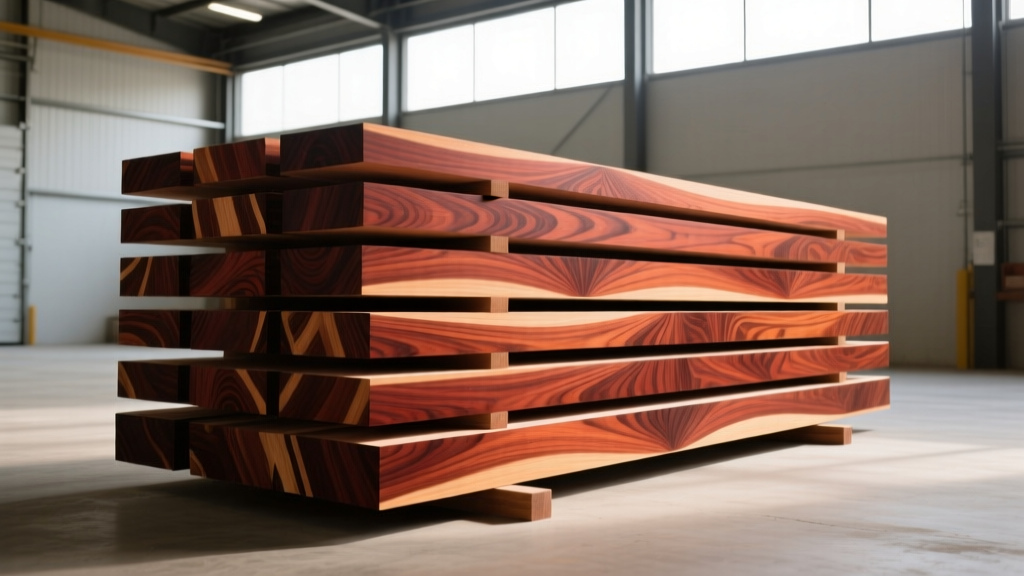
NHLA Grading Standards Applied to Genuine Mahogany
Genuine and African mahoganies are graded using the National Hardwood Lumber Association (NHLA) rules, which evaluate boards based on the size and number of clear-face cuttings that can be extracted. Because mahogany is primarily used for long, continuous runs of trim, stair treads, and wide paneling, the yield of long, defect-free cuttings is more critical than in species used for short cabinet parts.
| NHLA Grade | Minimum Board Size | Clear-Face Yield | Primary Construction Application |
|---|---|---|---|
| FAS (Firsts and Seconds) | 6" x 8' | 83.3% to 100% | Wide architectural paneling, solid core doors, marine brightwork. |
| FAS One Face (F1F) | 6" x 8' | 83.3% (on best face) | Interior trim, baseboards, and casings where one face is concealed. |
| Selects | 4" x 6' | 83.3% to 100% | Shorter millwork runs, window stools, and furniture components. |
| #1 Common | 3" x 4' | 66.6% to 83.3% | Cabinet face frames, stile-and-rail doors, and structural blocking. |
Evaluating Moisture Content and Kiln-Drying Schedules
Improperly dried mahogany will fail in the field through joint separation, panel cupping, or fastener pop-out. The target Equilibrium Moisture Content (EMC) must match the installation environment. Interior climate-controlled environments (HVAC maintained at 35-55% RH) require lumber dried to 6-8% MC. Exterior applications or unconditioned spaces require 9-12% MC.
Genuine mahogany is highly susceptible to case-hardening if subjected to aggressive kiln schedules. If the surface dries and sets before the core, internal tensile stresses develop. This results in 'honeycomb checking' (internal splits invisible on the surface) that will only reveal themselves when the board is ripped on a table saw. Ensure your supplier utilizes a mild kiln schedule (e.g., starting at 120°F dry bulb with high humidity) and verify that the mill has relieved case-hardening stresses via a final equalization and conditioning phase.
Fastener Compatibility and Corrosion Risks
While genuine mahogany is largely non-corrosive to metals, African mahogany (Khaya) contains higher levels of silica and tannins that can react with iron and standard zinc-galvanized fasteners, resulting in severe black staining and localized wood degradation. Always specify Type 304 or Type 316 stainless steel fasteners for any mahogany species in exterior or high-humidity applications.
Visual Quality Markers: Color, Grain, and Figure
NHLA grading evaluates clear-face yield, but it does not account for aesthetic figure, which heavily influences market pricing in the mahogany trade. Graders must balance structural yield against visual character.
- Ribbon Stripe: Found primarily in quartersawn Sapele and African mahogany. The interlocked grain reflects light in alternating dark and light bands. Highly prized for veneers and premium paneling.
- Block Mottle and Fiddleback: Rare genetic anomalies in the wood fibers that create a 3D, undulating visual effect. Boards exhibiting these figures are often pulled from standard FAS bundles and sold at a 50-100% premium to specialty luthiers and custom yacht builders.
- Sapwood Inclusion: Genuine mahogany sapwood is pale yellowish-white and does not darken to the rich reddish-brown of the heartwood. Under strict NHLA rules, sapwood is considered a defect on the graded face unless specifically allowed. For high-end architectural work, specify 'heartwood-only' to avoid the cost of bleaching or custom staining to match sapwood edges.
Pricing Tiers by Grade and Origin (2026 Market Estimates)
Mahogany pricing is highly volatile, driven by CITES export quotas, freight costs, and currency fluctuations. The table below reflects Q1 2026 wholesale estimates for 4/4 (1-inch) rough-sawn lumber in standard bundles.
| Species / Origin | FAS Grade (per BDFT) | #1 Common (per BDFT) | CITES Status |
|---|---|---|---|
| Honduran (Genuine) | $13.50 - $18.00 | $8.00 - $11.00 | Appendix II (Strict Quotas) |
| African (Khaya) | $7.50 - $9.50 | $4.50 - $6.00 | Unlisted / Regional Bans |
| Sapele | $6.50 - $8.50 | $4.00 - $5.50 | Unlisted |
| Utility / Plantation | $5.00 - $7.00 | $3.00 - $4.50 | Varies by Region |
Sourcing and Certification: CITES and FSC Compliance
Genuine mahogany (Swietenia macrophylla) is listed on CITES Appendix II, meaning international trade is strictly regulated to prevent over-exploitation. Procurement officers must ensure that every shipment of genuine mahogany is accompanied by a valid CITES export permit from the country of origin and a corresponding import permit.
For projects targeting LEED certification or requiring strict environmental stewardship, specify FSC (Forest Stewardship Council) 100% certified mahogany. FSC-certified lumber ensures chain-of-custody tracking from sustainably managed concessions, particularly those in Central and South America. Verify the supplier's FSC certificate number directly on the FSC global database before issuing a purchase order, as fraudulent chain-of-custody documentation remains a risk in the tropical hardwood market.
Verification Checklist for Procurement Officers
- Confirm the botanical name on the commercial invoice matches the specified species (e.g., Swietenia macrophylla, not just 'Mahogany').
- Request a pre-shipment moisture content report verifying 6-8% MC for interior grades.
- Verify CITES permits for genuine mahogany prior to customs clearance to avoid port seizures.
- Specify 'steamed' or 'kiln-dried' explicitly, as air-dried mahogany will not meet interior EMC requirements and will harbor latent fungal spores.
Written by
Sarah WhitfieldSarah Whitfield is a chartered quantity surveyor (MRICS) and construction cost analyst with 15 years of experience in material pricing, procurement strategy, and project budgeting. She earned her degree in Construction Management from the University of Reading (UK) and has worked on projects ranging from $2M custom homes to $180M mixed-use developments across North America and Europe. Sarah currently leads cost estimating for BuildMat Insight, maintaining a proprietary database of 4,000+ material price points updated quarterly. She is a frequent contributor to RSMeans cost data panels and has presented at the International Cost Engineering Council (ICEC) congress. Based in Denver, CO, Sarah is an avid trail runner and volunteer mentor for Women in Construction.
More from Sarah Whitfield
View all
Wood & Lumber
What Are the Different Types of Wood? A Builder's Guide
Compare structural softwoods, finish hardwoods, and engineered lumber. Analyze Janka ratings, MOE values, and 2026 pricing for construction.
Aug 4, 2026

Walls & Panels
Steel Framing vs Wood Framing: Corrosion and Moisture Defense
Compare steel framing vs wood framing for moisture resistance. Learn about galvanized coatings, condensation risks, and corrosion protection strategies.
Jul 21, 2026

Stone & Masonry
How to Cut Stone Veneer: Wet Saw vs Grinder Comparison
Compare the best tools for cutting stone veneer. We review wet saws, angle grinders, and chop saws to help you achieve clean, chip-free cuts.
Jul 21, 2026