Preserving Types of Engineered Wood: GLM, CLT, LSL and OSL
Expert guide to treating and preserving engineered wood types including GLM, CLT, LSL, and OSL against moisture, decay, and fire damage.

The Structural Reality of Engineered Wood Preservation
Preserving engineered wood requires a fundamentally different approach than treating solid sawn lumber. When dealing with the primary types of engineered wood—GLM (Glued Laminated Timber, commonly known as Glulam), CLT (Cross-Laminated Timber), LSL (Laminated Strand Lumber), and OSL (Oriented Strand Lumber)—you are not just protecting wood fibers; you are protecting the structural adhesives and the specific geometric grain orientations that give these materials their load-bearing capacity. Standard pressure treatment protocols used for dimensional pine can delaminate certain glue lines or cause catastrophic edge swelling in strand-based products if applied incorrectly.
According to the APA - The Engineered Wood Association, moisture management and biological preservation in mass timber and engineered lumber must be integrated into the manufacturing, detailing, and on-site handling phases. This guide details the specific treatment chemistries, moisture thresholds, and preservation frameworks required for GLM, CLT, LSL, and OSL in modern construction.
Moisture Management and Borate Treatments for CLT and GLM
Cross-Laminated Timber (CLT) and GLM are massive structural elements. A standard 5-ply CLT panel measures 6.875 inches thick, while structural GLM beams can exceed 40 inches in depth. Because of this mass and the impermeability of their structural adhesives (typically Phenol-Resorcinol-Formaldehyde or Melamine-Formaldehyde), these products cannot be effectively pressure-treated with liquid preservatives post-manufacturing. The treatment fluid simply cannot penetrate to the core without compromising the panel integrity.
Surface Coatings and Borate Diffusion
Instead of pressure treatment, CLT and GLM rely on surface-applied preservatives and strict moisture control. For interior applications where termite or fungal resistance is required (AWPA Use Category UC2), manufacturers often utilize solid borate treatments. Disodium Octaborate Tetrahydrate (DOT) is introduced during the laminating process or applied via surface diffusion. Borates are highly effective against subterranean termites and wood-decaying fungi, and they do not corrode steel fasteners or degrade PRF glue lines.
For exterior or high-humidity applications (AWPA Use Category UC3B), surface coatings are mandatory. Products like Prosoco R-Guard or Sika's specialized timber coatings provide a breathable, water-repellent barrier that allows water vapor to escape while preventing liquid water ingress, which is critical for preventing the trap-moisture decay that plagues poorly detailed mass timber facades.
Protecting Strand-Based Lumber: LSL and OSL Preservation
Laminated Strand Lumber (LSL) and Oriented Strand Lumber (OSL) are manufactured by compressing wood strands with adhesives under high heat and pressure. LSL utilizes longer strands (up to 12 inches) and is often used for long-span headers and rim boards. OSL uses shorter strands (3 to 6 inches) and is heavily utilized for I-joist flanges and structural rim boards. Unlike CLT, the strand-based architecture of LSL and OSL allows for better preservative penetration, but it introduces a critical vulnerability: edge swelling.
Adhesive Compatibility and Preservative Chemistry
LSL and OSL are typically bonded using Methylene Diphenyl Diisocyanate (MDI) or Phenol-Formaldehyde (PF) resins. When specifying pressure treatments for these products, the alkalinity of the preservative must be matched to the resin. Copper-based preservatives like Alkaline Copper Quaternary (ACQ) or Copper Azole (CA-B) have high pH levels that can hydrolyze and degrade MDI glue lines over time if not properly buffered.
For exterior-rated LSL and OSL (such as treated rim boards), the USDA Forest Products Laboratory recommends utilizing borate-based pressure treatments (like SBX) for dry-use termite protection, or specialized micronized copper formulations that maintain a near-neutral pH to preserve the structural integrity of the MDI bonds. Furthermore, factory-applied edge sealers are mandatory for LSL and OSL to prevent the "wicking" effect, where end-grains and exposed edges absorb moisture and swell up to 15% in thickness.
Comparative Treatment Matrix: GLM vs. CLT vs. LSL vs. OSL
Selecting the correct preservation method requires understanding the manufacturing and structural limitations of each engineered wood type. The matrix below outlines the primary treatment pathways for these materials.
| Engineered Wood Type | Primary Adhesive | Preservative Penetration Method | Max Moisture Threshold | Fire Retardant Compatibility |
|---|---|---|---|---|
| GLM (Glulam) | PRF / MF Resins | Surface coating; Pre-lamination borate | 19% MC | Surface intumescent coatings |
| CLT (Cross-Laminated) | PRF / PUR / MF | Surface coating; End-grain sealing | 16% MC (Service) | Gypsum encapsulation; Intumescent |
| LSL (Laminated Strand) | MDI / PF Resins | Pressure treatment (pH buffered); Borate | 19% MC | Pressure-impregnated (PIFR) |
| OSL (Oriented Strand) | MDI / PF Resins | Pressure treatment (pH buffered); Borate | 19% MC | Pressure-impregnated (PIFR) |
Fire-Retardant Impregnation Standards and Application
Preservation against biological decay is only half the battle; fire preservation is equally critical for engineered wood. The American Wood Protection Association (AWPA) Standard U1 and ASTM E84 dictate the requirements for fire-retardant-treated (FRT) wood.
For LSL and OSL rim boards, Pressure-Impregnated Fire Retardants (PIFR) are standard. The strand architecture allows the fire-retardant salts to penetrate deeply, achieving a Class A flame spread rating (0-25). However, treating thick CLT panels or deep GLM beams with PIFR is physically impossible in standard retorts. For mass timber, fire preservation relies on the inherent char rate of the wood (typically 1.5 inches per hour for CLT) combined with surface-applied intumescent paints or code-mandated gypsum board encapsulation to achieve the required 1-hour or 2-hour fire resistance ratings.
On-Site Handling and End-Grain Sealing Protocols
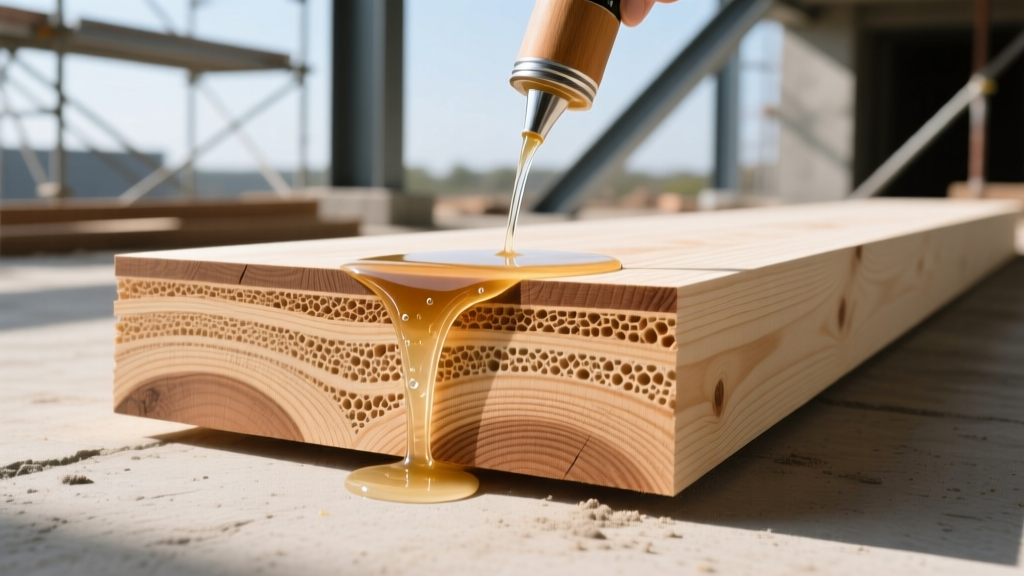
The most common failure point in engineered wood preservation occurs on the job site during field modifications. When a contractor cross-cuts an LSL header or rips a CLT panel to fit an HVAC chase, the factory-applied preservation and moisture barriers are breached.
Step-by-Step Field Sealing Protocol
- Step 1: Clean the Cut. Remove all sawdust from the cut face using a brush or compressed air. Sawdust traps moisture and prevents sealers from bonding to the wood fibers.
- Step 2: Apply End-Grain Sealer. Apply a heavy coat of a wax-based end-grain sealer (such as AnchorSeal) or a specialized mass timber tape (like Siga or Pro Clima tapes for CLT). Wax-based sealers physically block the capillary tubes in the wood.
- Step 3: Reapply Surface Preservative. If the engineered wood was borate-treated or coated with a water repellent, brush a compatible field-applied preservative onto the newly exposed surfaces.
- Step 4: Protect from UV and Rain. If the material will be exposed for more than 14 days before enclosure, apply a temporary UV-stable weather barrier to prevent surface checking and graying.
Long-Term Maintenance and Biological Decay Prevention
Engineered wood products are highly durable when kept dry. The primary preservation strategy for GLM, CLT, LSL, and OSL in the finished structure is architectural detailing. Ensuring adequate roof overhangs, utilizing capillary breaks between concrete foundations and wood sill plates, and maintaining interior relative humidity between 30% and 50% will prevent the conditions necessary for fungal growth. By combining correct factory-applied adhesives, pH-compatible borate treatments, and rigorous on-site end-grain sealing protocols, builders can ensure these advanced engineered wood products achieve their full multi-decade structural lifespan.
Written by
Marcus ChenMarcus Chen is a licensed structural engineer (PE) and building materials analyst with over 12 years of experience across residential, commercial, and industrial construction. He holds a Master of Science in Civil Engineering from UC Berkeley and spent six years at Thornton Tomasetti before transitioning to independent consulting and technical writing. Marcus specializes in material selection for seismic-prone regions, concrete reinforcement strategies, and lifecycle cost analysis. His work has been cited by the American Concrete Institute (ACI) and the Structural Engineers Association of California (SEAOC). When he is not on a job site or at his desk, you will find him hiking the Sierra Nevada or restoring a 1920s craftsman bungalow in Oakland, CA.
More from Marcus Chen
View all
Construction Cost
How Much Did the Eiffel Tower Cost to Build?
How much did the Eiffel Tower cost to build in 1889? We adjust for inflation and compare its budget to modern skyscraper construction.
Aug 4, 2026

Fire Resistance
What Is a Fire Resistant Material? Testing & Certification Guide
Discover what is a fire resistant material through ASTM and UL testing. Learn how fire ratings, certifications, and assemblies work in construction.
Aug 4, 2026

Construction Cost
How Much Did the Burj Khalifa Cost to Build?
How much did the Burj Khalifa cost to build? We break down the $1.5B project and extract 5 money-saving strategies for your next build.
Jul 30, 2026