Which Type of Fire Extinguisher for Wood Paper and Fabric is Best?
Discover the best type of fire extinguisher for wood paper and fabric. Compare Class A agents, top models, and residue impacts on treated lumber.

The Anatomy of Class A Fires in Lumber and Woodworking Environments
Fires involving ordinary combustibles are classified as Class A. In lumber yards, timber framing shops, and millwork facilities, the fuel load consists almost entirely of raw timber, engineered wood products, paper blueprints, and fabric upholstery materials. However, selecting the correct suppression agent goes far beyond simply putting out the flames. The type of fire extinguisher for wood paper and fabric must also account for the unique preservation requirements of treated lumber and the secondary damage caused by extinguishing residues.
Kiln-dried framing lumber typically has a moisture content (MC) of 15% to 19%, making it highly susceptible to rapid surface ignition. Conversely, heavy timber and glued-laminated (glulam) beams char on the outside, protecting their structural core but creating deep-seated embers that require prolonged cooling to prevent rekindling. Furthermore, suspended wood dust in poorly ventilated shops can transition a standard Class A surface fire into a deflagration event. According to OSHA's woodworking safety guidelines, managing both the macro-fuel (stacked lumber) and micro-fuel (airborne particulates) dictates your suppression strategy.
Standard Class A water stream extinguishers can blow settled wood dust off surfaces and into the air, potentially creating an explosive dust cloud if the fire has compromised structural ventilation. In environments with heavy dust accumulation, water mist or specialized foam agents are required to suppress flames without disturbing particulate matter.
Identifying the Correct Type of Fire Extinguisher for Wood Paper and Fabric
The universal standard for suppressing ordinary combustibles is a Class A rated extinguisher. However, 'Class A' encompasses several distinct chemical and mechanical agents. Choosing the wrong agent can ruin expensive architectural millwork, corrode structural fasteners, or fail to penetrate deep-seated timber embers.
| Extinguisher Agent | Class Rating | Suppression Mechanism | Impact on Treated Wood & Finishes |
|---|---|---|---|
| Stored Pressure Water | 2-A | Cools fuel below ignition temperature; penetrates deep embers. | Minimal chemical damage. May raise grain on unfinished wood; safe for ACQ treatments. |
| Water Mist (Deionized) | 2-A:C | Displaces oxygen and cools via micro-droplets; non-conductive. | Zero residue. Ideal for finished millwork, stained timber, and electronics-heavy CNC areas. |
| Foam (AFFF/AR-AFFF) | 1-A:10-B | Forms a vapor-sealing blanket; cools and prevents re-ignition. | Leaves a soapy film that requires wash-down. Can stain porous, unsealed lumber. |
| Dry Chemical (ABC) | 4-A:80-B:C | Interrupts chemical chain reaction via monoammonium phosphate. | Severe: Acidic residue destroys polyurethane finishes and accelerates corrosion in metal timber connectors. |
Top Extinguisher Technologies and Specific Models
When outfitting a lumber storage facility or custom woodworking shop, facility managers should procure specific models that balance high Class A ratings with low collateral damage to preserved wood products.
1. Amerex 240 (2.5 Gallon Stored Pressure Water)
The Amerex 240 is the industry workhorse for raw lumber yards and rough-framing sites. Delivering a 2-A rating, it provides 55 seconds of continuous discharge. The solid stream penetrates tightly stacked dimensional lumber (like 2x4 and 2x6 bundles) to reach hidden embers. Priced around $115 to $135, it is the most cost-effective solution for areas where water damage to unfinished wood is not a primary concern.
2. Badger Advantage P500 (Water Mist)
For environments featuring high-value treated lumber, stained architectural beams, or active CNC machinery, the Badger Advantage P500 water mist extinguisher is the superior choice. Using deionized water, it sprays a fine mist that absorbs heat rapidly without soaking the wood or causing grain swelling. Because deionized water lacks free ions, it is non-conductive (earning a C rating) and leaves absolutely zero chemical residue. Expect to invest between $175 and $210 per unit.
3. Buckeye 2.5 Gallon Water with Pump Tank
For remote timber framing sites or off-grid cabin builds where pressurized canisters may lose pressure in extreme cold, manual pump-tank water extinguishers (often featuring anti-freeze additives like potassium acetate) provide reliable Class A suppression. These are highly effective for soaking down fabric scaffolding and paper site plans, though the wetting agents used can sometimes leave a sticky residue on raw timber.
Preserving Treated Lumber: The Hidden Danger of ABC Dry Chemical
A common mistake in facility management is placing standard ABC dry chemical extinguishers in finished wood showrooms or treated lumber storage areas. While ABC extinguishers are versatile, the primary agent—monoammonium phosphate—is highly acidic and hygroscopic (moisture-attracting).
When this powder settles on modern pressure-treated lumber (such as ACQ or Copper Azole formulations), it triggers an accelerated galvanic corrosion reaction with the hot-dipped galvanized fasteners required by building codes for treated wood. Furthermore, if the powder contacts oiled, varnished, or polyurethane-finished millwork, the acidic nature of the chemical etches into the finish within hours, requiring complete sanding and refinishing of the affected timber. For these preservation-sensitive zones, strict adherence to pure Class A water or water mist agents is mandatory.
Heavy timber and glulam beams resist water penetration due to their density and surface glues. Adding a Class A foam concentrate or wetting agent to a standard water extinguisher reduces the surface tension of the water, allowing it to soak deep into the end-grain of large structural beams, effectively killing hidden embers that standard water streams bounce off of.
Placement and Spacing Requirements (NFPA 10 Standards)
According to the NFPA 10 Standard for Portable Fire Extinguishers, the placement of Class A extinguishers is dictated by the hazard level of the occupancy. Woodworking shops and lumber storage facilities generally fall under Ordinary Hazard (Group 1 or 2) or Extra Hazard classifications depending on dust collection efficiency and total fuel load.
- Travel Distance: Extinguishers must be placed so that the maximum travel distance from any point in the facility to the nearest unit does not exceed 75 feet (22.9 meters).
- Mounting Height: Units weighing 40 lbs or less must be mounted with the top no higher than 5 feet from the floor. Heavier units (like 2.5-gallon water tanks) should have the top no higher than 3.5 feet.
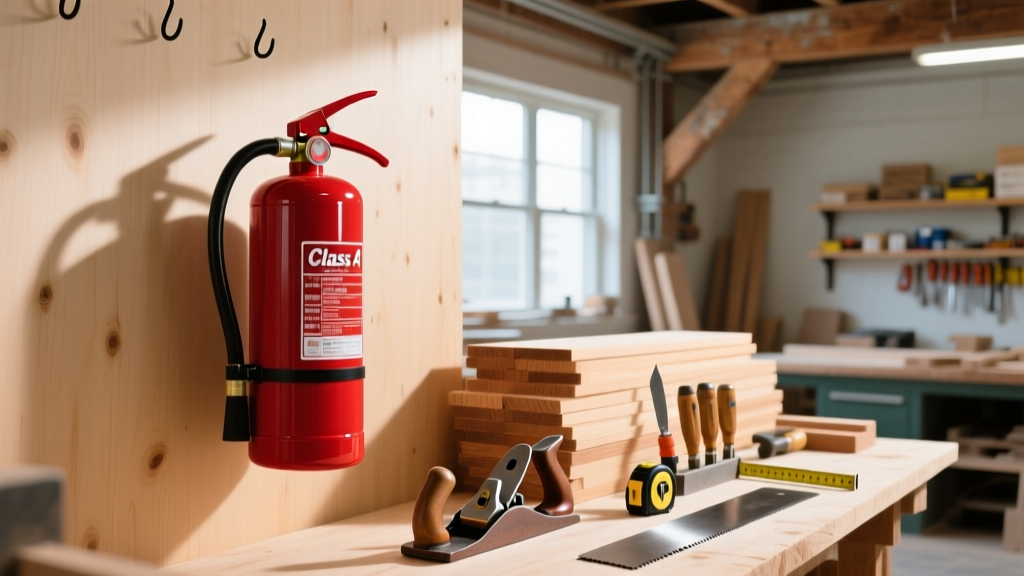
- Visibility: In lumber yards where stacked timber can obscure wall-mounted units, extinguishers must be mounted on structural columns or freestanding pedestals with highly visible 3D signage projecting above the stack height.
Maintenance and Hydrostatic Testing Schedules
Water-based Class A extinguishers require rigorous maintenance to prevent internal cylinder corrosion, which can lead to catastrophic failure during discharge. Stored pressure water units must undergo annual tear-down inspections by certified technicians. Furthermore, the steel cylinders require hydrostatic testing every 5 years to verify structural integrity under pressure. Water mist units utilizing stainless steel cylinders often have extended hydrostatic testing intervals (up to 10 years depending on the manufacturer), reducing long-term lifecycle costs for large millwork facilities.
Frequently Asked Questions
Can I use a CO2 extinguisher on a wood or fabric fire?
No. Carbon dioxide (CO2) extinguishers are rated only for Class B (flammable liquids) and Class C (electrical) fires. CO2 dissipates almost instantly and provides no cooling effect on deep-seated embers. Using CO2 on a wood fire will temporarily blow out the surface flames, but the wood will immediately rekindle once the gas clears.
Are Halotron or Clean Agent extinguishers effective on lumber fires?
Clean agents like Halotron are designed for Class B and C fires, specifically to protect sensitive electronics without leaving residue. They lack the thermal mass and penetration required to cool burning timber or thick fabric. They are highly ineffective and unnecessarily expensive for Class A wood and paper fires.
How do I clean dry chemical residue off treated wood framing?
If an ABC extinguisher is accidentally discharged in a framing environment, the monoammonium phosphate must be removed immediately. Use a HEPA-filtered vacuum to remove dry powder, followed by a wash with a mild alkaline solution (like baking soda and water) to neutralize the acid. Do not use high-pressure water, as it will drive the corrosive chemicals deeper into the wood grain and fastener joints.
Written by
Marcus ChenMarcus Chen is a licensed structural engineer (PE) and building materials analyst with over 12 years of experience across residential, commercial, and industrial construction. He holds a Master of Science in Civil Engineering from UC Berkeley and spent six years at Thornton Tomasetti before transitioning to independent consulting and technical writing. Marcus specializes in material selection for seismic-prone regions, concrete reinforcement strategies, and lifecycle cost analysis. His work has been cited by the American Concrete Institute (ACI) and the Structural Engineers Association of California (SEAOC). When he is not on a job site or at his desk, you will find him hiking the Sierra Nevada or restoring a 1920s craftsman bungalow in Oakland, CA.
More from Marcus Chen
View all
Construction Cost
How Much Did the Eiffel Tower Cost to Build?
How much did the Eiffel Tower cost to build in 1889? We adjust for inflation and compare its budget to modern skyscraper construction.
Aug 4, 2026

Fire Resistance
What Is a Fire Resistant Material? Testing & Certification Guide
Discover what is a fire resistant material through ASTM and UL testing. Learn how fire ratings, certifications, and assemblies work in construction.
Aug 4, 2026

Construction Cost
How Much Did the Burj Khalifa Cost to Build?
How much did the Burj Khalifa cost to build? We break down the $1.5B project and extract 5 money-saving strategies for your next build.
Jul 30, 2026