What Type of Wood Is Strongest for Structural Framing and Load-Bearing Beams?
Discover what type of wood is strongest for structural applications. Compare SYP, Douglas Fir, and engineered lumber for load-bearing beams and framing.

Redefining Strength: The Physics of Structural Timber
When builders and architects ask, "what type of wood is strongest," the answer requires dissecting the specific mechanical forces at play. In structural engineering, wood strength is not a single metric; it is a matrix of distinct load-bearing capacities. A species that excels in resisting downward bending forces might perform poorly under lateral shear or vertical compression.
To select the right material, you must understand the three primary structural design values published in the American Wood Council's National Design Specification (NDS):
- Modulus of Rupture (Fb): Also known as bending strength, this measures the maximum stress a beam can withstand before snapping. It is the critical metric for floor joists, rafters, and headers.
- Modulus of Elasticity (E or MOE): This defines stiffness. A high MOE means the wood will resist deflection (sagging) under load. Stiffness often dictates the design of long-span floor systems to prevent bouncy floors.
- Compression Parallel to Grain (Fc): This measures how much crushing force a vertical column or stud can bear before buckling or crushing.
The Strongest Solid-Sawn Species for Framing
For standard residential and light commercial framing, solid-sawn lumber remains the baseline. However, not all species are created equal. The two undisputed heavyweights in North American structural framing are Southern Yellow Pine and Douglas Fir-Larch.
Southern Yellow Pine (SYP): The High-Density Powerhouse
If you are looking for the highest raw bending strength (Fb) and compression values in solid-sawn dimensional lumber, Southern Yellow Pine is the answer. Grown in the southeastern United States, SYP boasts a high specific gravity (often exceeding 0.55), which translates directly to superior density and load-bearing capacity.
A 2x10 graded as "Dense Select Structural" SYP can achieve an Fb value of 2,550 psi and an MOE of 2.0 x 10^6 psi. This exceptional density also gives SYP the highest nail-withdrawal resistance of any common framing lumber, making it the premier choice for shear walls, hurricane-strapped roof trusses, and heavy deck framing. The trade-off is that its high density makes it prone to splitting if nails are driven near the ends without pre-drilling, and it experiences higher volumetric shrinkage during kiln-drying compared to western softwoods.
Douglas Fir-Larch: The Standard for Beams and Stability
While SYP wins on sheer density, Douglas Fir-Larch (often stamped as DF-L) is the preferred choice for long-spanning beams, heavy timber posts, and applications requiring exceptional dimensional stability. DF-L has a tighter, straighter grain pattern and lower moisture-related shrinkage, meaning it is less likely to warp, twist, or check as it acclimates to a building's interior environment.
A Select Structural DF-L 2x10 yields an Fb of roughly 2,100 psi and an MOE of 1.9 x 10^6 psi. While slightly lower in bending strength than Dense SYP, DF-L's superior workability, predictable fastener performance, and resistance to checking make it the default specification for exposed structural beams and heavy timber framing.
Structural Design Values: Solid-Sawn Comparison Matrix
The following table compares the baseline structural design values for common framing species at the #2 Grade level (the standard for most wall framing and floor joists). Data aligns with standard NDS reference design values for visually graded dimensional lumber.
| Species / Grade | Bending (Fb) psi | Stiffness (E) psi | Compression (Fc) psi | Best Structural Application |
|---|---|---|---|---|
| Southern Pine (#2) | 1,500 | 1.7 x 10^6 | 1,650 | Shear walls, trusses, high-load joists |
| Douglas Fir-Larch (#2) | 1,500 | 1.9 x 10^6 | 1,700 | Beams, headers, exposed timber posts |
| Hem-Fir (#2) | 1,300 | 1.6 x 10^6 | 1,500 | Standard wall studs, light roof rafters |
| SPF (Spruce-Pine-Fir) (#2) | 1,350 | 1.6 x 10^6 | 1,450 | Interior non-load-bearing, basic framing |
Engineered Wood: Surpassing Solid Timber Limits
When architectural designs demand clear spans exceeding 20 feet, or when point loads exceed the capacity of solid timber, the answer to "what type of wood is strongest" shifts from natural species to engineered wood products (EWP). By breaking wood down into veneers or strands and reassembling them with structural adhesives, manufacturers eliminate natural defects like knots, slope of grain, and checks.
Laminated Veneer Lumber (LVL)
LVL is manufactured by peeling logs into thin veneers, drying them, and laminating them with parallel grain orientation. According to the APA – The Engineered Wood Association, LVL beams can achieve bending design values (Fb) exceeding 3,100 psi and an MOE up to 2.8 x 10^6 psi. LVL is the undisputed king of residential headers, long-span floor beams, and rim boards. Because it is manufactured in continuous billets, LVL can be ordered in lengths up to 60 feet, completely eliminating the splicing required with solid sawn lumber.
Parallel Strand Lumber (PSL)
For heavy point loads—such as a massive girder supporting a multi-story atrium or a concentrated column load—PSL is the strongest option. PSL is made from long, thin strands of wood veneer laid parallel and pressed under high heat and pressure. PSL columns routinely boast compression values (Fc) exceeding 3,000 psi, making them significantly stronger than solid DF-L or SYP posts of the same dimension. PSL is also highly resistant to checking and warping, making it ideal for exposed architectural columns.
Glued Laminated Timber (Glulam)
Glulam consists of multiple layers of dimensional lumber (lamellas) bonded together. While its raw Fb values might not always exceed high-grade LVL, Glulam's true strength lies in its versatility and massive scale. Glulam can be fabricated into deep, curved arches and massive straight beams for commercial and institutional buildings. A 6.75-inch by 24-inch DF-L Glulam beam can easily span 40 feet while supporting heavy commercial roof loads, a feat impossible for solid sawn timber.
The structural design values for solid-sawn lumber are calibrated for a maximum moisture content (MC) of 19%. If you are using SYP or DF-L in an unconditioned space (like a barn or open pavilion) where the wood will absorb moisture and exceed 19% MC, you must apply a wet-use reduction factor (typically multiplying the Fb value by 0.85). Engineered wood products like LVL and Glulam are manufactured at much lower moisture levels (usually under 16%) and require specific waterproof adhesives if exposed to the elements.
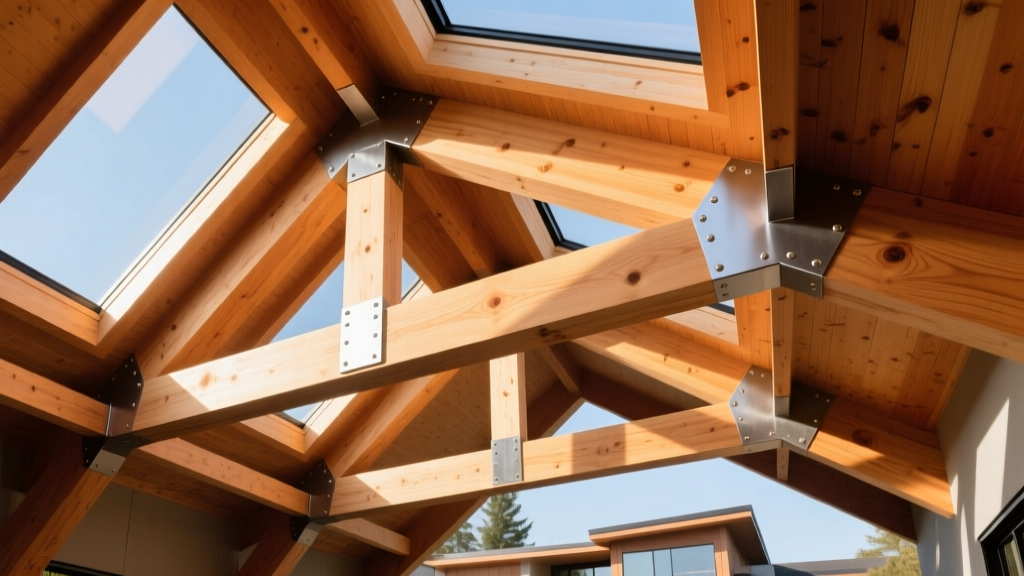
The Hardness Misconception: Janka vs. Structural Strength
A common error among DIY builders and novice designers is conflating surface hardness with structural strength. When searching for the "strongest wood," many encounter the Janka Hardness Scale and assume that tropical hardwoods like Ipe (3,680 lbf) or Hickory (1,820 lbf) are ideal for structural beams.
"Hardness measures a wood's resistance to surface denting and wear, which is vital for flooring and decking, but it has almost no correlation to its bending strength (MOR) or stiffness (MOE) in structural applications."
In fact, using Ipe or Hickory for structural framing is highly discouraged. These ultra-dense hardwoods are incredibly brittle under sudden impact loads, difficult to drive structural fasteners into without extensive pre-drilling, prohibitively expensive, and lack the standardized grading infrastructure that softwoods possess. Structural engineering relies on the predictable, ductile failure modes of graded softwoods and engineered composites, not the surface hardness of exotic timber.
Practical Selection Framework: Matching Wood to the Load
To specify the strongest wood for your specific project, use this decision framework based on span and load type:
- Standard Wall Framing (Spans under 10 ft, vertical loads): Use #2 SPF or Hem-Fir. The compression loads are well within their capacity, and they are cost-effective and lightweight.
- High-Wind/Seismic Shear Walls & Trusses: Specify #2 or Select Structural Southern Yellow Pine. The superior nail-holding capacity and high specific gravity are critical for resisting uplift and lateral shear forces.
- Floor Joists and Rafters (Spans 12 ft to 20 ft): Use #2 Douglas Fir-Larch or SYP. Prioritize the species with the higher MOE (stiffness) to minimize floor bounce and roof deflection.
- Long-Span Headers and Beams (Spans 20 ft to 40 ft): Transition to LVL or Glulam. Solid timber becomes too heavy, prone to checking, and difficult to source in high grades at these dimensions.
- Heavy Point Loads and Columns: Specify PSL (Parallel Strand Lumber) or solid Select Structural DF-L timbers to maximize compression parallel to grain (Fc).
Ultimately, the strongest wood is the one correctly graded, properly sized, and matched to the specific mechanical forces of your building's design. Always consult the latest NDS supplement and work with a licensed structural engineer to verify span tables and fastener schedules for your local building codes.
Written by
Elena RodriguezElena Rodriguez is a civil engineer and technical writer specializing in concrete technology, masonry systems, and ASTM/ACI compliance. She earned her B.S. in Civil Engineering from Texas A&M University and spent a decade at a materials testing laboratory, performing over 2,000 concrete compressive strength tests and masonry prism evaluations. Elena is an ACI-certified Field Testing Technician (Grade I) and a member of ASTM Committee C12 on Natural Building Stone. She currently consults on forensic engineering cases involving concrete failures and moisture intrusion. Based in San Antonio, TX, Elena is a proud member of the Society of Women Engineers (SWE) and coaches her daughter's FIRST Robotics team.
More from Elena Rodriguez
View all
Walls & Panels
Cost Analysis: Light Gauge Steel Framing Advantages and Disadvantages
Evaluate light gauge steel framing advantages and disadvantages through a strict cost analysis lens, comparing material, labor, and lifecycle expenses.
Aug 4, 2026

Walls & Panels
Gypsum Board Types: Exact Specifications, Thickness & Dimensions
Compare standard, Type X, and moisture-resistant gypsum board types. Get exact specifications, thicknesses, dimensions, and ASTM standards for your project.
Aug 4, 2026

Fire Resistance
Best Fire-Resistant Outdoor Decking Materials: 2026 Buyer Guide
Discover the best fire-resistant outdoor decking materials for 2026. Compare Class A PVC, aluminum, and hardwood options for WUI compliance and safety.
Aug 4, 2026