Types of Wood Joints: Cost vs. Structural Value Analysis
Compare the labor costs, equipment expenses, and structural value of common types of wood joints to optimize your next woodworking or framing project.

The Economics of Wood Joinery: Labor vs. Material
When evaluating the types of wood joints for cabinetry, furniture making, or structural millwork, the true cost extends far beyond the price of the lumber and fasteners. The primary cost driver in joinery is shop time. A joint that requires 20 minutes of precision machining and 45 minutes of clamping fundamentally alters project profitability compared to a joint assembled in 60 seconds with a pneumatic nailer. To accurately assess value, professionals use a total joinery cost formula: Total Cost = (Material Waste + Fastener/Adhesive Cost) + (Machining Time × Hourly Shop Rate).
However, structural value and longevity must offset these costs. A joint that fails under lateral racking or tensile withdrawal within five years destroys brand reputation and leads to costly warranty claims. The US Forest Service Forest Products Laboratory notes that long-grain to long-grain glue joints actually exceed the shear strength of the surrounding wood fibers, provided the clamping pressure and adhesive viscosity are correctly calibrated. This means the geometry of the joint—how much long-grain surface area it exposes to the adhesive—dictates its ultimate structural value.
Comparative Cost and Strength Matrix
The following matrix breaks down the relative costs, equipment investments, and structural performance of standard joinery methods used in modern woodshops.
| Joint Type | Setup / Machining Time | Assembly Time | Relative Shear Strength | Required Equipment Cost |
|---|---|---|---|---|
| Butt (Screwed) | 0 - 1 min | 1 min | Low | $50 - $150 (Drill/Driver) |
| Pocket Hole | 1 - 2 min | 1 min | Medium | $100 - $150 (Kreg Jig) |
| Biscuit (Plate) | 2 - 3 min | 2 min | Medium-High | $150 - $200 (Plate Joiner) |
| Dowel | 3 - 5 min | 3 min | High | $50 - $150 (Doweling Jig) |
| Mortise & Tenon | 10 - 15 min | 5 min | Very High | $50 (Hand) to $1,200 (Domino) |
| Dovetail | 20 - 45 min | 5 min | Very High | $50 (Hand) to $10k+ (CNC) |
High-Volume Production Joints: Speed Over Aesthetics
For face frames, built-in cabinetry, and quick-assembly furniture, production speed is paramount. These joints hide fasteners or prioritize rapid alignment over heirloom durability.
Pocket Hole Joinery
Pocket hole joinery utilizes self-tapping screws driven at a 15-degree angle to pull pieces together. The Kreg 720 Pro (retailing around $130) automates the clamping and drilling process, reducing setup time to roughly 15 seconds per hole. Value Analysis: Pocket holes offer excellent tensile withdrawal strength (resisting being pulled apart) but perform poorly under lateral racking forces. They are ideal for face frames and cabinet boxes where the structure is later reinforced by a plywood back panel, but they are entirely unsuitable for load-bearing table legs or chairs.
Biscuit (Plate) Joinery
Using a #20 compressed beech biscuit and PVA glue, plate joiners like the Makita PJ7000 ($159) cut crescent-shaped slots for alignment. Value Analysis: Biscuits are unparalleled for edge-joining panels and aligning miters. However, because the biscuit sits in a cross-grain slot, it adds minimal structural tensile strength. The true value here is in reducing assembly frustration and minimizing sanding time by keeping panels perfectly flush during glue-ups.
Never use rigid mechanical fasteners (like screws or tight dowels) to lock cross-grain wood pieces together. As seasonal humidity fluctuates, wood expands and contracts across the grain. A rigidly fastened cross-grain joint will inevitably split the lumber. Always allow for lateral movement using slotted holes or floating tenons.
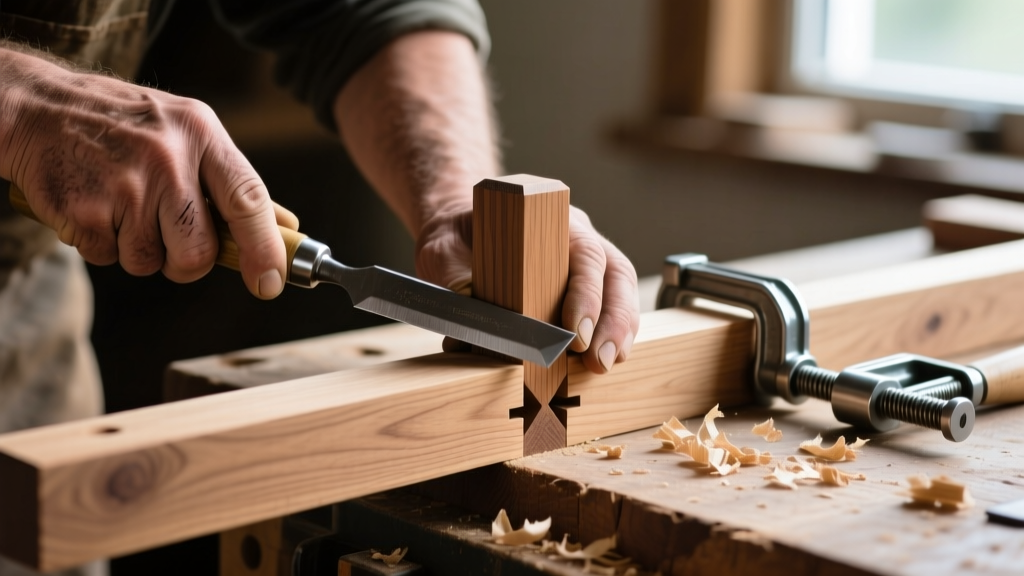
Structural and Heirloom Joints: The ROI of Precision
When building dining tables, chairs, or architectural millwork intended to last generations, the initial time investment in complex joinery yields massive dividends in structural integrity and resale value.
Mortise and Tenon
The mortise and tenon remains the undisputed king of structural woodworking. As documented in Fine Woodworking’s joinery stress tests, a well-fitted mortise and tenon joint can withstand over 500 lbs of lateral racking force before catastrophic failure. The Domino ROI Calculation: Hand-cutting a mortise and tenon takes an experienced craftsman 15 to 20 minutes per joint. The Festool Domino DF 500 Q router (priced at $1,199) reduces this to under 2 minutes. If a custom shop charges $95 per hour, and the Domino saves 12 minutes per joint on a set of four cabinet doors (16 joints total), that equates to 3.2 hours saved per set. That is $304 saved per project. The $1,199 tool pays for itself in exactly four sets of doors, making it one of the highest-ROI machinery investments a modern woodshop can make.
Hand-Cut vs. CNC Dovetails
Dovetails provide immense mechanical resistance to being pulled apart, making them the standard for drawer boxes. Value Analysis: A CNC router can machine blind dovetails in roughly 4 minutes per drawer, but requires $15,000+ in equipment and extensive CAD/CAM programming time. Hand-cut dovetails take 30 to 45 minutes per corner. While CNC is cheaper for runs of 50+ units, hand-cut dovetails command a 20% to 35% price premium in the luxury furniture market due to their aesthetic authenticity. The "cost" of hand-cutting is offset by the higher retail value of the finished heirloom piece.
Hidden Costs: Adhesives, Clamping, and Waste
When calculating the cost of different types of wood joints, shop managers frequently overlook the secondary expenses of adhesives and clamping logistics.
- Clamp Time Bottlenecks: Standard PVA glues (like Titebond III) require 45 to 60 minutes of clamping time. If a shop only owns 12 parallel clamps, production halts once those clamps are in use. Upgrading to a fast-set PVA or utilizing a radio-frequency (RF) glue press can cure joints in seconds, but RF presses cost upwards of $20,000.
- Glue Squeeze-Out Cleanup: Joints with high surface area (like large finger joints or loose-fitting tenons) force excess glue out of the seam. If this PVA glue dries on the surface, it will reject stains and finishes. The labor cost of scraping and sanding dried glue squeeze-out often exceeds the cost of the joint machining itself.
- Bit and Blade Wear: Routing deep mortises in abrasive woods like White Oak or Ipe rapidly degrades carbide bits. A high-quality solid carbide spiral upcut bit costs $45 to $80 and may only survive 50 to 100 deep mortises before requiring replacement.
Decision Framework: Selecting the Right Joint for Your Budget
Use this operational logic tree to determine the most cost-effective joint for your specific application:
1. Is the joint part of a structural building frame?
According to the APA - The Engineered Wood Association, modern structural framing relies heavily on engineered metal connectors rather than traditional wood-to-wood notching. Notching a 2x10 joist to fit over a beam severely compromises its structural integrity. Decision: Use standard butt joints reinforced with APA-rated metal joist hangers and hurricane ties. The $15 cost of a galvanized steel hanger vastly outperforms the labor cost and structural weakness of a hand-framed birdsmouth joint.
2. Are you producing more than 50 identical units per month?
Decision: Invest in CNC routing or automated dowel-insertion machinery. The upfront capital expenditure ($15k - $40k) is justified by the elimination of human error, consistent glue application, and the ability to employ lower-skilled (and lower-wage) assembly labor.
3. Is the piece a high-wear, movable item (e.g., dining chairs)?
Decision: Use floating tenons (Domino) or traditional pegged mortise and tenons. Chairs endure constant dynamic lateral loads. Screws and pocket holes will eventually wallow out the wood fibers, causing the chair to wobble. The 10 extra minutes spent per joint on a mortise and tenon prevents warranty returns and ensures the piece survives decades of use.
4. Is the piece a stationary, built-in cabinet or shelving unit?
Decision: Use pocket holes for face frames and dado/rabbet joints (cut on a table saw or CNC) for cabinet boxes. Dado joints provide excellent shear strength for supporting shelf weight while requiring only a single pass over a dado stack blade, minimizing both machining time and adhesive costs.
Written by
Marcus ChenMarcus Chen is a licensed structural engineer (PE) and building materials analyst with over 12 years of experience across residential, commercial, and industrial construction. He holds a Master of Science in Civil Engineering from UC Berkeley and spent six years at Thornton Tomasetti before transitioning to independent consulting and technical writing. Marcus specializes in material selection for seismic-prone regions, concrete reinforcement strategies, and lifecycle cost analysis. His work has been cited by the American Concrete Institute (ACI) and the Structural Engineers Association of California (SEAOC). When he is not on a job site or at his desk, you will find him hiking the Sierra Nevada or restoring a 1920s craftsman bungalow in Oakland, CA.
More from Marcus Chen
View all
Construction Cost
How Much Did the Eiffel Tower Cost to Build?
How much did the Eiffel Tower cost to build in 1889? We adjust for inflation and compare its budget to modern skyscraper construction.
Aug 4, 2026

Fire Resistance
What Is a Fire Resistant Material? Testing & Certification Guide
Discover what is a fire resistant material through ASTM and UL testing. Learn how fire ratings, certifications, and assemblies work in construction.
Aug 4, 2026

Construction Cost
How Much Did the Burj Khalifa Cost to Build?
How much did the Burj Khalifa cost to build? We break down the $1.5B project and extract 5 money-saving strategies for your next build.
Jul 30, 2026