Types of Wood Oak: Red vs White Oak Lumber Selection Guide
Compare types of wood oak for construction. This guide details red vs white oak lumber specs, Janka hardness, NHLA grades, and current pricing.

The Botanical and Cellular Divide: White vs. Red Oak
When evaluating the different types of wood oak available for commercial and residential projects, the primary distinction is not merely aesthetic—it is fundamentally cellular. North American oak lumber is broadly categorized into two groups: the White Oak group (Quercus alba and related species) and the Red Oak group (Quercus rubra and related species). Understanding the microscopic anatomy of these woods is critical for specifying the correct material for structural, exterior, and interior applications.
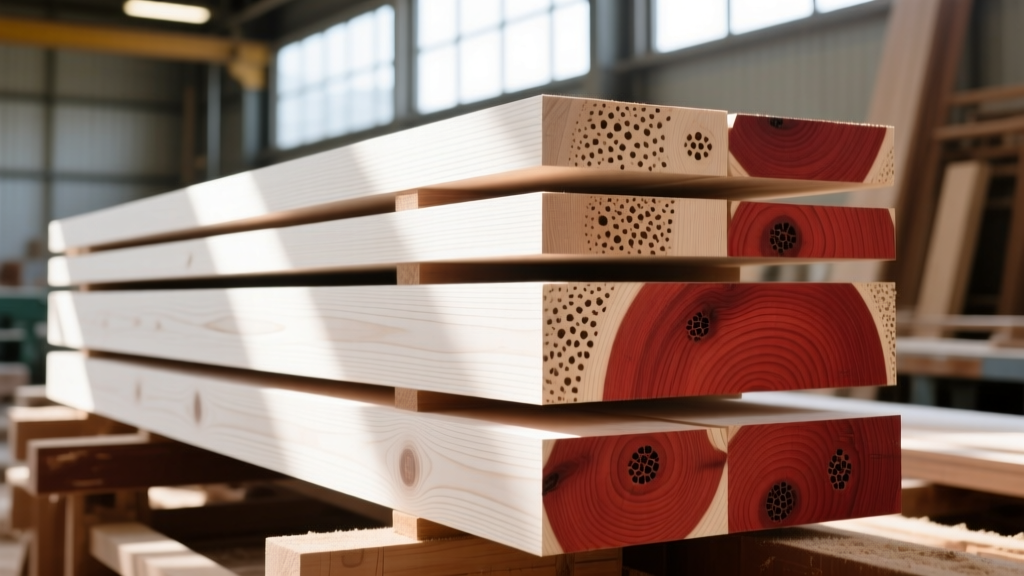
The defining anatomical feature of white oak is the presence of tyloses—membranous outgrowths that plug the xylem vessels (pores) of the wood. This cellular blockage makes white oak virtually impermeable to water and liquids, which is why it is the exclusive choice for whiskey barrels, boatbuilding, and exterior siding. Conversely, red oak lacks tyloses. Its open, continuous pores act like a bundle of microscopic straws, allowing moisture to wick deeply into the end grain. If red oak is used in ground-contact or high-moisture exterior applications, it will rapidly succumb to fungal decay and dimensional instability.
Technical Specification Matrix: Types of Wood Oak
Specifying the correct oak requires looking beyond general hardness. The Tangential-to-Radial (T/R) shrinkage ratio is a vital metric for predicting cupping and warping during seasonal humidity shifts. A lower T/R ratio indicates greater dimensional stability.
| Property | White Oak (Quercus alba) | Red Oak (Quercus rubra) |
|---|---|---|
| Janka Hardness | 1,360 lbf (6,049 N) | 1,290 lbf (5,738 N) |
| Specific Gravity (Basic) | 0.60 | 0.56 |
| Radial Shrinkage | 5.6% | 4.0% |
| Tangential Shrinkage | 10.5% | 8.6% |
| T/R Ratio | 1.9 (Highly Stable) | 2.2 (Moderate Movement) |
| Crushing Strength | 7,440 lbf/in² | 6,780 lbf/in² |
| Avg. Retail Cost (FAS Grade) | $8.50 - $12.00 / bd ft | $5.50 - $8.00 / bd ft |
Note: Pricing reflects 2026 North American wholesale-to-retail averages for domestically milled, kiln-dried 4/4 (1-inch) rough lumber. Quartersawn stock commands a 30-50% premium over plainsawn.
NHLA Grading Standards and Procurement
Procuring oak lumber requires fluency in the National Hardwood Lumber Association (NHLA) grading system. Unlike softwoods graded for structural load-bearing capacity (e.g., #2 SPF), hardwoods are graded based on the percentage of clear, defect-free cuttings yieldable from a board.
- FAS (First and Seconds): The premium grade. Minimum board size is 6 inches wide by 8 feet long. Must yield at least 83.3% clear-face cuttings. Specify FAS for long, continuous runs of architectural millwork, stair treads, and high-end cabinetry.
- Selects: Similar to FAS in yield (83.3%), but allows for smaller minimum board sizes (4 inches wide by 6 feet long). Ideal for cabinet face frames and shorter furniture components.
- #1 Common: The "cabinet grade." Minimum size 3 inches wide by 4 feet long, yielding 66.7% to 83.3% clear cuttings. This is the most cost-effective grade for kitchen cabinets, flooring, and paneling where shorter cut lengths are acceptable.
- #2 Common: Yields 50% to 66.7% clear cuttings. Best utilized for rustic flooring, pallet stock, and hidden structural framing where character marks, knots, and sapwood are permissible.
Application-Specific Selection Framework
Exterior, Marine, and Wet Environments
For exterior cladding, timber frame pergolas, or marine dock decking, white oak is mandatory. Its natural rot resistance (rated as "Resistant to very resistant" by the Wood Database) allows it to perform in ground-contact scenarios without chemical pressure treatment. When specifying white oak for exterior use, request all-heartwood stock; the sapwood of white oak lacks rot resistance and will decay rapidly if exposed to the elements.
Interior Flooring and Millwork
Both red and white oak excel in interior flooring, but they behave differently during finishing. Red oak’s open pores accept penetrating oil stains deeply and evenly, making it highly forgiving for DIY staining. White oak’s closed cellular structure can result in blotchy staining if a pre-stain wood conditioner is not applied. Furthermore, for wide-plank flooring (boards exceeding 7 inches in width), specify quartersawn white oak. The vertical grain orientation drastically reduces seasonal cupping and showcases the wood's medullary rays (the striking "fleck" pattern unique to oak species).
Machining, Drying, and Acclimation Protocols
Oak’s density and interlocked grain demand specific machining parameters to prevent tearout and tool wear.
Moisture Content (MC) and Acclimation
Improper acclimation is the leading cause of oak flooring failure. According to the USDA Forest Products Laboratory, wood reaches equilibrium moisture content (EMC) based on ambient relative humidity.
- Kiln-Dried (KD) Standard: Oak lumber is typically kiln-dried to 6-8% MC for interior use.
- Acclimation Timeline: Unpack and sticker (stack with spacers) the lumber in the installation environment for a minimum of 7 to 14 days prior to installation. The HVAC system must be operational and maintaining standard living conditions (65°F-75°F, 30-50% RH) during this period.
Finishing Chemistry: The Tannin Factor
White oak contains exceptionally high levels of tannic acid. This chemical property allows for unique architectural finishes, most notably ebonizing. By applying a solution of iron acetate (created by dissolving steel wool in white vinegar) to white oak, the iron reacts with the tannins to create a permanent, deep black finish that does not obscure the grain. Red oak contains significantly fewer tannins; applying the same solution yields a muddy, unappealing gray-green hue.
When applying modern water-based polyurethanes to white oak, the water in the finish can draw tannins to the surface, causing a yellow or brown "tannin bleed" that ruins the clarity of the topcoat. To prevent this, always apply a barrier coat of dewaxed shellac (such as Zinsser SealCoat) or a dedicated tannin-blocking primer before applying water-based topcoats to white oak.
Written by
Marcus ChenMarcus Chen is a licensed structural engineer (PE) and building materials analyst with over 12 years of experience across residential, commercial, and industrial construction. He holds a Master of Science in Civil Engineering from UC Berkeley and spent six years at Thornton Tomasetti before transitioning to independent consulting and technical writing. Marcus specializes in material selection for seismic-prone regions, concrete reinforcement strategies, and lifecycle cost analysis. His work has been cited by the American Concrete Institute (ACI) and the Structural Engineers Association of California (SEAOC). When he is not on a job site or at his desk, you will find him hiking the Sierra Nevada or restoring a 1920s craftsman bungalow in Oakland, CA.
More from Marcus Chen
View all
Construction Cost
How Much Did the Eiffel Tower Cost to Build?
How much did the Eiffel Tower cost to build in 1889? We adjust for inflation and compare its budget to modern skyscraper construction.
Aug 4, 2026

Fire Resistance
What Is a Fire Resistant Material? Testing & Certification Guide
Discover what is a fire resistant material through ASTM and UL testing. Learn how fire ratings, certifications, and assemblies work in construction.
Aug 4, 2026

Construction Cost
How Much Did the Burj Khalifa Cost to Build?
How much did the Burj Khalifa cost to build? We break down the $1.5B project and extract 5 money-saving strategies for your next build.
Jul 30, 2026