What Type of Wood Was Jesus Crucified On? A Botanical Analysis
Discover what type of wood Jesus was crucified on by analyzing 1st-century Levantine timber species, structural properties, and Roman engineering.

The Historical and Botanical Reality of Roman Crucifixion Timber
When investigating what type of wood was Jesus crucified on, we must separate centuries of European theological myth from the hard botanical and structural realities of 1st-century Judea. The New Testament does not specify the wood species used for the cross. However, by cross-referencing Roman execution logistics, regional forestry data, and modern wood science, we can determine the most structurally and historically viable candidates.
Roman crucifixion was an industrialized method of execution. The apparatus typically consisted of a stipes (the permanent upright post) and a patibulum (the removable crossbar). According to historical analyses by the Biblical Archaeology Society, the stipes was often left in the ground at execution sites like Golgotha to be reused, while the patibulum was carried by the condemned. The timber required for this purpose had to be locally abundant, cheap, straight-grained, and possess the mechanical strength to support a dynamic load of 150 to 200 pounds without catastrophic shear failure.
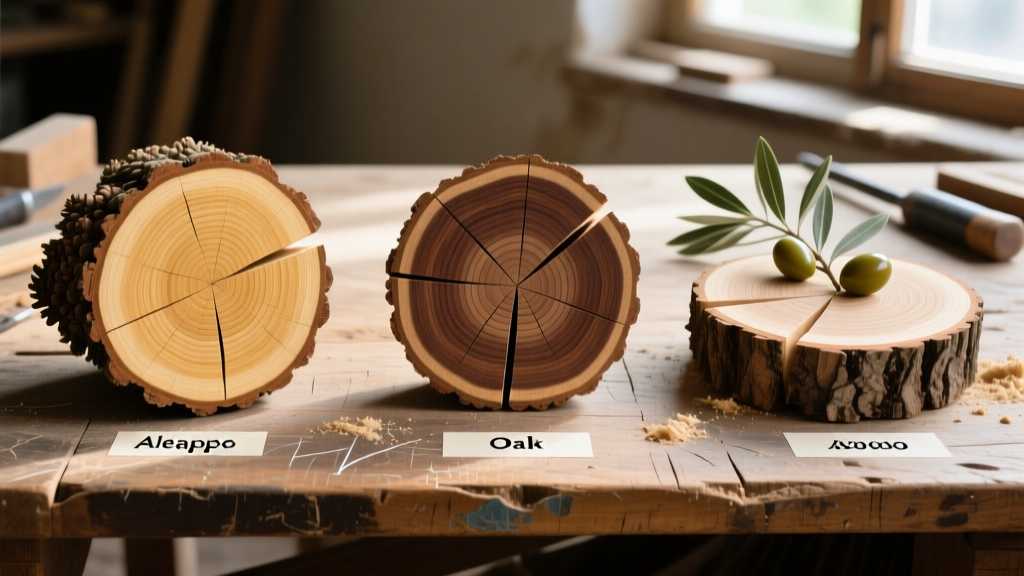
Analyzing the Candidate Species: A Structural Breakdown
To identify the wood, we must evaluate the native and imported timber species available in the Levant during the early 1st century, measuring them against the structural demands of Roman carpentry.
Aleppo Pine (Pinus halepensis): The Pragmatic Choice
Aleppo Pine was the most common construction timber in ancient Judea. According to data from Flora of Israel Online, this species thrives in the Mediterranean climate and can grow up to 20 meters (65 feet) tall with relatively straight, knot-free trunks. From a wood science perspective, Aleppo Pine offers an excellent strength-to-weight ratio. Its Modulus of Rupture (MOR)—a measure of bending strength—sits at approximately 10,100 psi. Furthermore, its moderate Janka hardness (around 800 lbf) meant that Roman carpenters, using iron asciae (adzes) and serrulae (hand saws), could fell, mill, and shape the timber efficiently. For a disposable execution device, Aleppo Pine is the most botanically and economically probable candidate for the patibulum.
Palestine Oak (Quercus calliprinos): The Heavy-Duty Native
The Kermes Oak or Palestine Oak is a dense, slow-growing hardwood native to the Judean hills. With a Janka hardness exceeding 1,500 lbf and an MOR often surpassing 14,000 psi, oak is structurally superior to pine. It would easily bear the weight of the condemned without bowing. However, oak presents two significant historical hurdles. First, native Levantine oaks rarely grow perfectly straight; they are highly branched and twisted, making it difficult to mill a continuous 10-foot beam. Second, cutting and shaping dense oak with 1st-century iron saws—which lacked the hardened, set teeth of modern crosscut saws—would cause rapid metallurgical dulling and require immense labor. Oak was highly prized for heavy load-bearing joints and tool handles, making it too valuable to waste on a single-use crossbar.
Olive Wood (Olea europaea): Theological Tradition vs. Structural Reality
Christian tradition and Renaissance art frequently depict the cross as being made of olive wood. While olive wood is incredibly hard (Janka rating of ~2,700 lbf) and features beautiful interlocked grain, it is structurally unsuited for a Roman cross. Olive trees are notoriously short, rarely exceeding 15 feet in height, and their trunks are heavily gnarled, twisted, and often hollow in the center. It is botanically impossible to extract a straight, solid, 10-foot structural beam from a native olive tree. Furthermore, the severe interlocked grain makes its bending strength highly unpredictable; under a heavy, shifting load, an olive beam is prone to sudden, catastrophic splitting along the grain lines. While olive wood was used for small, high-value items like combs and decorative boxes, it was not used for heavy timber framing.
Cedar of Lebanon (Cedrus libani): The Imperial Import
Cedar of Lebanon is a world-class structural timber. It grows exceptionally tall and straight, is highly resistant to rot and insect decay, and is easy to work with hand tools. However, in 1st-century Judea, Cedar was a luxury import from the mountains of Lebanon. It was heavily taxed and strictly reserved for high-status imperial and religious projects, such as the roofing of the Second Temple and the expansion of Herod’s palaces. The Roman military administration would not requisition expensive, imported, architectural-grade cedar for the provincial execution of a common criminal.
Structural Properties of 1st-Century Levantine Timbers
The following data, cross-referenced with the USDA Forest Service Wood Handbook, illustrates the mechanical limitations and advantages of the regional species.
| Wood Species | Botanical Name | Janka Hardness (lbf) | Modulus of Rupture (psi) | Max Trunk Height | Crucifixion Viability |
|---|---|---|---|---|---|
| Aleppo Pine | Pinus halepensis | 800 | 10,100 | 65 ft (20m) | Highly Probable |
| Kermes Oak | Quercus calliprinos | 1,520 | 14,500 | 30 ft (9m) | Probable (Upright Post) |
| Olive | Olea europaea | 2,710 | 12,000 (Variable) | 15 ft (4.5m) | Structurally Impossible |
| Cedar of Lebanon | Cedrus libani | 820 | 10,900 | 100+ ft (30m+) | Historically Unlikely |
Debunking the Myth of the Dogwood
A persistent European legend claims that the cross was made of Dogwood (Cornus). The myth states that the Dogwood was once a towering, mighty tree, but was cursed by God to forever remain small and twisted so it could never again be used for a crucifixion.
From a botanical standpoint, this is entirely apocryphal. Dogwood species are not, and never were, native to the Levant or the Middle East. The legend originated in the mountainous regions of Europe and North America centuries later, created by local populations attempting to insert their native flora into biblical narratives. In the context of 1st-century Jerusalem, Dogwood is a geographical and botanical impossibility.
Conclusion: The Verdict of Wood Science
While relics in various European cathedrals claim to be fragments of the True Cross—often identified microscopically as pine or cedar by modern researchers—the most scientifically sound answer relies on local availability and structural engineering. The upright post (stipes) was most likely a heavy, durable native hardwood like Kermes Oak, driven deep into the bedrock of Golgotha to resist lateral tipping. The crossbar (patibulum), which needed to be straight, lightweight, and easily milled by Roman military engineers, was almost certainly Aleppo Pine. Olive wood, despite its deep theological resonance, simply lacks the physical dimensions and grain structure required to serve as a structural beam in any era of carpentry.
Written by
Elena RodriguezElena Rodriguez is a civil engineer and technical writer specializing in concrete technology, masonry systems, and ASTM/ACI compliance. She earned her B.S. in Civil Engineering from Texas A&M University and spent a decade at a materials testing laboratory, performing over 2,000 concrete compressive strength tests and masonry prism evaluations. Elena is an ACI-certified Field Testing Technician (Grade I) and a member of ASTM Committee C12 on Natural Building Stone. She currently consults on forensic engineering cases involving concrete failures and moisture intrusion. Based in San Antonio, TX, Elena is a proud member of the Society of Women Engineers (SWE) and coaches her daughter's FIRST Robotics team.
More from Elena Rodriguez
View all
Walls & Panels
Cost Analysis: Light Gauge Steel Framing Advantages and Disadvantages
Evaluate light gauge steel framing advantages and disadvantages through a strict cost analysis lens, comparing material, labor, and lifecycle expenses.
Aug 4, 2026

Walls & Panels
Gypsum Board Types: Exact Specifications, Thickness & Dimensions
Compare standard, Type X, and moisture-resistant gypsum board types. Get exact specifications, thicknesses, dimensions, and ASTM standards for your project.
Aug 4, 2026

Fire Resistance
Best Fire-Resistant Outdoor Decking Materials: 2026 Buyer Guide
Discover the best fire-resistant outdoor decking materials for 2026. Compare Class A PVC, aluminum, and hardwood options for WUI compliance and safety.
Aug 4, 2026