Best Types of Wood for Fence Builds: Complete Species Guide
Compare the best types of wood for fence builds. This species guide covers cedar, redwood, tropical hardwoods, and treated pine costs and lifespans.
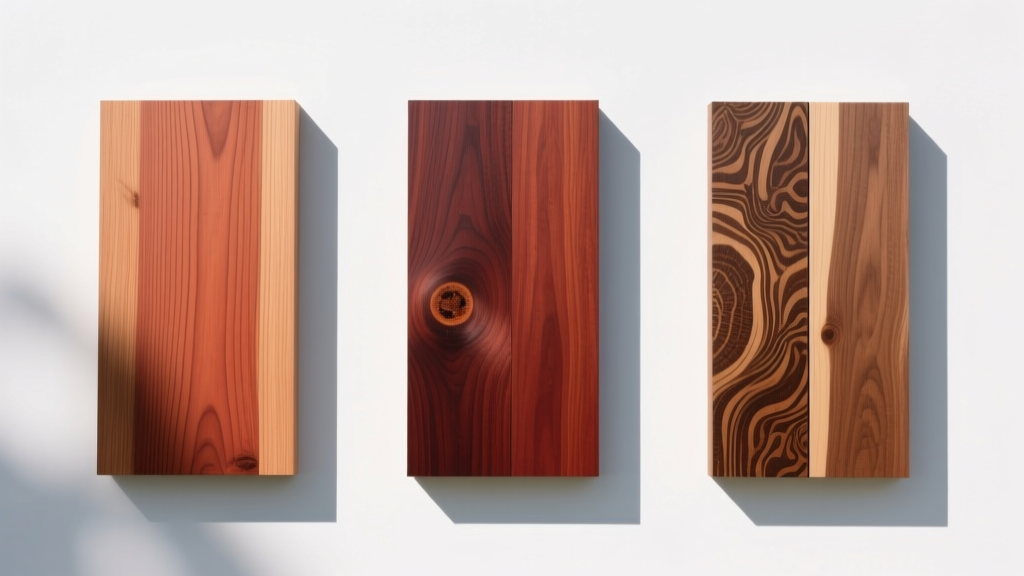
The Anatomy of Fence Failure: Why Species Selection Matters
When evaluating the best types of wood for fence projects, contractors and homeowners must look beyond aesthetics and focus on cellular biology. Wood fences almost universally fail at the post-to-soil interface. This transition zone traps moisture, creating an environment where fungal decay and wood-boring insects thrive. The natural extractives, density, and cellular structure of the wood species you choose dictate its baseline resistance to these biological threats.
While installation techniques (such as gravel drainage beds and concrete collars) heavily influence longevity, the species itself establishes the absolute ceiling for your fence's lifespan. According to the USDA Forest Products Laboratory, wood maintained below a 20% moisture content is virtually immune to decay. However, fence posts embedded in soil regularly exceed 40% moisture content, making natural rot resistance or chemical treatment non-negotiable.
Premium Rot-Resistant Softwoods (The Natural Standards)
For residential privacy fences and picket styles, naturally decay-resistant softwoods remain the most popular choice due to their workability, dimensional stability, and natural beauty.
Western Red Cedar (Thuja plicata)
Western Red Cedar is the benchmark for natural fence materials. Its decay resistance comes from thujaplicins, water-soluble chemical extractives that act as natural fungicides. However, these extractives are only present in the heartwood.
- Grading Matters: Always specify "Select Tight Knot" or "Clear Heartwood" grades. "Construction" or "Standard" grades often include wide bands of sapwood, which lacks thujaplicins and will rot within 3 to 5 years in ground contact.
- Dimensional Stability: Cedar has a very low shrinkage factor, meaning it is less prone to warping, cupping, or splitting compared to pine.
- Cost & Lifespan: $18 to $28 per linear foot (installed). Expect 15 to 25 years for above-ground pickets, but only 10 to 15 years for untreated posts in direct soil contact.
California Redwood (Sequoia sempervirens)
Redwood relies on high concentrations of tannins and complex polymers to resist decay and insects. It is denser and slightly harder than cedar, offering superior holding power for nails and screws.
Just like cedar, only redwood heartwood is rot-resistant. When purchasing redwood for fence posts, look for the California Redwood Association grade stamp indicating "Construction Heart" or better. "Construction Common" includes sapwood and should only be used for above-ground rails and pickets.
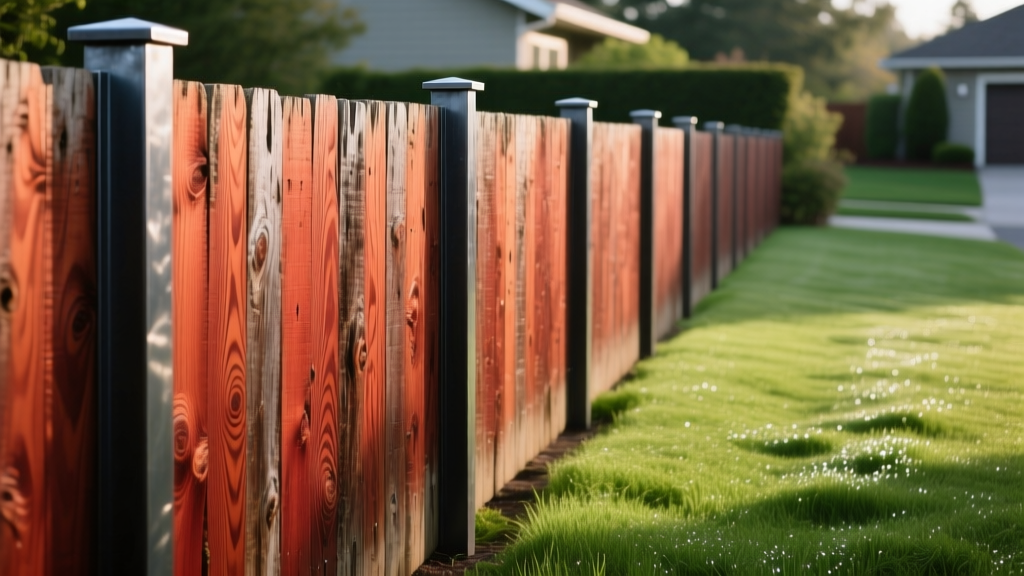
High-Density Hardwoods (Maximum Lifespan & Security)
If budget allows and the goal is a multi-generational fence, tropical and domestic hardwoods offer unmatched structural integrity. Their extreme density makes them virtually impervious to moisture absorption and physical impact.
Ipe and Cumaru (Tropical Hardwoods)
Ipe (Handroanthus spp.) and Cumaru (Dipteryx odorata) are South American hardwoods that boast Janka hardness ratings exceeding 3,000 lbf. They are so dense they sink in water and possess a Class A fire rating, matching steel and concrete.
- Installation Realities: You cannot use standard galvanized nails. The tannins and acids in Ipe will corrode standard steel, causing black streaks. You must use 304 or 316-grade stainless steel screws and pre-drill every hole.
- Sustainability: Only purchase FSC-certified (Forest Stewardship Council) tropical hardwoods to ensure the timber was not illegally logged from protected rainforests.
Black Locust (Robinia pseudoacacia)
Black Locust is the premier domestic alternative to tropical hardwoods. Native to the Appalachian region, it boasts a Janka hardness of 1,700 lbf and contains natural flavonoids that make it highly resistant to rot. Black Locust posts can last 50 to 100 years in direct ground contact without any chemical treatment, rivaling pressure-treated pine but without the environmental toxicity.
Hardwood Fence Species Comparison Matrix
| Species | Janka Hardness (lbf) | Natural Decay Resistance | Avg. Installed Cost (per lin. ft.) | Expected Post Lifespan |
|---|---|---|---|---|
| Western Red Cedar | 350 | High (Heartwood) | $18 - $28 | 10 - 15 Years |
| Redwood | 420 | High (Heartwood) | $25 - $40 | 15 - 20 Years |
| Black Locust | 1,700 | Exceptional | $35 - $55 | 50+ Years |
| Ipe | 3,680 | Exceptional | $60 - $90 | 75+ Years |
Pressure-Treated Softwoods (The Budget Workhorses)
Southern Yellow Pine (SYP) is the most widely used fencing material in North America. In its natural state, SYP has virtually no decay resistance. However, modern pressure treatment forces chemical preservatives deep into the cellular structure, transforming it into a highly durable building material.
Understanding AWPA Use Categories for Fence Posts
Not all pressure-treated wood is created equal. The American Wood Protection Association (AWPA) classifies treated wood based on its intended hazard level. According to AWPA standards, you must read the end-tags on lumber carefully:
- UC3B (Above Ground, Coated): Suitable for pickets and rails that will be painted or stained and will not touch the soil.
- UC4A (Ground Contact): The minimum standard for fence posts. Requires a preservative retention level of 0.40 pcf (pounds per cubic foot).
- UC4B (Heavy Duty Ground Contact): Required for critical structural posts, posts in areas with poor drainage, or posts supporting heavy gates. Requires a higher retention level of 0.60 pcf.
Modern treatments like Micronized Copper Azole (MCA) and Alkaline Copper Quaternary (ACQ) are highly corrosive to standard steel and aluminum. You must use hot-dipped galvanized (HDG) fasteners meeting ASTM A153 standards, or stainless steel. Electro-galvanized nails will corrode and fail within a few seasons.
Species to Strictly Avoid for Ground Contact
If you are sourcing local, rough-cut lumber from a sawmill, avoid the following species for fence posts unless they are going to be heavily charred (Shou Sugi Ban) or chemically treated:
- Spruce (Picea spp.): Low natural durability, highly susceptible to moisture wicking and fungal rot. Often sold cheaply as "white wood" in big box stores.
- Untreated Douglas Fir: While excellent for structural framing above ground, its heartwood has only moderate decay resistance, and its sapwood rots rapidly in soil.
- Hemlock: Prone to severe checking (splitting) as it dries, which opens pathways for moisture and insects to destroy the post from the inside out.
The Decision Framework: Which Wood Should You Buy?
Use this practical matrix to select the right wood based on your project constraints:
- Scenario A: Budget is under $18/linear foot, and you plan to paint or stain the fence.
Verdict: Pressure-Treated Southern Yellow Pine (UC4A for posts, UC3B for pickets). It provides the best structural ROI and accepts opaque exterior paints beautifully once fully cured (wait 3-6 months). - Scenario B: Budget is $18-$30/linear foot, you want a natural wood aesthetic, and you prefer low-maintenance.
Verdict: Western Red Cedar (Select Tight Knot). It will weather to a silvery-gray if left untreated. If you want to maintain the warm amber tone, you must apply a penetrating UV-blocking oil sealer every 2 to 3 years. - Scenario C: Budget is $35+/linear foot, and you want a "lifetime" fence with zero chemical treatments.
Verdict: Black Locust or Ipe. The upfront material and labor costs are high (due to pre-drilling and specialty hardware), but the total cost of ownership over 50 years is lower than replacing a cedar fence three times.
Installation Specs That Override Species Selection
Even the most rot-resistant wood will fail if installed incorrectly. To maximize the lifespan of any wood species chosen for your fence, adhere to these installation parameters:
- The Gravel Base: Dig post holes 6 inches deeper than the required frost line depth. Fill the bottom 6 inches with 3/4-inch crushed gravel. This prevents the post end from sitting in a water trap.
- The Concrete Collar: Do not encase the entire post in concrete. Concrete acts as a sponge, holding moisture against the wood. Instead, use a concrete collar that stops 2 inches below grade, and backfill the top 2 inches with soil sloped away from the post to shed surface water.
- End-Grain Sealing: Whenever you cut a pressure-treated, cedar, or hardwood post, the exposed end-grain acts like a bundle of straws, wicking moisture into the core. Always coat field cuts with a copper naphthenate brush-on preservative or a high-quality end-grain sealer.
Written by
Elena RodriguezElena Rodriguez is a civil engineer and technical writer specializing in concrete technology, masonry systems, and ASTM/ACI compliance. She earned her B.S. in Civil Engineering from Texas A&M University and spent a decade at a materials testing laboratory, performing over 2,000 concrete compressive strength tests and masonry prism evaluations. Elena is an ACI-certified Field Testing Technician (Grade I) and a member of ASTM Committee C12 on Natural Building Stone. She currently consults on forensic engineering cases involving concrete failures and moisture intrusion. Based in San Antonio, TX, Elena is a proud member of the Society of Women Engineers (SWE) and coaches her daughter's FIRST Robotics team.
More from Elena Rodriguez
View all
Walls & Panels
Cost Analysis: Light Gauge Steel Framing Advantages and Disadvantages
Evaluate light gauge steel framing advantages and disadvantages through a strict cost analysis lens, comparing material, labor, and lifecycle expenses.
Aug 4, 2026

Walls & Panels
Gypsum Board Types: Exact Specifications, Thickness & Dimensions
Compare standard, Type X, and moisture-resistant gypsum board types. Get exact specifications, thicknesses, dimensions, and ASTM standards for your project.
Aug 4, 2026

Fire Resistance
Best Fire-Resistant Outdoor Decking Materials: 2026 Buyer Guide
Discover the best fire-resistant outdoor decking materials for 2026. Compare Class A PVC, aluminum, and hardwood options for WUI compliance and safety.
Aug 4, 2026