What Type of Wood is Used in a Sauna: A Builder's Selection Framework
Discover what type of wood is used in a sauna with our expert selection framework. Compare cedar, hemlock, and spruce for heat, moisture, and cost.

The Core Criteria: What Type of Wood is Used in a Sauna?
When determining what type of wood is used in a sauna, builders must look beyond basic aesthetics and evaluate lumber through the lens of extreme thermal and hygroscopic stress. A sauna environment subjects materials to ambient temperatures between 150°F and 195°F (65°C to 90°C), coupled with rapid humidity spikes when water is thrown on heated rocks. Hardwoods and high-density softwoods fail in this environment because they absorb and radiate heat, creating burn hazards for bare skin, while high-resin woods weep sticky pitch that can cause severe burns.
The correct answer to what type of wood is used in a sauna is always a low-density, low-resin, kiln-dried softwood. However, selecting the exact species requires a structured decision matrix based on budget, allergy profiles, and desired aesthetic.
- Thermal Conductivity: Must be low. Wood density directly correlates to heat absorption. Target specific gravity below 0.45.
- Dimensional Stability: Must resist warping, cupping, and checking during extreme moisture cycling. Kiln-dried to <10% moisture content (MC) is mandatory.
- Extractive & Resin Content: Must be devoid of large pitch pockets. Heat liquefies resin, creating a dripping and skin-burning hazard.
- Splinter Resistance: Milling must yield a micro-smooth surface. Bare skin contacts the wood at high temperatures, making microscopic splinters highly problematic.
Species Comparison Matrix
The three dominant species utilized in commercial and residential sauna construction are Western Red Cedar, Canadian Hemlock, and Nordic Spruce. The following matrix benchmarks these species against critical performance metrics based on data from the USDA Forest Products Laboratory Wood Handbook.
| Wood Species | Avg. Density (pcf) | Resin Bleed Risk | Natural Rot Resistance | 2026 Cost (1x6 T&G / lin. ft.) |
|---|---|---|---|---|
| Western Red Cedar | 22 | Very Low | High (Plicatic Acid) | $4.50 - $7.50 |
| Canadian Hemlock | 28 | None (No resin canals) | Low | $2.50 - $4.00 |
| Nordic Spruce | 27 | Low (If heat-treated) | Low | $2.00 - $3.50 |
| Clear Basswood | 26 | None | Very Low | $5.00 - $8.00 |
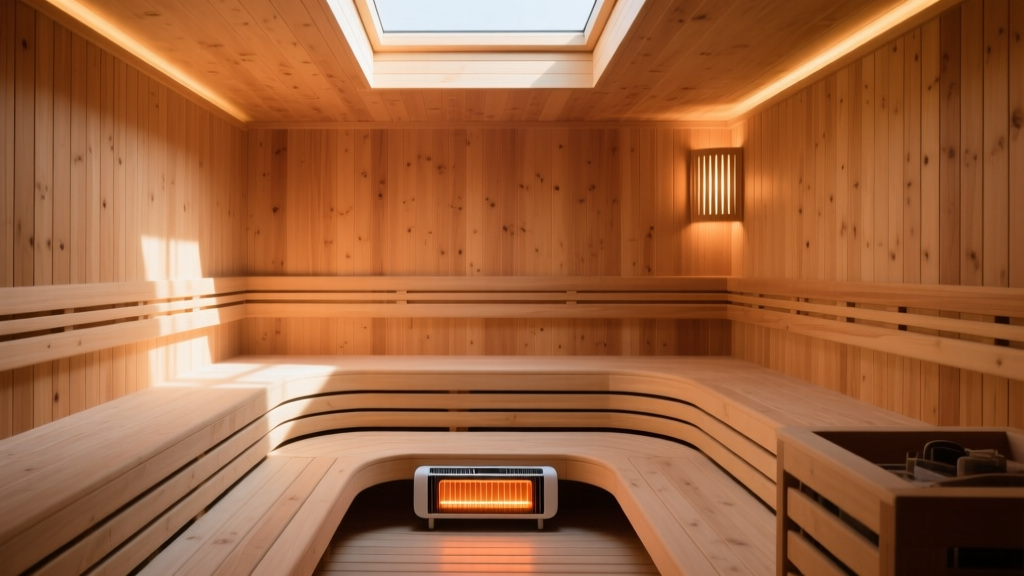
Deep Dive: Evaluating the Top Contenders
Western Red Cedar (Thuja plicata): The Premium Standard
Western Red Cedar remains the most specified material in North American sauna builds. According to the Western Red Cedar Lumber Association, its cellular structure contains a high volume of microscopic air pockets, granting it exceptional thermal insulation properties. This means the wood stays relatively cool to the touch even when the ambient room temperature exceeds 180°F.
The Extractive Advantage: Cedar contains plicatic acid, a natural water-soluble extractive that provides high resistance to fungal decay and moisture rot. This is critical for the lower wall sections and bench supports where moisture accumulates.
Failure Mode to Watch: While cedar is low in pitch, it is not entirely devoid of extractives. In poorly ventilated saunas, cedar can 'weep' dark tannin stains when exposed to repeated condensation cycles. Furthermore, a small percentage of users experience contact dermatitis from plicatic acid, making it unsuitable for commercial facilities with high user turnover without prior allergy warnings.
Canadian Hemlock (Tsuga canadensis): The Hypoallergenic Alternative
For builders seeking a uniform, light-colored aesthetic without the aromatic oils of cedar, Canadian Hemlock is the optimal choice. Hemlock lacks resin canals entirely, completely eliminating the risk of hot pitch bleeding onto bathers. Its grain is straight, uniform, and machines to an exceptionally smooth finish, minimizing splinter risks.
Moisture Management: Hemlock's primary vulnerability is its lack of natural decay resistance. It must be sourced strictly as kiln-dried (KD) lumber with a moisture content below 10%. If installed at higher moisture levels, hemlock is prone to severe warping and cupping when subjected to the rapid drying cycles of a sauna heater. Always specify 'Sauna Grade' or 'KD-HT' (Kiln-Dried Heat Treated) hemlock from your supplier.
Nordic Spruce (Picea abies): The Traditionalist's Choice
Authentic Finnish saunas predominantly utilize Nordic Spruce. It offers a bright, clean appearance with tight, small knots that are visually appealing. However, sourcing true Nordic Spruce in North America can be challenging and often requires specialized importers.
The Heat-Treatment Requirement: Spruce contains small resin pockets. To be viable for sauna use, it must undergo Thermally Modified Timber (TMT) processing, where the wood is heated to over 400°F in an oxygen-deprived environment. This crystallizes the resins and alters the cellular structure, permanently locking in dimensional stability and preventing future weeping. Never install untreated, standard construction-grade spruce in a sauna.
Never use standard Pine (Pinus species) for sauna paneling or benches. Pine contains large, highly concentrated resin canals. When exposed to 180°F heat, these canals will liquefy and drip boiling pitch. Additionally, pine's density variations lead to uneven thermal conductivity, creating localized hot spots that can blister skin.
Dimensional Requirements and Milling Profiles
Selecting the species is only half the battle; the milling profile dictates the structural integrity and visual continuity of the sauna interior.
- Wall Paneling (1x6 T&G): Tongue and Groove (T&G) is mandatory. A 1x6 nominal profile (actual 3/4" x 5 1/2") provides the best balance of coverage and expansion tolerance. The T&G joint allows the wood to expand and contract laterally without exposing the backing membrane or insulation.
- Bench Material (2x4 or 1x4): Benches require structural rigidity. Use 2x4 lumber laid flat, or 1x4 lumber with robust underlying joist spacing (maximum 16 inches on center). Bench wood must be surfaced on four sides (S4S) with eased edges (a slight rounding of the corners) to prevent uncomfortable pressure points on the skin.
- Grades (STK vs. Clear): Select Tight Knot (STK) cedar offers a rustic look and costs roughly 30% less than Clear grade. However, ensure all knots are 'tight' (solidly integrated). Loose or 'black' knots will eventually fall out, creating holes that trap moisture and compromise the vapor barrier behind the paneling.
Acclimatization and Fastening Protocols
Even perfectly kiln-dried wood will react to the micro-climate of the build site. Before installation, stack the sauna lumber in the room where it will be installed with spacers (stickers) between each layer. Allow it to acclimatize for a minimum of 72 hours while the home's HVAC system is running at normal living temperatures.
Fastening Specifications: Use only 304 or 316 stainless steel finishing nails or screws. Galvanized or coated fasteners will corrode rapidly in the high-humidity, high-heat environment, leaving unsightly black streaks down the cedar or hemlock walls. Utilize a blind-nailing technique, driving the nail at a 45-degree angle through the tongue of the T&G profile. This hides the fastener head and allows the groove of the next board to slide seamlessly into place.
Frequently Asked Questions
Can I use hardwoods like oak or maple for sauna benches?
No. Hardwoods have a high specific gravity and density, meaning they absorb and retain heat aggressively. An oak bench at 170°F will cause immediate contact burns to bare skin. Softwoods act as thermal insulators, remaining safe to touch.
Should I seal or stain the interior sauna wood?
Never apply polyurethane, varnish, or synthetic sealants to the interior of a sauna. High heat will cause these finishes to off-gas toxic fumes and peel. If you wish to protect the wood from sweat and body oils, apply a single coat of pure, food-grade mineral oil or a specialized paraffin-based sauna wood wax to the benches and backrests.
What is the best wood for the sauna floor?
Wood is generally not recommended for sauna floors due to standing water and drainage requirements. The industry standard is a sloped concrete subfloor finished with non-slip ceramic or porcelain tile. If a wooden duckboard (removable floor grate) is desired for underfoot comfort, build it using thick, untreated Western Red Cedar or teak, allowing for easy removal and cleaning.
Written by
Sarah WhitfieldSarah Whitfield is a chartered quantity surveyor (MRICS) and construction cost analyst with 15 years of experience in material pricing, procurement strategy, and project budgeting. She earned her degree in Construction Management from the University of Reading (UK) and has worked on projects ranging from $2M custom homes to $180M mixed-use developments across North America and Europe. Sarah currently leads cost estimating for BuildMat Insight, maintaining a proprietary database of 4,000+ material price points updated quarterly. She is a frequent contributor to RSMeans cost data panels and has presented at the International Cost Engineering Council (ICEC) congress. Based in Denver, CO, Sarah is an avid trail runner and volunteer mentor for Women in Construction.
More from Sarah Whitfield
View all
Wood & Lumber
What Are the Different Types of Wood? A Builder's Guide
Compare structural softwoods, finish hardwoods, and engineered lumber. Analyze Janka ratings, MOE values, and 2026 pricing for construction.
Aug 4, 2026

Walls & Panels
Steel Framing vs Wood Framing: Corrosion and Moisture Defense
Compare steel framing vs wood framing for moisture resistance. Learn about galvanized coatings, condensation risks, and corrosion protection strategies.
Jul 21, 2026

Stone & Masonry
How to Cut Stone Veneer: Wet Saw vs Grinder Comparison
Compare the best tools for cutting stone veneer. We review wet saws, angle grinders, and chop saws to help you achieve clean, chip-free cuts.
Jul 21, 2026