Types of Wood With Pictures: Visual Guide & Cost Analysis
Identify construction lumber visually and analyze costs. This guide pairs wood identification traits with 2026 pricing and ROI value for builders.

Visual Identification: The First Step in Lumber Procurement
Procuring the correct lumber species is a critical juncture in construction budgeting. Relying solely on supplier invoices without visual verification frequently leads to material substitution errors, resulting in premature structural degradation or finish failures. Understanding the visual markers of different wood species—grain orientation, pore structure, and heartwood-to-sapwood contrast—allows project managers and builders to verify deliveries on-site and ensure the material aligns with the project's cost-to-value targets.
This analysis breaks down the primary wood species used in modern construction, pairing their distinct visual identifiers with current 2026 market pricing and long-term value metrics.
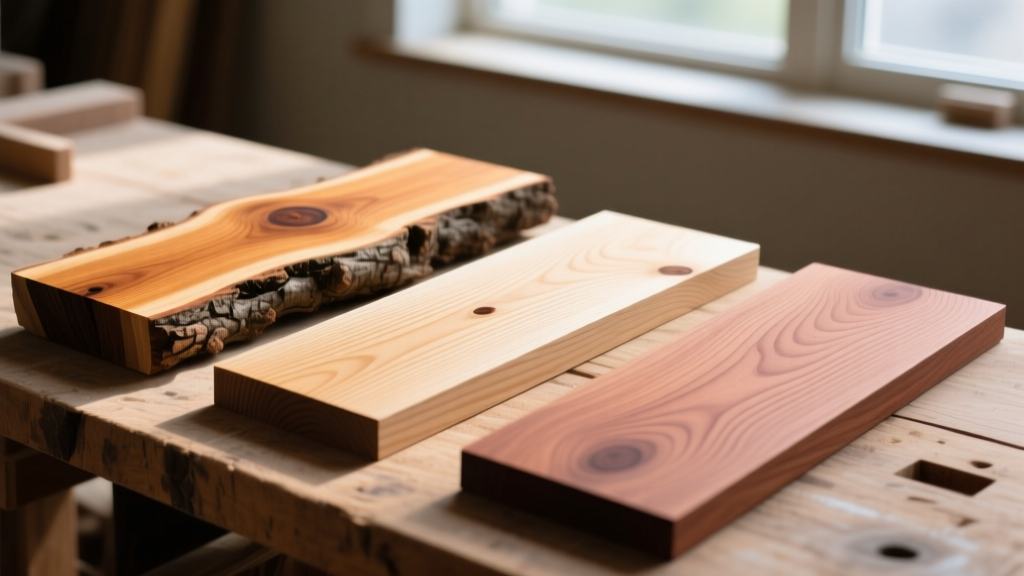
Hardwood Species: Visual Traits and Premium Value Analysis
Hardwoods are primarily deployed for finish carpentry, flooring, and high-wear architectural elements. The cost premium for these species is justified by their density (Janka hardness) and natural durability, provided the correct species is selected for the specific environmental exposure.
White Oak (Quercus alba)
Cost & Value Metrics: FAS (First and Seconds) grade White Oak currently trades between $9.50 and $14.00 per board foot. While this represents a 40% to 60% premium over Red Oak ($5.50–$8.00/bdft), the value proposition for exterior trim, stair treads, and wet-area flooring is unmatched. The tyloses prevent water wicking, eliminating the need for expensive chemical sealants and reducing lifecycle maintenance costs by an estimated 35% over a 20-year period.
Black Walnut (Juglans nigra)
Visual Identifiers: Deep, rich chocolate brown heartwood, often with darker streaks, contrasting sharply with pale yellow sapwood. The grain is generally straight but can exhibit highly figured, curly, or crotch patterns near the base of the tree. The wood has a moderate natural luster and medium texture with open, semi-ring-porous end-grain.
Cost & Value Metrics: Black Walnut is a luxury-tier material, pricing between $13.00 and $19.50 per board foot for standard grades, with figured slabs exceeding $35.00/bdft. From a value perspective, Walnut is deployed as a high-ROI focal point in custom residential builds (e.g., feature walls, custom cabinetry, library millwork). Appraisals consistently show that premium Walnut millwork yields a higher return on investment in luxury real estate markets compared to painted MDF alternatives.
Softwood Species: Structural Workhorses and Budget Metrics
Softwoods dominate the structural framing and exterior cladding markets. Visual identification here is less about aesthetic beauty and more about verifying structural grading and natural decay resistance.
| Species | Primary Visual Marker | 2026 Avg. Cost (Framing) | Structural Bending (Fb) |
|---|---|---|---|
| Douglas Fir | Pronounced early/latewood contrast; reddish-brown | $4.85 / 2x4x8 (Stud) | 1,500 psi (No. 2) |
| SPF (Spruce-Pine-Fir) | White to pale yellow; minimal grain contrast; small tight knots | $3.95 / 2x4x8 (Stud) | 1,100 psi (No. 2) |
| Southern Yellow Pine | Dense, heavy; abrupt transition between light/dark bands | $4.25 / 2x4x8 (Stud) | 1,600 psi (No. 2) |
| Western Red Cedar | Uniform reddish-brown; straight grain; distinct sweet/aromatic scent | $7.50+ / bdft (Clear) | 750 psi (No. 2) |
Douglas Fir (Pseudotsuga menziesii)
Visual Identifiers: The heartwood ranges from orange to reddish-brown, while the sapwood is yellowish-white. The most reliable visual cue is the extreme contrast between the light, porous earlywood and the dense, dark latewood within each growth ring. This creates a highly pronounced, striped grain pattern on flat-sawn surfaces.
Cost & Value Metrics: Douglas Fir commands a slight premium over generic SPF framing lumber but offers superior structural value. According to the USDA Forest Products Laboratory, Douglas Fir possesses one of the highest modulus of elasticity (MOE) ratings among North American softwoods. For long-span floor joists or roof rafters where deflection limits govern the design, utilizing Douglas Fir can allow for wider joist spacing (e.g., 24" on-center instead of 16"), ultimately reducing the total linear footage of lumber required and offsetting the higher per-stick cost.
Western Red Cedar (Thuja plicata)
Visual Identifiers: Cedar exhibits a remarkably uniform texture with very little contrast between earlywood and latewood. The color ranges from pale pinkish-brown to deep reddish-brown. It lacks the resin canals found in pines, giving it a duller, more matte appearance when unfinished.
Cost & Value Metrics: At $7.50 to $11.00 per board foot for clear grades, Cedar is an expensive cladding option. However, its value lies in its natural chemistry. The wood contains thujaplicins, water-soluble fungicides that provide Class 1 decay resistance without pressure treatment. For exterior siding and decking in high-moisture climates, Cedar eliminates the need for chemical preservatives and reduces the frequency of re-sealing, offering a lower total cost of ownership over a 30-year lifecycle compared to cheaper, treated pine alternatives.
Engineered Wood: When Visual Grain is a Veneer
Modern construction relies heavily on engineered lumber to solve the structural limitations and dimensional instability of solid sawn timber. Visual identification of these products is straightforward but vital for verifying load-bearing specifications.
- Laminated Veneer Lumber (LVL): Visually appears as tightly compressed, parallel layers of thin wood veneers (usually 1/8" thick) with no continuous, natural grain lines running the length of the beam. Used for headers and rim boards. Cost: $2.80 to $4.50 per linear foot for standard 1.75" x 11.875" profiles.
- Glued Laminated Timber (Glulam): Composed of thicker dimensional lumber laminations (typically 1.5" thick) stacked and glued together. Visually, you can see the distinct glue lines and the individual end-grains of the constituent boards on the beam ends. Cost: $3.50 to $6.00 per linear foot.
- Oriented Strand Board (OSB): A panel product visually characterized by large, distinct rectangular wood flakes compressed in cross-directional layers. Used for shear walls and roof decking. Cost: $35 to $55 per 4x8 sheet (7/16" thickness).
As detailed by APA - The Engineered Wood Association, these products offer predictable engineering values and eliminate the visual defects (knots, splits, wane) that downgrade solid lumber. The visual uniformity of LVL and Glulam is a direct indicator of their consistent load-bearing reliability.
The Procurement Decision Framework
To optimize budget allocation without compromising structural integrity or aesthetic longevity, procurement teams should apply the following decision matrix when evaluating wood species:
- Define the Exposure Class: Is the material exposed to ground contact, weather, or interior climate control? (e.g., Do not substitute Red Oak for White Oak in exterior applications, regardless of cost savings, as Red Oak will wick moisture and rot).
- Calculate the Yield Factor: Lower-grade lumber (e.g., #2 Common) may be 30% cheaper per board foot than FAS, but the waste factor from cutting around defects often pushes the net cost higher. Always calculate the usable yield cost.
- Assess Structural Span Requirements: For framing, cross-reference the visual species identification with the span tables. Paying a 15% premium for Douglas Fir over SPF may allow you to drop a joist size (e.g., from 2x10 to 2x8), saving money on the total material volume.
Common Procurement Pitfalls and Misidentifications
Warning: The "White Wood" Trap
In many regional markets, framing lumber is sold generically as "White Wood" or SPF. If your structural engineer specified Southern Yellow Pine (SYP) for its superior withdrawal resistance (holding power for nails and screws in high-wind shear walls), accepting a delivery of generic SPF will result in a failed structural inspection. SYP is visually distinct: it is significantly heavier, highly resinous, and features abrupt color transitions between growth rings. Always verify the grade stamp and visual traits upon delivery.
Another frequent error occurs in finish carpentry when suppliers substitute Ash for White Oak. While Ash shares a similar prominent grain pattern, it lacks the tyloses of White Oak and will react poorly to water-based stains, often raising the grain and requiring extensive secondary sanding. Ash also lacks the rot resistance required for exterior thresholds or window sills. Always inspect the end-grain with a 10x loupe; if the pores are open and hollow, it is Ash or Red Oak, not White Oak.
Accurate visual identification of lumber, combined with a rigorous understanding of current market pricing and lifecycle value, is the most effective method for controlling material costs in both structural and finish carpentry. For comprehensive anatomical data and macro-photography of end-grain structures, builders should consult The Wood Database prior to finalizing material schedules.
Written by
Marcus ChenMarcus Chen is a licensed structural engineer (PE) and building materials analyst with over 12 years of experience across residential, commercial, and industrial construction. He holds a Master of Science in Civil Engineering from UC Berkeley and spent six years at Thornton Tomasetti before transitioning to independent consulting and technical writing. Marcus specializes in material selection for seismic-prone regions, concrete reinforcement strategies, and lifecycle cost analysis. His work has been cited by the American Concrete Institute (ACI) and the Structural Engineers Association of California (SEAOC). When he is not on a job site or at his desk, you will find him hiking the Sierra Nevada or restoring a 1920s craftsman bungalow in Oakland, CA.
More from Marcus Chen
View all
Construction Cost
How Much Did the Eiffel Tower Cost to Build?
How much did the Eiffel Tower cost to build in 1889? We adjust for inflation and compare its budget to modern skyscraper construction.
Aug 4, 2026

Fire Resistance
What Is a Fire Resistant Material? Testing & Certification Guide
Discover what is a fire resistant material through ASTM and UL testing. Learn how fire ratings, certifications, and assemblies work in construction.
Aug 4, 2026

Construction Cost
How Much Did the Burj Khalifa Cost to Build?
How much did the Burj Khalifa cost to build? We break down the $1.5B project and extract 5 money-saving strategies for your next build.
Jul 30, 2026